
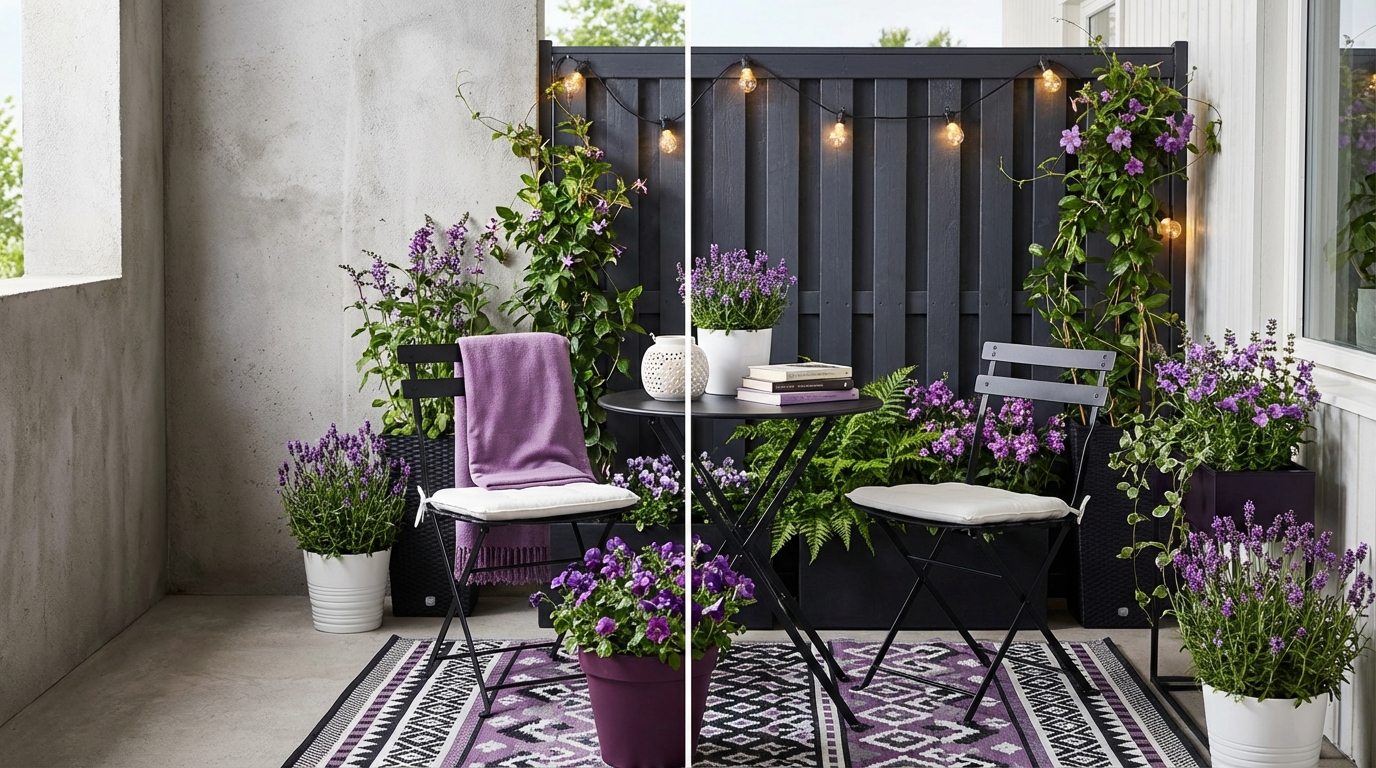

“Small balconies are useless. There is no way to turn that cramped little ledge into something relaxing or beautiful.”
That line is wrong. Completely. A small balcony will limit how much you can put on it, but it does not limit how much you can enjoy it. The real problem is not the size. The real problem is random choices, bulky furniture, and no clear plan. Once you treat your balcony like a tiny room with a purpose, it turns from “useless” into a real oasis faster than most people expect.
I might be wrong, but most people start with furniture shopping. They see a pretty chair on Instagram, buy it, drag it home, and then discover it blocks the door or leaves no space to walk. That is the point where they blame the balcony. They say things like “There is just not enough space” when the real issue is that the chair is too big and the goal is not clear.
So I want to walk through balcony makeovers from a different angle. Not from “What is trendy right now?” but from “What do you want this space to do for you?” When you answer that clearly, the rest comes down to removing clutter, choosing the right scale, and layering comfort in smart ways. It sounds simple. It is simple. But people skip these steps all the time.
“I will fix the balcony when I move to a bigger place.”
That mindset keeps people stuck with a dead space for years. If your balcony is empty, it is still part of your home. You pay rent or a mortgage on it. Ignoring it wastes money and mental energy, because every time you see it you feel a small pinch of “I should do something there.” A basic makeover can clear that feeling in a weekend.
Let me break this down the same way I would plan a campaign or a content calendar: by choosing one core goal, then building everything around that goal.
Step 1: Decide the main purpose of your balcony
Before you buy anything, decide what this balcony is for. One main purpose. Not three. Not “a mini garden, plus a gym, plus a bar, plus a workspace.” A small space cannot handle that. When you try to make it do everything, it ends up doing nothing well.
Ask yourself blunt questions:
– Do you want a quiet reading spot?
– Do you want a place for morning coffee or tea?
– Do you want a plant-filled corner that feels like a mini garden?
– Do you want space to sit with one other person and chat?
– Do you want somewhere to stretch or do light yoga?
Pick one as the priority. Secondary uses can fit around it later, but only if they do not hurt the main purpose.
If you push back on this and think, “But I need it to do two or three things,” here is where you are taking a bad approach. Multitasking sounds smart, yet in small areas it usually leads to chaos. A tiny balcony is like a headline. If it tries to say everything, no message lands.
“A good balcony has to be ready for every situation: guests, work, meals, workouts, all of it.”
That sounds reasonable, but it sets you up for clutter and stress. Focus makes design easier. For many people, “quiet retreat for one or two people” is the most realistic purpose. Start there. Once that is working, you can layer in a folding table or a storage box without ruining the space.
Common balcony purpose ideas
Here is a simple view of common purposes and what they often require at minimum:
| Main purpose | Key needs | What to avoid |
|---|---|---|
| Reading nook | Comfortable chair, good back support, soft light, small side table | Huge dining sets, loud colors that distract, strong direct light without shade |
| Morning coffee spot | Two compact seats, small table, weather-safe cushions | Oversized loungers, heavy furniture that is hard to move |
| Mini garden | Vertical planters, railing planters, drip trays, easy hose or watering can access | Too many floor pots that block walking space |
| Yoga / stretching | Open floor area, storage for mat, soft outdoor rug or deck tiles | Fixed tables in the middle of the floor |
| Work-from-home corner | Stable surface for laptop, shade, power access or long cable, comfortable chair | Low, soft chairs only, no shade during bright hours |
Once you have a clear purpose, it becomes much easier to say no to things that do not fit.
Step 2: Measure and audit your balcony
This is the boring step people skip. Then they wonder why nothing fits. Before you order anything, measure:
– Width (side to side)
– Depth (from door to railing)
– Height of railing
– Space taken by any built-in units or AC compressors
Write those numbers down. Take a photo of the balcony from the doorway and from one corner. That gives you context when you shop.
Then do a quick audit:
– Is the floor level or sloped?
– Where does rainwater collect?
– Is there direct sun? At what time of day?
– Is it windy?
– Is there privacy from neighbors, or do you feel watched?
This audit sounds minor, yet it shapes every choice. For example:
– Strong afternoon sun means you will need shade or heat-friendly plants.
– Windy balconies need heavier pots and clipped fabrics.
– Low privacy calls for screens, tall plants, or outdoor curtains.
If you ignore these factors, you end up with drooping plants, cushions that keep flying away, or a balcony that looks nice in photos but feels harsh and exposed in real life.
“I will fix problems like sun and wind later. First I need to buy furniture and plants.”
That sequence is backwards. Solve for climate and privacy first. Then pick furniture and decor that works with those limits.
Step 3: Clear, clean, and set basic rules
Before any makeover, the balcony usually holds random items: old boxes, broken chairs, cleaning supplies, shoes, things you do not know where to put. Many people treat the balcony like a storage unit. That kills any chance of an oasis.
Take everything off the balcony. Everything. Put it in one place inside your home and ask questions you probably do not want to ask:
– Do I use this at least once per month?
– Could it live somewhere else without pain?
– Am I keeping it “just in case” when I know that “case” never comes?
Be honest. Throw away broken things. Donate items in usable shape. Try not to let the balcony become the “maybe” zone. If you absolutely must store something outdoors, use a storage bench or a closed storage box that also serves as seating.
Then clean the balcony:
– Sweep and scrub the floor.
– Wipe railings and walls.
– Clean the glass if there is a barrier.
This sounds like basic housework, yet it changes how you feel instantly. A clean, empty balcony gives you a blank page.
Now set a few rules for the future. For example:
– Rule 1: No random storage here. If it sits in this space, it must support the balcony’s main purpose.
– Rule 2: If a new item comes in, one old item leaves.
– Rule 3: The floor stays at least one-third open for walking and stretching.
These rules protect your balcony long term. Without them, it slowly slides back into storage mode.
Step 4: Plan the layout on paper first
Before you buy furniture, sketch the balcony on paper. It does not need to be perfect. Mark:
– Door swing
– Railing line
– Any fixed units (AC, drain pipes, etc.)
– The path you need to walk
Then add the core element for your chosen purpose:
– A chair for reading
– A yoga mat
– A small table and two chairs
– A vertical plant wall
Draw the biggest piece first, not the decor. Ask:
– Can I open the door fully?
– Can I stand comfortably and move around the chair or table?
– Is there at least one clear path from door to railing?
If your drawing feels cramped, scale down the furniture. This is where many people push for that extra large chair or that full bistro set because “it looks nice in the catalog.” But catalogs do not know your measurements.
When in doubt, go smaller and lighter. You can add later. Removing bulky items costs time and money.
Good vs weak balcony layouts
| Layout type | Characteristics | Result |
|---|---|---|
| Good layout | One main seating zone, clear walking path, furniture pushed to sides, vertical storage for plants | Feels open, easy to move, easy to clean |
| Weak layout | Furniture in the center, many small decor items, no clear path | Feels busy, hard to use, cleaning becomes a chore |
| Good layout for very small balcony | Foldable rail table, one chair or floor cushions, no floor pots | Flexible use, fast to set up and pack away |
| Weak layout for very small balcony | Two bulky chairs, fixed table, many pots along the floor edge | Door access blocked, no space for legs or movement |
If you notice a mismatch between what you want and what your sketch allows, adjust expectations now, not after shopping.
Step 5: Choose flooring that feels good underfoot
Most balconies have basic concrete or tile floors. They are hard, often cold, and look plain. You do not have to accept that. The ground is one of the easiest parts to improve.
There are three common options that work for many spaces:
1. Outdoor rugs
2. Interlocking deck tiles
3. Bare floor with a small mat or runner
Let us look at them closely.
Outdoor rugs
Outdoor rugs soften the floor, add color or texture, and feel better for bare feet. They work well for rented apartments because you can roll them up when you move.
Tips:
– Pick a rug that fits most of the floor, not a tiny one that floats in the middle.
– Check it is rated for outdoor use so it handles moisture.
– If your balcony gets strong wind, use rug grippers or place furniture partly on the rug so it stays in place.
Rugs suit people who want comfort and do not receive heavy rain all year.
Interlocking deck tiles
Deck tiles click together over the existing floor. Many brands do not require tools. They can be wood, composite, or plastic look.
Advantages:
– Fast visual upgrade.
– Water flows under them if the balcony already drains well.
– Easy to remove if you move.
Risks:
– If your balcony has poor drainage, water can collect under tiles and cause mold.
– You need to cut tiles to fit corners sometimes, which may require tools.
If you choose tiles, test drainage first by pouring water and watching where it goes. If it pools in one spot for a long time, fix that before adding tiles.
Bare floor with a focused mat
For micro-balconies, a full rug or tiles may feel heavy. A small mat under a chair or at the door can be enough. This keeps cleaning easy and avoids trapping water.
There is no single right choice here. It comes back to your audit: climate, rain, and how often you want to clean.
Step 6: Pick furniture that fits both space and habits
Furniture is where makeovers go wrong most often. People fall in love with a look and forget about daily behavior. I have done this too. It seems to me that our brains love what we see over what we actually do.
To avoid that trap, ask three questions before you buy any piece:
1. Will I use this at least once a week?
2. Does it fit my measurements with space to walk?
3. Can I move it alone if I need to clean or rearrange?
If the answer to any of these is no, do not buy it.
Smart seating for small balconies
Some flexible options:
| Seating type | Best for | Benefits | Watch out for |
|---|---|---|---|
| Foldable chairs | Very small balconies, renters | Compact, easy to store inside when not in use | Check weight capacity and comfort; many are too stiff |
| Stackable chairs | People who host sometimes | Stack in a corner; simple to bring out more seats | Height and width can still be bulky if you pick large designs |
| Bench with storage | Balconies used for both relaxing and light storage | Extra space inside for cushions, tools, small items | Must be water-resistant; can feel heavy visually |
| Floor cushions / poufs | Very tight floors, casual sitting | Easy to move, soft, creates lounge feel | Need storage indoors when it rains; not ideal for people who need back support |
Pick one main seating type. If you start adding multiple types, the balcony will look crowded and messy.
Tables and surfaces
For a small balcony oasis, you rarely need a big table. You need something to hold a cup, a book, maybe a plate. That is it.
Consider:
– A small side table between two chairs
– A folding table that hooks over the railing
– A narrow console-style shelf against the wall
Avoid heavy square dining tables unless your balcony is wide. They eat space and often block movement.
“A proper balcony must have a full dining table so guests can eat outside.”
That belief comes from large terrace photos, not from real-life small balconies. If your primary goal is a calm place for yourself, committing to a full dining setup is a misstep. You will use it less than you imagine, and you will feel cramped every time you step outside.
Step 7: Bring in plants the right way
Plants turn a balcony into an oasis faster than any other decor. Yet people overload them, then struggle with care. The trick is to start small and think vertical.
Choosing the right plants
Your earlier audit helps here:
– Strong sun: Pick sun-loving plants like herbs (rosemary, thyme, basil), succulents, geraniums.
– Part shade: Many ferns, snake plants, pothos, and some flowers can thrive.
– Windy: Plants with sturdy stems and thicker leaves, in heavier pots.
If you are not confident with plants, pick a few hardy species first rather than ten different delicate ones. It is better to have three thriving plants than ten struggling ones.
Using vertical space
In small balconies, floor space is precious. Use:
– Railing planters on the outside of the rail (if safe) or inside.
– Wall-mounted shelves or brackets to hold small pots.
– A vertical plant stand with multiple steps.
This keeps the ground clear and draws the eye upward, which makes the area feel taller.
Water and maintenance
Bad approach: filling the balcony with pots and then realizing watering them is a hassle, so you rush or forget.
Better approach:
– Group plants with similar water needs together.
– Use pots with trays or self-watering systems if possible.
– Keep a small watering can or spray bottle nearby.
Create a simple rhythm: water deeply on one or two set days each week, rather than tiny sips every day. That supports healthier roots for many common plants.
Step 8: Layer lighting for evening calm
Lighting can turn an average balcony into a place you actually want to use at night. It shapes mood more than people expect.
Think in layers:
1. Ambient light: general soft light for overall visibility.
2. Task light: focused light if you want to read or work.
3. Accent light: small touches that give character.
“I do not need balcony lighting. Indoor light spilling through the window is enough.”
That might work on paper, but in practice it often makes the balcony feel like a dark edge of the room. One or two dedicated outdoor lights change that feeling and invite you out.
Common balcony lighting options
| Lighting type | Use | Pros | Cons |
|---|---|---|---|
| String lights | Ambient | Soft glow, easy to hang, popular look | Need safe mounting points; check outdoor rating |
| Solar lanterns | Accent | No wiring, charge in sunlight, portable | Dim on very cloudy days, quality varies |
| Plug-in floor or table lamp (outdoor-rated) | Task / ambient | Better for reading or working, focused light | Needs nearby outlet or extension, must be weather-safe |
| LED candles | Accent | Safe, soft light, no fire risk | Need batteries or charging |
Aim for warm white light, not cool blue. Warm tones feel calmer and more inviting.
Step 9: Add privacy without closing everything off
Many people say they cannot enjoy their balcony because they feel watched. Or because they see a busy street or the wall of another building. You cannot control the whole view, but you can frame and filter it.
Options include:
– Tall planters with bamboo or other slim plants.
– Outdoor curtains attached to a rod or wire.
– Reed or bamboo screens attached to the railing.
– Lattice panels with climbing plants.
The key is balance. You want enough coverage to feel comfortable, but not so much that all light and air vanish. Test this: sit in your planned seating position and look around. Where do you feel exposed? Focus your privacy solutions there first.
If you rent, check rules about attaching anything to the exterior. In many places you can use tension rods or free-standing screens to avoid drilling.
Step 10: Use textiles and decor carefully
Once structure, seating, plants, and lighting are set, it is easy to go overboard with decor. Pillows, throws, candles, statues, more pots. Each item can be nice, but they add up.
Textiles are powerful:
– Outdoor cushions make chairs comfortable and add color.
– A throw or light blanket makes evening use more pleasant.
– Seat pads protect from hot or cold surfaces.
Aim for a limited color palette, maybe two main colors and a neutral. That helps the balcony feel calm instead of visually busy.
Decor should support use, not just fill space. A few ideas:
– Tray for carrying drinks in and out.
– Small box or basket for holding matches, lighter, or LED remote.
– Hooks on the wall for hanging lanterns or a watering can.
If a decor piece does not serve comfort or function, you do not need it. This may sound strict, yet small spaces benefit a lot from restraint.
Balcony makeover examples by size
It can help to see specific scenarios. These are simple patterns, not fixed rules.
Very small balcony (depth 60-90 cm)
Purpose: Morning coffee and fresh air for one person.
Plan:
– Floor: One narrow outdoor runner from door to railing.
– Seating: One foldable chair, kept inside when not in use if needed.
– Table: Rail-mounted folding table, just wide enough for a cup and plate.
– Plants: Two railing planters with herbs or flowers.
– Lighting: Short string lights along the railing or one small lantern on the table.
Behavior fit: Fast to set up and tidy. You step out in the morning, unfold the chair, enjoy your drink, then fold and lean it inside.
If you tried to fit two fixed chairs and a big table here, you would bump into them every time you opened the door. That is how many people block themselves from using the balcony at all.
Small balcony (depth 1-1.5 m)
Purpose: Reading nook and conversation spot for one or two people.
Plan:
– Floor: Interlocking tiles or a mid-size outdoor rug covering most of the area.
– Seating: One small lounge chair with good back support plus one stackable chair for a guest.
– Table: Compact side table between chairs.
– Plants: One vertical stand with 4-5 pots in the back corner, one railing planter.
– Lighting: String lights overhead, one small plug-in or battery lamp near the chair.
Privacy: One side curtain or tall plant screen on the most exposed side.
Daily use: You sit alone most days, but you can bring out the second chair when someone visits. Most of the time, the space is calm, clear, and easy to maintain.
Long, narrow balcony
Purpose: Mix of mini garden and stretching space.
Plan:
– Floor: Bare tile with a yoga mat stored on hooks, or an outdoor rug at one end.
– Seating: One bench against the wall at one end.
– Plants: Railing planters along the length, plus a narrow vertical stand.
– Lighting: Lanterns placed down the length for soft glow.
– Storage: Storage bench or a slim box under the bench for mat, tools.
You keep one zone open for movement and one zone for sitting. You do not put sofas or heavy tables in the center, so the path remains clear.
Balcony safety and practical limits
There are some non-negotiable points you cannot ignore, even if they clash with your creative ideas.
– Weight limits: Balconies have load limits. Heavy soil, tiles, furniture, and multiple people can add up. If you plan large planters or heavy items, check building rules or consult an expert. Overloading is a real risk.
– Fire rules: Many buildings restrict grills, open flames, or certain heaters. Before you dream of an outdoor kitchen or fire pit, read your contracts and local rules.
– Drain access: Do not block drains with tiles, pots, or rugs. Water needs a path. Blocked drains lead to flooding, mold, and damage.
– Neighbor impact: Smoke, strong smells, or loud noise can spread quickly. Be mindful of shared air and walls.
Ignoring these can turn a pleasant space into a source of conflict or damage. That is not worth any design trend.
Keeping your balcony oasis alive over time
The makeover is not a one-time event. Just like content needs updates and tracking, your balcony needs small recurring checks.
You can build a simple weekly and monthly rhythm.
Weekly tasks
– Water plants based on their needs.
– Shake out or lightly clean the rug or tiles.
– Wipe the table and seating surfaces.
– Put away items that have wandered onto the balcony.
This can take 10-15 minutes once you have a clear layout.
Monthly tasks
– Trim plants and remove dead leaves.
– Check for any water pooling or mold.
– Tighten screws on chairs or rail tables.
– Review once: is anything not used anymore?
If you notice a chair or decorative item has not been used for a month or more, question it. Maybe it belongs elsewhere, or maybe it should be sold or donated. That keeps the oasis from slowly turning into storage again.
Common mistakes to avoid
People often repeat the same problems with balcony makeovers. Recognizing them early saves time and money.
| Mistake | Why it hurts the space | Better move |
|---|---|---|
| Buying furniture before measuring | Leads to blocked doors, cramped walking space, returns | Measure and draw a simple plan first |
| Using the balcony for random storage | Kills the relaxing feel, makes the area visually heavy | Limit storage to a closed bench or box that doubles as seating |
| Too many plants at once | Hard to water and care, many plants die and create mess | Start with a few hardy plants and add more slowly |
| Ignoring climate and wind | Plants fail, fabrics fade or fly away, people avoid using the space | Select plants and textiles matched to sun, rain, and wind levels |
| No clear purpose | Results in random items and low actual use | Pick one main goal and judge choices against it |
If you catch yourself thinking, “I will buy this first and figure out the rest later,” pause. That pattern often leads to these mistakes.
A practical mini-checklist to start today
I want to keep this grounded. Here is a short sequence you can follow this week without treating it like a huge project.
1. Stand on your balcony and say out loud one main purpose you want for it.
2. Measure width, depth, and rail height; take two photos.
3. Clear everything off and clean the surfaces.
4. Remove or relocate anything that does not serve your chosen purpose.
5. Spend one day just using the empty, clean balcony, even if you just stand there. Notice light, wind, noise, and privacy.
6. Based on that, decide on flooring, one type of seating, and one lighting method.
7. Only then start shopping, with measurements and notes in your phone.
This sequence might feel slow if you want instant results. Still, it saves you from buying twice and living with regret.
“My balcony is too small to matter. I will just wait until I move to a bigger place and then I will build my oasis.”
You can hold that view, but it limits you. A well-planned small balcony teaches you skills you will use in any larger outdoor area later: clear purpose, smart layout, restraint in buying, and respect for climate and maintenance. Those skills do not depend on square meters.
Even a narrow strip of outdoor space can become a place where you read, breathe, and reset. Not perfect. Not photo-ready every day. Just real, calm, and used often. That is what an oasis looks like in everyday life.
