
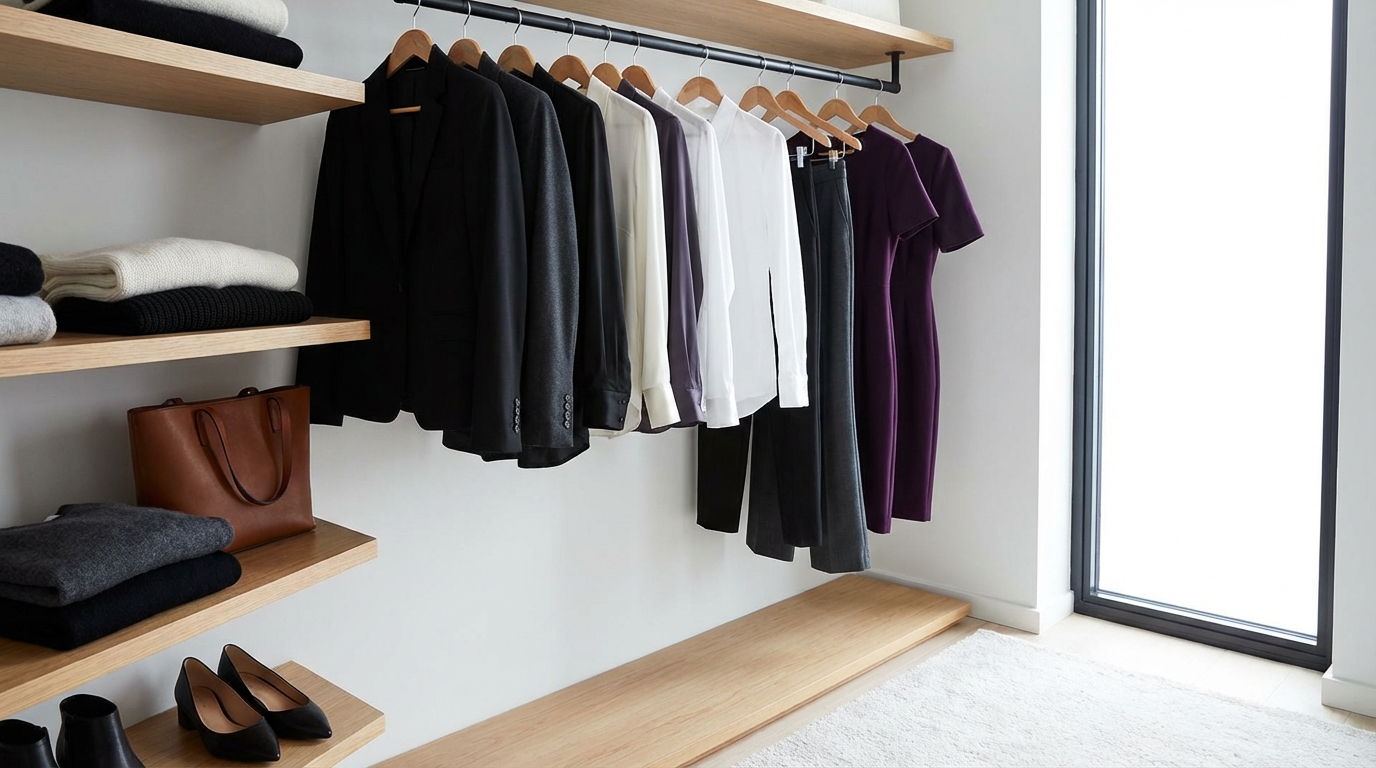

“A capsule wardrobe for work only works if you love neutral colors, own almost nothing, and dress like everyone else.”
That sounds neat and simple. It is also wrong. A good capsule wardrobe is not about owning the fewest items or killing your style. It is about removing daily stress, limiting choice fatigue, and still looking put together on workdays. You can have color. You can have personality. You just need a clear structure and some rules you actually follow.
For most people, the real struggle is not a lack of clothes. It is too many clothes that do not work together. You buy a great shirt, but it only matches one pair of pants. You pick up a bold blazer that needs dry cleaning every time you wear it. Over time, your closet fills with one-off pieces that looked good in the store but never became part of a useful system.
What you need is a small group of reliable items that can mix together without effort. If you plan this group around your job, your body, and your actual habits, you end up freeing mental space every morning. No more standing in front of the closet thinking, “I have nothing to wear,” while staring at a full rail of clothes.
I might be wrong, but most capsule wardrobe advice online aims at minimalists. People who want to fit their life into a suitcase. That is not what most working people need. You probably need enough clothes to cover meetings, quiet desk days, work-from-home, and maybe events. That is not a 10-piece wardrobe. It is more structured, but it is not extreme.
So let me walk through how to build a capsule wardrobe for work that does three things: respects your dress code, fits your lifestyle, and still feels like you. No complicated fashion theory. Just clear decisions, some guardrails, and a bit of planning up front so you stop planning every single morning.
Start with your real work life, not your dream one
“Dress for the job you want, not the job you have.”
That line sounds inspiring, but it often leads people to buy clothes for a fantasy version of their life. Suits for a casual office. Blazers for someone who rarely leaves their desk. Heels for a commute that involves walking a mile.
Before you buy anything, map your real week. Not the aspirational one.
Ask yourself:
– How many days are in-person at the office?
– How formal is your workplace actually, not just on the website?
– How often do you meet clients or leadership in person or on video?
– How much do you move in your job? Walking, standing, lifting, commuting?
– How strict are temperature and comfort needs? Cold office, hot commute, long days?
Then check your calendar for the last month. Notice patterns. For example:
– 2 days at home, 3 in office.
– 1 or 2 client meetings per week.
– Once-a-month big presentation or important review.
Your capsule needs to fit those patterns first. Buying for the rare event and ignoring the daily rhythm is a bad approach. You can always have a very small “special event” mini-capsule on the side.
Define your work dress code properly
“Our office is business casual.”
That phrase means very different things from company to company. One office might treat “business casual” as jeans and hoodies. Another expects blazers and pressed shirts without ties. You cannot build a smart capsule if you misread the real norms.
The easiest way to decode it:
1. Look at what respected people in your department wear. Not just leadership, but the ones people trust.
2. Look at what new hires who are doing well wear after 3 to 6 months.
3. Compare how people dress on:
– normal days
– presentation days
– Fridays or remote days
From there, decide which of these buckets you occupy most:
– Formal: suits, tailored dresses, structured pieces most days.
– Smart: blazers, chinos, structured knitwear, simple dresses, clean footwear.
– Relaxed: neat jeans, polos, shirts, simple tees under layers, smart sneakers.
Your capsule will fail if you mix all three styles in equal parts. You need one main level, then a lighter and heavier version for the edges.
Think of it like this:
– One main level you live in 70 to 80 percent of the time.
– One step up for big meetings.
– One step down for casual days or work-from-home.
You do not need many items for the step up and step down. You just need them to work with your core pieces.
Pick a simple color system you can actually follow
“A real capsule wardrobe must be neutral: black, white, beige, gray.”
That is another half-true statement. Neutrals help. They mix well. They reduce clashes. But if you restrict yourself too hard, you risk a wardrobe that feels flat and boring. You will get tired of it and start breaking your own rules with impulse buys.
A better path is a simple color structure:
1. Choose 1 or 2 base neutrals
These are the colors of your main trousers, skirts, and some jackets. They should be easy to match.
Common options:
– Black
– Navy
– Charcoal
– Medium gray
– Camel or tan (works better in certain climates and with certain skin tones)
Pick one primary base neutral and one secondary. For example:
– Main: Navy
– Secondary: Gray
Or:
– Main: Black
– Secondary: Camel
Try not to pick three or four. That spreads your wardrobe too thin and makes matching harder.
2. Choose 1 light neutral and 1 dark neutral
Light neutral: for shirts, blouses, tees.
– White
– Off-white
– Light gray
– Pale beige
Dark neutral: often the same as the base neutral, or close to it.
– Black
– Navy
– Dark gray
Most of your daily outfits will be a mix of one light neutral plus one base neutral.
3. Choose 2 to 3 accent colors
This is where you keep your personality alive.
These are colors for:
– Knitwear
– Shirts or blouses
– Ties or scarves
– Some dresses
– Maybe one standout blazer
Examples:
– Soft blue
– Forest green
– Burgundy
– Mustard
– Rust
– Blush
– Deep purple
Try this test: Imagine wearing each color near your face, on a Zoom call, multiple times per month. If that feels fine, it is a good accent color. If it feels too loud or tiring, leave it out.
Simple color capsule example
| Role | Color choice | Used for |
|---|---|---|
| Main base neutral | Navy | Trousers, blazer, skirt |
| Secondary base neutral | Gray | Trousers, knitwear |
| Light neutral | White / off-white | Shirts, tees, blouses |
| Dark neutral | Black | Shoes, belt, bag |
| Accent 1 | Light blue | Shirts, knitwear |
| Accent 2 | Forest green | Sweater, scarf |
| Accent 3 | Burgundy | Dress, tie, small accessories |
This structure might feel strict at first, but it gives you clear guidance when you shop. If a new piece does not fit into one of these groups, think twice before buying.
Audit your current wardrobe before you buy anything
Skipping this step is a bad approach. You risk buying duplicates, repeating past mistakes, and keeping items that quietly annoy you.
Do a simple audit with three questions for each work item:
1. Does it fit me well right now?
2. Does it match my chosen color system?
3. Do I reach for it at least once a month in the relevant season?
If the answer is “no” for all three, that piece is not part of your future capsule.
Use four simple piles:
– Keep for capsule: fits, matches colors, matches dress code.
– Keep for non-work: good item, but more casual or more formal than your daily work needs.
– Repair or tailor: small fixes needed for a piece that you actually like wearing.
– Let go: does not fit, wrong style, wrong color, or just never used.
To keep this practical, focus first on:
– Trousers and skirts
– Blazers or jackets
– Dresses
– Shirts, blouses, and knits you actually wear to work
Put “occasion” items aside: event dresses, rare-use suits, seasonal party wear. They can live outside the capsule and do not need perfect integration.
Decide on your ideal work capsule size
There is no perfect number. Anyone telling you that you “must” have 33 items or 50 items is guessing. The right size depends on:
– How often you do laundry.
– How much you perspire or move.
– Your climate.
– How much you care about variety.
That said, a range helps. For a typical office schedule with 5 workdays, many people function well with a core capsule somewhere in this range for one season:
| Category | Typical range | Comment |
|---|---|---|
| Trousers / skirts | 4 – 7 | More if you commute a lot or have strict dress codes. |
| Dresses (work-appropriate) | 2 – 5 | Optional, but very useful for quick outfits. |
| Blazers / jackets / structured layers | 2 – 4 | More formal offices may need 4. |
| Shirts / blouses / main tops | 7 – 12 | Depends on laundry frequency. |
| Knitwear / cardigans | 3 – 6 | Crucial for cold offices. |
| Work shoes | 2 – 5 | Rotate to extend life and comfort. |
These ranges are not rules. They are guardrails. If you love dresses, shift more into that category and fewer trousers. If you hate layers, have one or two good jackets and rely on neat tops.
Build the foundation: bottoms and layers first
A common mistake is starting with tops, prints, and fun items. Then nothing works together because your base pieces do not support them. A more reliable order is:
1. Bottoms
2. Layers
3. Tops
4. Shoes and accessories
Step 1: Choose your core bottoms
Ask yourself:
– Do I feel better in trousers, skirts, or dresses most days?
– Do I sit a lot or move a lot?
– Are my main shoes flat, mid-heel, or something else?
Try to cover these pockets:
– 2 to 3 pairs in your main base neutral.
– 1 to 2 pairs in your secondary base neutral or subtle pattern (like a small check).
– 1 or 2 more casual bottoms for dress-down days, if your office allows it.
Examples:
– For formal or smart offices:
– 2 navy tailored trousers
– 1 gray tailored trousers
– 1 navy or black pencil skirt or A-line skirt
– 1 more relaxed pair in a soft fabric for long desk days
– For relaxed offices:
– 1 dark non-distressed jean
– 1 chino or smart trouser in navy
– 1 trouser in gray or camel
– 1 easy pull-on trouser that still looks neat
Each bottom should work with at least 4 or 5 tops in your plan. If you cannot match it with that many, it might be too unique for a capsule.
Step 2: Add structured layers
Blazers, jackets, and structured cardigans decide how formal your outfit looks. The same pair of trousers and shirt can swing from relaxed to very polished with one layer.
Given your dress code, aim for something like:
– 1 blazer or jacket in your main base neutral.
– 1 blazer or jacket in your secondary neutral or a subtle pattern.
– 1 softer layer that still reads as professional (cardigan, knitted blazer, casual jacket).
Check that:
– Sleeves work with your usual tops.
– You can raise your arms comfortably.
– You can sit for long periods without feeling restricted.
A well-chosen blazer in your main neutral will carry a lot of weight. It is worth getting the fit right, even if that means tailoring.
Choose tops that mix freely
Once you have bottoms and layers, you can choose tops that actually fit into that framework.
Aim for three groups:
1. Base shirts / blouses / simple tops in light neutrals.
2. Accent tops that bring color near the face.
3. A few patterned pieces, if you like them, that still match your base neutrals.
“Patterns do not belong in a capsule wardrobe.”
That is not accurate. Patterns can work, but they need some discipline. Stripes, small checks, or subtle prints usually mix more easily than large, bold patterns.
Group 1: Light neutral tops
These are the workhorses. They go with almost everything.
Examples:
– White or off-white shirt
– Light gray knit top
– Simple shell top in cream
– Plain tee in a nice fabric for casual offices
Try for:
– 3 to 5 pieces in white, off-white, or light gray.
– A mix of sleeve lengths for your climate.
Group 2: Accent color tops
These give life to your outfits without killing flexibility.
Pick 2 to 3 colors from your earlier color system. Then get:
– 1 or 2 shirts or blouses in each accent color.
– 1 or 2 knit tops or thin sweaters.
Check that each top works with:
– At least 2 bottoms from your capsule.
– At least 1 jacket or blazer.
If it only works with one bottom, it might become a “trapped” piece that reduces flexibility.
Group 3: Patterned tops
If you enjoy prints:
– Limit yourself to 1 or 2 main patterns per season.
– Keep at least one color of the pattern in your base neutrals.
Example: a navy-and-white stripe shirt works well with navy trousers, gray trousers, and black shoes. It stays within your system.
Large floral prints or strong, multi-color patterns are harder to mix and can dominate the capsule. If you love them, have one or two and treat them as special pieces, not daily basics.
Plan around your week: outfit formulas
At this point, it helps to design a few “outfit formulas” you can repeat with variations. This is where a capsule becomes powerful. You are not just matching pieces; you are building repeatable patterns.
Some simple formulas, depending on your dress code:
– Formal:
– Formula A: Suit trousers + shirt + blazer + classic shoes.
– Formula B: Structured dress + blazer + low heels.
– Formula C: Skirt + blouse + knit or jacket.
– Smart:
– Formula A: Trousers + blouse + blazer + loafers.
– Formula B: Dark jeans (if allowed) + shirt + blazer + clean sneakers or loafers.
– Formula C: Knit dress + tights + ankle boots.
– Relaxed:
– Formula A: Trousers or jeans + tee + cardigan.
– Formula B: Chinos + polo or henley + clean sneakers.
– Formula C: Casual dress + simple jacket.
Now match each formula to days in your normal week.
Example workweek:
| Day | Typical schedule | Dress formula |
|---|---|---|
| Monday | Office, 1 internal meeting | Smart: Trousers + blouse + blazer |
| Tuesday | Focus day at desk | Relaxed: Soft trousers + knit top |
| Wednesday | Client meeting | Formal: Suit or structured dress + blazer |
| Thursday | Mixed, some video calls | Smart: Skirt or trousers + light neutral top |
| Friday | Casual, maybe work-from-home | Relaxed: Dark jeans + neat tee + cardigan |
If your capsule cannot cover each of these formulas with at least 2 variations, you still have gaps.
Choose shoes and accessories that support the system
Shoes and accessories can quietly ruin a good capsule or make it work better.
Shoes
Think comfort first. You do not get points for suffering through eight hours in painful shoes.
Pick a small rotation:
– 1 pair of smart shoes in dark neutral: loafers, oxfords, simple heels, or ankle boots.
– 1 pair of slightly more formal shoes for big meetings or events, still wearable for a full day if needed.
– 1 pair more relaxed: clean sneakers or casual loafers, if your office allows them.
Try to keep shoes mostly in one color group, like black or brown. If your wardrobe uses mostly navy and gray, black shoes are simpler. If you wear a lot of tan and warm shades, brown or tan shoes might work better.
Belts, bags, and small items
Aim for:
– 1 daily work bag that fits your laptop and essentials.
– 1 smaller bag for lighter days or nights.
– 1 or 2 belts in your shoe color.
– A small set of jewelry or accessories that you do not need to rethink daily.
These do not have to match perfectly, but some consistency helps. You want to grab any belt and know it goes with your shoes and watch.
Adapt your capsule to seasons
If you live in a place with clear seasons, one static capsule for the whole year will frustrate you. You will end up with too many items in the closet at once and feel overwhelmed again.
A straightforward approach:
– Keep your “style structure” and color system the same all year.
– Swap fabrics, sleeve lengths, and some shoe types per season.
For example:
– Winter:
– Heavier fabrics: wool trousers, lined dresses, thicker knits.
– Layers: more cardigans, jackets, coats.
– Shoes: closed shoes, ankle boots.
– Summer:
– Lighter fabrics: cotton, linen blends, breathable synthetics.
– Short sleeves or sleeveless tops with smart coverage.
– Shoes: breathable closed shoes or dressier sandals if acceptable.
You still follow the same rules:
– Same base neutrals.
– Same accent colors.
– Same general outfit formulas.
You just adjust how warm each piece is. This makes shopping easier because you are not reinventing your style each season, just refreshing the fabric weight.
Test your capsule with a trial period
“Once you build a capsule, you should commit 100% and never look back.”
I disagree with that. A capsule wardrobe is a working system, not a strict vow. You are allowed to test and adjust.
Run a 2 to 4 week trial where you:
– Only use your chosen capsule pieces on workdays.
– Notice what you reach for often.
– Notice gaps or annoyances.
Questions to ask after 2 weeks:
– Are there items I am always avoiding? Why?
– Do I have enough bottoms that feel comfortable all day?
– Are there days I feel underdressed or overdressed?
– Do I get bored, or does the simplicity feel calming?
If some pieces stay unused except in rare cases, remove them from the capsule and see if you miss them. If you hit situations where you want something you do not have, write that down as a targeted future purchase.
This feedback loop is where the capsule becomes personal. The first version is a draft, not a final product.
Create buying rules so you stop backsliding
Without clear rules, it is easy to slip back into random shopping “because it was on sale” or “because it looked nice.” Then your capsule loses focus over time.
Simple buying rules you can adopt:
Rule 1: New piece must match at least three existing items
Before buying:
– List at least 3 outfits you can build with that item and your current wardrobe.
– If you cannot find at least 3, hold off.
Rule 2: Stick to your color system
If a new color tempts you, ask:
– Does it fit with my base neutrals?
– Can I wear it to work without feeling too loud or out of place?
You can have some fun non-work colors outside your work capsule. Just do not let them creep into your daily system and break its clarity.
Rule 3: Do not buy “fixes” for bad-fit items
If you can only wear a jacket with one particular shirt because of fit issues, that is a sign the jacket or the shirt is wrong. Do not buy more items to make the wrong piece work.
It seems to me that many people waste money this way. They keep a slightly off item and buy three more things to make it usable, when letting go of that one piece would have been cheaper and cleaner.
Example work capsule: smart office
To make this less abstract, here is a sample capsule for a “smart” dress code: not full suit daily, but structured and neat.
| Category | Items | Notes |
|---|---|---|
| Base neutrals | Navy, gray, white, black | Accent colors: light blue, forest green |
| Bottoms |
– 2 navy tailored trousers – 1 gray tailored trousers – 1 navy skirt – 1 dark jean (if allowed) |
5 total |
| Layers |
– 1 navy blazer – 1 gray blazer – 1 soft navy cardigan |
3 total |
| Tops – light neutrals |
– 2 white shirts – 1 off-white shell top – 1 light gray knit top |
4 total |
| Tops – accents |
– 1 light blue shirt – 1 light blue knit – 1 forest green blouse |
3 total |
| Tops – pattern | – 1 navy & white stripe shirt | 1 total |
| Dresses |
– 1 navy sheath dress – 1 dark green knit dress |
2 total |
| Shoes |
– 1 pair black loafers – 1 pair black low heels or ankle boots – 1 pair clean black sneakers (if acceptable) |
3 total |
| Accessories |
– 1 black belt – 1 black work bag – Simple watch and small jewelry |
Flexible |
From this set, you can create many outfits:
– Navy trousers + white shirt + gray blazer.
– Gray trousers + light blue shirt + navy blazer.
– Navy skirt + stripe shirt + cardigan.
– Sheath dress + navy blazer.
– Dark jeans + off-white shell + cardigan for Fridays.
You do not need to think hard each morning. You grab a bottom, a top, and a layer from within a tight system. The result looks consistent and intentional without being rigid.
Adjust for your body, not someone else’s ideal
Any capsule advice that ignores body shape, comfort, and personal quirks is incomplete.
Some practical angles:
– If you sit most of the day, check waistbands and fabric stretch when seated, not just standing.
– If your shoulders are broad, select blazers with softer shoulders and more room across the back.
– If you have sensitive skin, avoid scratchy fabrics near the neck and wrists, even if they look sharp.
Do not force someone else’s “must-have” list onto your body. If you hate blazers, rely on structured knitwear or shirt jackets that give a similar polish without the same stiffness. If dresses always ride up or twist, focus on trousers and tops.
The test is simple: can you work a full day in the outfit and still feel like yourself?
Keep your capsule alive with periodic reviews
A good capsule wardrobe for work is not static. Your role may change. Your company dress norms may shift. Your body may change. If you lock yourself into a past version, you will end up with a tight but wrong set of clothes.
Every 3 to 6 months, ask:
– What items did I wear the most?
– What items almost never left the hanger?
– Did any recurring problems show up? (wrinkling, shoes hurting, colors that feel off)
– Did I buy anything on impulse that does not fit the system?
Then:
– Remove low-use items from the main capsule. Store, donate, or repurpose them.
– Note which high-use items need replacing soon due to wear.
– Add 1 or 2 intentional new pieces if you have clear gaps.
The goal is not perfection. It is steady improvement. If each review makes your work wardrobe slightly more supportive and slightly less stressful, you are headed the right way.
Signs your capsule wardrobe for work is working
You will know the system is doing its job when:
– You can get dressed in under 5 minutes without stress.
– You rarely change outfits during the morning.
– You feel appropriately dressed for most work situations with minimal planning.
– You start buying fewer random pieces and spending more on the few items that really serve you.
If you do this and still feel bored or constrained, it might mean:
– Your color palette is too narrow for your taste.
– You cut variety too aggressively in the name of minimalism.
– Your style level does not match your office reality yet.
In that case, widen the palette slightly, add a few more tops, or add one more type of layer. The capsule is there to support you, not to show how restrained you can be.
Building a capsule wardrobe for work is less about fashion and more about decision design. You set up rules that fit your life, pick pieces that respect those rules, and let the system remove daily friction. Over time, you spend less energy on clothing choices and still walk into work feeling prepared.
