
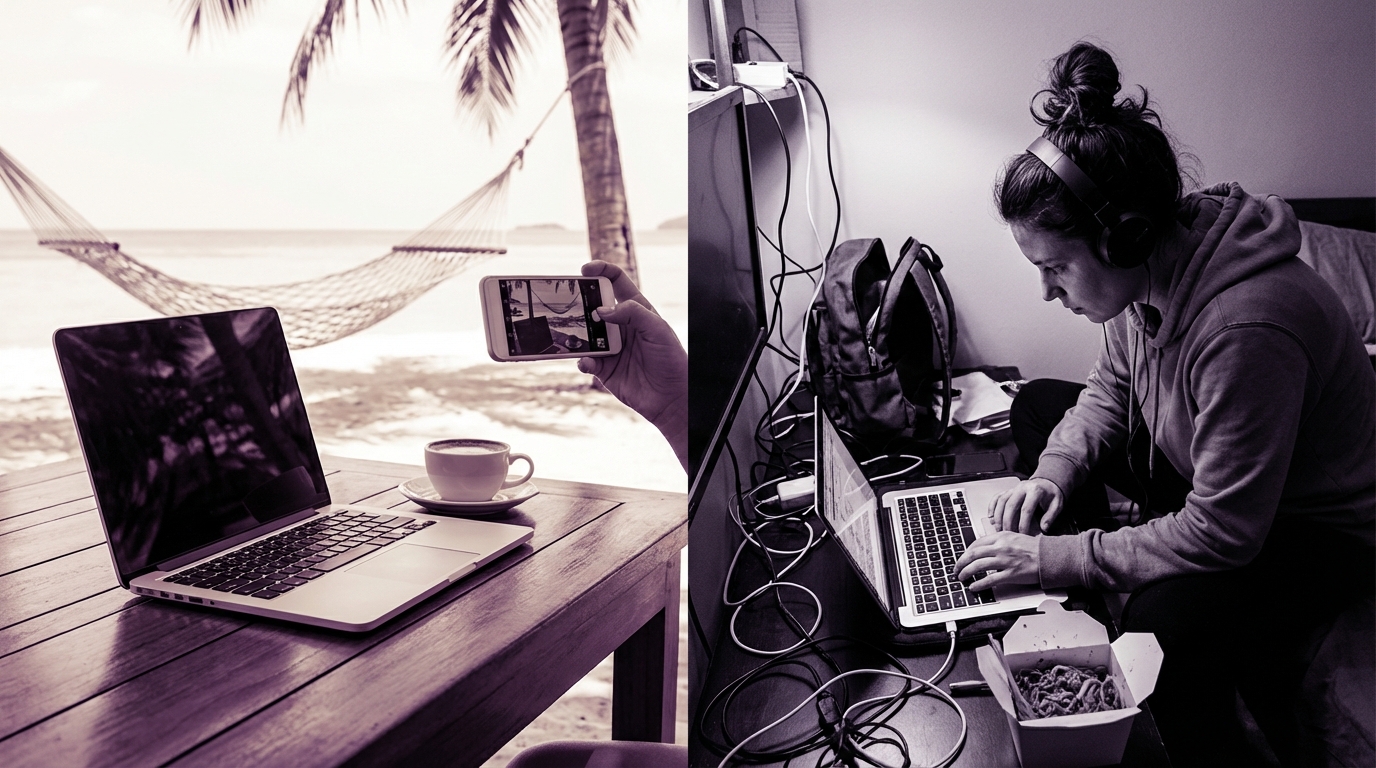

“Digital nomad life is just working from the beach with a laptop, drinking smoothies, and never worrying about money.”
That sentence is false for almost everyone. The photos look like that, but the day-to-day reality feels very different. If you want a quick answer: digital nomad life can be rewarding, but it is work-heavy, lonely at times, and much less glamorous than Instagram suggests. If you go into it expecting an endless vacation, you will feel disappointed and probably broke.
What Instagram Never Shows You About Digital Nomad Life
The social feed version of remote work focuses on sunsets, coworking spaces with plants, and planes. It rarely shows someone trying to upload a client video on a slow hostel connection at 1 a.m. or arguing with a bank over a frozen card while sitting on the floor of a noisy airport.
That gap between photo and reality is where most people struggle.
The problem is not that digital nomad life is bad. It is that people compare their actual days to someone else’s highlight reel. Then they assume they are doing it wrong because their days look normal: emails, deadlines, errands, and the same stress they had at home, just in a different time zone.
I might be wrong, but the biggest trap seems to be expectation inflation. People see 15-second clips and shape a life goal around them. No context. No trade-offs. Just a mood.
“If I become a digital nomad, I will finally feel free.”
Sometimes you do. Often you do not. You just trade one set of limits for another:
You get more location choice, but less routine.
You get more variety, but more decision fatigue.
You get more stories, but less stability.
This does not make it a bad choice. It just makes it a choice with clear costs.
The Money Reality: Income, Costs, and the Stuff Nobody Posts
Money is where a lot of digital nomad dreams crash. Most of the photos you see come from people who either:
1. Already have a stable remote income.
2. Are spending savings.
3. Are on a short trip, not living this way long-term.
“You can live like a king abroad for $500 a month.”
That line floats around the internet all the time. It might work in very rare cases, for a short period, in a very cheap place, with a very low standard of comfort. For most people, that number is not realistic for a balanced life.
Here is a simplified view of real-world monthly costs for a solo digital nomad in common hubs. These are rough ranges, not guarantees.
| City | Housing (room / small studio) | Food (eating in + some eating out) | Workspace / SIM / Internet | Local transport & misc | Approx. total range |
|---|---|---|---|---|---|
| Chiang Mai (Thailand) | $250-$500 | $200-$350 | $50-$120 | $100-$200 | $600-$1,100 |
| Bali (Canggu / Ubud) | $350-$700 | $250-$400 | $60-$140 | $150-$250 | $810-$1,490 |
| Lisbon (Portugal) | $700-$1,200 | $300-$450 | $60-$150 | $150-$300 | $1,210-$2,100 |
| Mexico City (Mexico) | $500-$900 | $250-$400 | $50-$130 | $140-$250 | $940-$1,680 |
| Medellín (Colombia) | $400-$800 | $220-$380 | $50-$120 | $120-$220 | $790-$1,520 |
This table leaves out:
– Flights between countries.
– Visas and border runs.
– Health insurance and medical visits.
– Gear replacement (laptop, phone, bag).
– Taxes.
If your income is $1,500 a month and you want to bounce between Europe and Southeast Asia, you will feel stressed. Not because the internet lied, but because the margin is too thin.
A Simple Income Filter Before You Go Nomad
Before you try to live the digital nomad life full-time, ask yourself three blunt questions:
1. Do I already earn enough remotely, for at least 6 consistent months?
2. Do I have 3 to 6 months of expenses saved, separate from travel money?
3. Do I understand how my taxes work if I move around?
If the answer to any of these is “no”, your approach is risky. You can still travel. Shorter trips can be a smarter step. But building a whole life around remote work without stable remote income sets you up for stress.
One more mental check: if you cannot keep money under control in your home city, where you know the prices, you will likely struggle in a new country with a new currency and temptations to “experience everything”.
The Work Part: What Digital Nomads Actually Do All Day
A digital nomad is not a job. It is just someone who uses the internet to earn money and does not stay long-term in one place. The “digital” is just the tool. The “nomad” is just the lifestyle decision.
Most nomads you do not see on social media do work that looks pretty boring from the outside:
– Writing: blogs, articles, copy for websites, email campaigns.
– Design: websites, social media graphics, branding, UX work.
– Development: coding, app development, software maintenance.
– Marketing: SEO, ads management, content strategy, analytics.
– Customer support: chat support, email support, tech support.
– Teaching: language teaching, coaching, training sessions.
– Operations: virtual assistance, project management, admin.
If you already have one of these skills and a remote job or clients, nomad life is a change of location. If you do not, and you are trying to learn from scratch while traveling, that is much harder than Instagram suggests.
A lot of people try this sequence:
1. Quit job.
2. Fly to a cheap country.
3. Try to learn a skill and find clients from zero.
4. Run out of money.
5. Go back home frustrated.
That is not a digital nomad problem. That is a planning problem.
A more grounded path is:
– Build your skill and income first, where you are now.
– Test remote work for months from home or a nearby city.
– Then add travel, one step at a time.
I might be wrong, but if you cannot stay focused while working remotely from your own home, trying to do it while surrounded by new people, new food, and beaches will not fix that.
The Emotional Reality: Freedom, Loneliness, and Identity
There is a reason many digital nomads talk about “community” all the time. The lifestyle can feel lonely. You say goodbye more than you say hello. People are always arriving or leaving.
“Digital nomads are always meeting new friends and having fun.”
Sometimes they are. Sometimes they are sitting alone in a room in a foreign country, tired of starting the same small talk:
Where are you from?
What do you do?
How long are you here?
Where are you going next?
Surface-level connection comes easy. Deeper connection takes time. A traveling life interrupts that time again and again.
Common Emotional Challenges Nomads Face
Here are some themes that come up often when you talk to long-term digital nomads:
– Identity confusion: You are neither a tourist nor a local.
– Social fatigue: Meeting new people constantly can drain you.
– Relationship strain: Long-distance relationships are hard to maintain.
– Decision overload: Where to live next? What visa? What flight? Which neighborhood?
– Rootlessness: No stable group of friends nearby. No familiar corner cafe. No default weekend plan.
There is also this strange mix of freedom and pressure. You feel free because your time and space are flexible. At the same time, you feel pressure to document everything, to “make it worth it”, to show family and friends that your choice was not a mistake.
Some people even end up working more hours, not less, because they fear losing the lifestyle if income drops. Remote work can become a kind of security blanket you never put down.
How Instagram Distorts the Story
Social media favors short, visual, simple stories. Digital nomad life is long, messy, and full of trade-offs. The camera cannot capture:
– The visa run gone wrong.
– The neighbor’s dog barking while you are on a sales call.
– The stomach issues from new food.
– The lost luggage with your only pair of work shoes.
– The time you misread a time zone and missed an important meeting.
Most creators also earn money from content about travel and nomad life. Their business model pushes them to show the highlight moments. That does not mean they are lying. It just means you see one angle.
“If they can do it, I can do it too, right now.”
Maybe. But you are not seeing their full context:
– Did they have savings?
– Did they build a business for 3 years before traveling?
– Did they burn out after 18 months and quietly settle down somewhere?
– Do they have support from family or a partner if things go wrong?
This is why comparing your starting point to someone else’s chapter 20 is not useful. You can learn from them. You just cannot copy-paste their path.
Health, Habits, and the Hidden Cost of Constant Movement
From the outside, constant travel looks energizing. Inside the routine, your body and mind take regular hits.
Sleep gets messed up. Time zones change. Planes, buses, and trains break your usual rhythm. Gyms are different. Food is different. Weather is different.
I have seen people say:
“Once I am a digital nomad I will eat healthier, exercise more, and have more time for myself.”
Sometimes that happens. More often, people struggle.
They snack more because they are always “on the go”.
They skip workouts because they cannot find a suitable place, or they are only in town for 3 weeks.
They drink more because social events often center around bars and parties in nomad hubs.
Here is a simple comparison to make this concrete:
| Area | Stable home life | Nomad life (frequent moves) |
|---|---|---|
| Sleep | Consistent bed, quiet patterns easier to build | Different beds, noise levels, jet lag, late-night flights |
| Exercise | Regular gym or running route | New gyms, day passes, weather uncertainty, short stays |
| Food | Familiar groceries, known healthy options | Tempting street food, eating out more, unknown ingredients |
| Medical care | Known doctor, insurance, language | New system each place, language gaps, cash payments |
This is not an argument against travel. It is just an honest look at the frictions that add up. If your health habits are already fragile, constant movement will likely expose that.
Visas, Logistics, and Boring Stuff You Cannot Ignore
You do not see many Instagram posts about visa conditions. Yet visas shape the entire lifestyle.
Many countries allow only 30 to 90 days on a tourist entry. Some digital nomads “border hop”, leaving and re-entering to reset the clock. That can work for a while, but rules change and border agents use judgment.
Some countries have introduced digital nomad visas with longer stays. It sounds simple: pay a fee, show income, get a year or more. The details still matter:
– Minimum income requirements.
– Tax obligations if you stay long enough.
– Health insurance rules.
– Limits on local work.
If you ignore these and just fly in and out, your anxiety will rise each time an officer looks at your passport.
Then there are ordinary logistics:
– Banking: Some banks block foreign transactions by default.
– Cards: If you lose your card abroad, replacement can take weeks.
– Phone: eSIMs and local SIM cards, plans, topping up data.
– Housing: Booking short stays costs more per night than stable rentals.
None of this is complicated alone. Together, they eat time and mental energy.
Who Actually Thrives As a Digital Nomad?
Different people handle this life differently. There is no single “nomad personality”, but some traits and conditions seem to help:
– You are self-motivated and can sit down and work without someone watching.
– You like alone time and do not panic without constant in-person social contact.
– You are comfortable with uncertainty and can stay calm when plans change.
– You handle money with care and do not treat travel as a permanent holiday.
– You enjoy learning about cultures and accept that you will make mistakes.
Some people try nomad life and realize they prefer a “slow travel” version: staying 6 to 12 months in one place at a time, with fewer flights and more local depth. Others prefer short trips from a stable base.
There is no prize for the person who visits the most countries.
Practical Steps If You Are Thinking About Going Nomad
Since you wanted real talk and not just theory, here is a grounded path. This is not the only path, but it reduces some of the biggest risks.
Step 1: Stabilize Your Remote Income First
– Aim for an income that covers your current life plus a buffer.
– Work remotely from your own city for at least a few months.
– Test your focus, your discipline, and how you handle isolation.
If you cannot get your work done from a quiet apartment, a beach cafe will not magically fix that. The background may look better, but the work will still be there.
Step 2: Build a Financial Cushion
– Save 3 to 6 months of expenses.
– Keep it separate from your travel budget.
– Assume the first months abroad will cost more than you expect.
Think of this as insurance against late invoices, lost clients, or surprise costs like emergency flights home.
Step 3: Try a “Nomad Test Trip”
– Go to one city for 4 to 8 weeks.
– Work your normal hours.
– Do not treat it as a vacation, treat it as a sample of actual life.
Pay attention to:
– How your energy feels after work.
– Whether you can create a daily routine.
– How often you feel lonely or distracted.
This short test will teach you more than hours of content. If it goes badly, that does not mean you failed. It just means a different setup might fit you better.
Step 4: Choose Slower Travel
Constant movement looks attractive but drains you. Staying at least 1 to 3 months in each place brings several benefits:
– Lower cost per month compared to quick short stays.
– More stable social connections.
– Better routine for sleep, exercise, and work.
Instead of chasing new places every week, treat each city as a temporary home.
Step 5: Set Clear Work Boundaries
– Pick core work hours and protect them.
– Do not move flights or major travel days into your busiest client days.
– Keep one full day each week with no travel and minimal social plans.
Digital nomad life falls apart when work and travel constantly collide. Plan your trips around your work, not the other way around.
Common Myths vs Reality
To close the loop on the Instagram version of this life, here is a simple myth vs reality table based on what many nomads report over time.
| Myth | Reality for many nomads |
|---|---|
| “You work less and relax more.” | You still work normal or longer hours; travel planning adds extra mental load. |
| “You are always on the beach.” | You spend more time indoors, in cafes or apartments, than photos suggest. |
| “Life is cheaper, so money is easy.” | Some cities are cheaper, but flights, visas, and social activities add up. |
| “You meet amazing people every day.” | You meet many people, but deep friendships take effort and time. |
| “Every day feels like an adventure.” | Most days feel like regular workdays, just set in another place. |
| “Once you go nomad, you never go back.” | Many nomads later choose a home base and mix travel with more stability. |
If you read this and still feel drawn to digital nomad life, that is a good sign. It means you are attracted not just to the photos, but to the trade-offs and the reality behind them.
If you read this and think, “Maybe I do not want this full-time,” that is also a good sign. You are not wrong to stick with a home base and travel part-time. Social media often treats “freedom” as one shape. In practice, freedom is alignment with how you like to live, work, and connect with people.
You do not need palm trees in your background to build a meaningful life. You need clarity about what you are choosing and what you are giving up. The digital nomad path is just one option, not a superior one. If you decide to walk it, walk it with your eyes open, not with your mind stuck on a filtered square of someone else’s day.
