
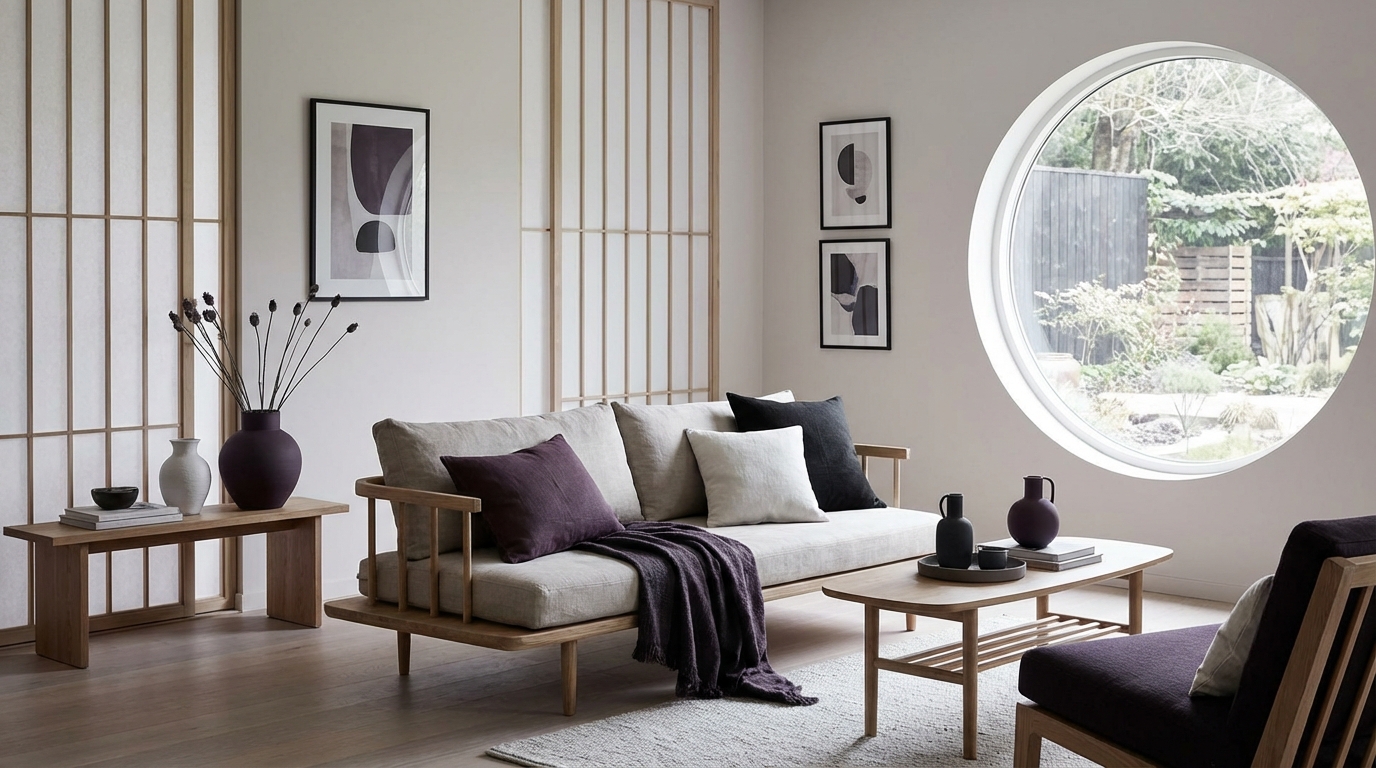

“Japandi style is just another short lived Instagram trend that will look outdated in a year.”
That line sounds confident. It also misses what Japandi actually is. Japandi works because it is not about chasing a trend. It is a mix of two long standing design traditions that already survived many trends on their own. When you mix Japanese and Scandinavian design with some care, you do not get something fragile or temporary. You get a home that feels calm, clear, and lived in. Not perfect. Just very intentional.
I might be wrong, but I think a lot of confusion around Japandi starts with people treating it like a hashtag, not like a mindset. They buy a beige sofa, a low table, a paper lamp, and call it a day. Then they wonder why the room feels flat or cold. Japandi is not beige minimalism. It is not “buy everything from one store and keep it all light wood.”
Japandi is a way to think about space. What you keep. What you remove. How each item earns its place. The style works best when you let it guide your decisions, not when you treat it as a label.
“Japandi just means minimal, right? White walls, black lines, and nothing on the shelves.”
That is one version. A shallow one. Real Japandi has warmth, texture, and a quiet sense of comfort. Scandinavian design brings light, coziness, and practicality. Japanese design brings restraint, balance, and respect for materials and negative space. When both meet, you get rooms that feel simple but not empty, warm but not cluttered.
So if you want to try Japandi at home, do not start with shopping. Start with a few questions:
Do you want your space to feel calm or energetic?
Are you willing to own fewer things?
Can you live with some empty space without rushing to fill it?
If your honest answer is “no” to all of these, forcing Japandi will frustrate you. You are not wrong; your lifestyle just leans in a different direction. If you say “yes” to at least one, there is something here for you.
“Japandi is only for big, bright apartments with huge windows. It will never work in a small or dark home.”
This is where people often take a bad approach. They try to copy what they see in large, staged photos. Those rooms are often shot in natural light with wide angles and no real life clutter. Your home has cables, laundry baskets, and plastic containers. Mine too. Japandi does not require perfect architecture. It asks for clear choices.
You can apply the same principles in a studio, a rental, or a busy family house. The scale and materials might change, but the logic stays.
What Japandi Style Really Means
Japandi is a hybrid of Japanese and Scandinavian interior design. That sentence sounds simple. The practice is more layered.
Here is how each part contributes.
Key qualities from Japanese design
Japanese design in homes often focuses on:
– Calm and balance
– Natural materials like wood, paper, clay, linen
– Low, grounded furniture
– Negative space (what is not there matters as much as what is there)
– Connection with nature, both visually and through materials
There is respect for imperfection and aging. A wooden table that gains scratches is not ruined. It gains character. This links to the idea of “wabi sabi” that accepts wear and change.
Key qualities from Scandinavian design
Scandinavian design focuses on:
– Light, both natural and artificial
– Practical comfort
– Simple forms that are easy to live with
– Neutral colors with some soft contrast
– Coziness (often called “hygge”) through textiles, candles, and texture
The goal is a space that works for daily life in long, dark winters: bright enough, warm enough, easy to maintain.
What happens when you mix them
Japandi blends these qualities. To keep it clear, here is a table that compares them.
| Aspect | Japanese design | Scandinavian design | Japandi mix |
|---|---|---|---|
| Overall feel | Calm, restrained | Light, cozy | Calm and cozy, but not crowded |
| Color palette | Earth tones, dark wood, off white | Light neutrals, soft pastels | Neutral base with soft contrast and depth |
| Furniture height | Low, close to the floor | Standard height, simple forms | Mostly low to mid, clean lines |
| Materials | Wood, paper, tatami, stone | Light wood, wool, cotton | Natural, tactile mix of wood, textiles, and some stone |
| Decor | Very few objects, each chosen | Functional decor, lamps, throws | Minimal decor with a focus on warmth and function |
| Space use | Emphasis on empty spaces | Emphasis on livable comfort | White space plus clear zones for living |
The reason Japandi feels stable, not trendy, is that both roots are practical and tested. You can still misapply it, though. That tends to happen in two extremes:
– People go too minimal and cold.
– Or they add too many cozy items and lose the calm.
Your job is to stay between those.
Core Principles of Japandi Design
Before you think about sofas and rugs, you need a filter for every choice. Japandi is less about “this chair vs that chair” and more about “should there be a chair here at all?”
1. Intentional simplicity, not emptiness
Simplicity is not the same as “own nothing.” A Japandi living room might have:
– One sofa
– One chair
– One coffee table
– One floor lamp
– A low shelf or cabinet
– A rug
That is not extreme minimalism. It is just not more than needed for daily life.
You are taking a bad approach if you remove furniture just to match photos, then end up without enough seating, storage, or surfaces. The test is simple: can you do what you need in the room without feeling cramped or deprived?
2. Function before decoration
This is one area where people often go wrong. They start by buying vases, trays, and art prints. In Japandi, you start with:
– Function of the room
– Flow through the room
– Storage needs
Only when those work do you add decor.
If your shelves are full of decor but you store daily items in plastic bins on the floor, the style is failing you. Use hidden storage and multi use pieces instead of many decorative objects.
3. Natural materials and tactile comfort
Japandi spaces feel good to touch. Wood, wool, linen, cotton, paper, clay. These materials age in a way that looks normal, not broken. That matters.
Artificial materials can still appear, especially for budget reasons, but treat them with some care. You want them to support the natural feel, not dominate it.
Here is a quick material comparison to guide choices.
| Element | Japandi friendly choice | Works with care | Often a bad fit |
|---|---|---|---|
| Flooring | Wood, bamboo, cork | High quality laminate in wood tones | Bright glossy tiles, busy patterns |
| Textiles | Linen, cotton, wool, jute | Blends that look and feel natural | Shiny synthetics, heavy patterns |
| Surfaces | Matte wood, stone, ceramic | Matte metal, powder coated finishes | High gloss lacquer, chrome overload |
| Lighting | Paper, fabric, wood details | Simple metal forms | Crystal, ornate chandeliers |
4. Neutral palette with soft contrast
Japandi color often sits in a calm range:
– Whites and off whites
– Greys and greige
– Beige and sand
– Light and mid wood tones
– Black or deep brown accents
The trick is subtle contrast. If everything is the exact same beige, the room looks flat. If you add too many strong colors, the calm drops.
You can bring in color, but keep it muted: sage green, soft clay, dusty blue. Use it in small doses, maybe one wall, one rug, or some cushions.
5. Respect for empty space
This might be the hardest part if you are used to filling every surface. Japandi needs negative space. Empty walls. Clear floor areas. Shelf gaps.
A simple test: if you remove one item from a surface and the space feels better, that item was not needed. Try this on your coffee table, console, desk, or nightstand.
Planning a Japandi Room the Smart Way
If you start with buying things, you often end up with a collection that does not fully work together. The better path is to follow a small sequence.
Step 1: Define what the room must do
Before thinking about style details, write down:
– What happens in this room every day?
– How many people use it at once?
– What items need storage here?
For example, a Japandi living room for a family of four has very different needs than a single person studio. If you copy a studio layout for a busy family, you will struggle.
If your answers are vague like “relax, entertain, do everything,” that is too broad. Narrow it a bit. For example: “relax in the evenings, read, host two friends.”
Step 2: Decide what to remove
Simplifying is not about throwing out everything. It is about removing what does not serve the use you just defined.
Ask:
– Does this piece get used weekly?
– Does it store something that matters?
– Does it add comfort or calm?
If not, consider donating, selling, or moving it to another room. You might be wrong about an item, so trial runs help. Move questionable pieces out for a week. If you do not miss them, that tells you something.
Step 3: Shape the layout and flow
Layout comes before style. Try to:
– Keep walkways clear and direct.
– Group seating so people can talk without shouting.
– Position key pieces so they get natural light if possible.
Japandi layouts rarely push all furniture against the walls. Sofas can float with space behind them, which allows for better flow and a sense of lightness.
Step 4: Build a simple palette
Pick:
– One main neutral for walls and large pieces.
– One secondary neutral for contrast (maybe darker or warmer).
– One accent color, if you want any.
Write these down. Use them as a filter when you shop or rearrange. If an item does not work with the palette, it has to earn its place in another way (function, texture, or strong emotional value).
Step 5: Add texture for warmth
When your base is neutral and simple, texture keeps it from feeling cold. Think:
– A wool or jute rug
– Linen curtains
– A knitted throw
– A woven basket
– A textured ceramic vase
You do not need all of these. Two or three can be enough if they are well placed.
Room by Room: How Japandi Shows Up
To make this practical, look at how Japandi can guide specific rooms.
Japandi living room
The living room carries much of the visual identity of a home, so choices here matter a lot.
Key aims:
– Calm but inviting seating area
– Clear surfaces with a few chosen items
– Soft, layered lighting
Possible layout:
– A low to mid height sofa in a neutral fabric
– One accent chair in wood with a simple seat cushion
– A low wooden coffee table, maybe rectangular or oval
– A wool or jute rug that anchors the seating area
– One or two side tables with lamps
– A low media console or storage cabinet with closed doors
Common mistakes:
– Giant sectional sofas that swallow the room and block flow
– Overly small rugs that make the space feel chopped up
– Many small decor pieces scattered everywhere
Aim for a rug size that reaches under at least the front legs of the sofa and chairs, and a coffee table that leaves enough walking space around.
Japandi bedroom
The bedroom is where Japandi often feels most natural, because the style aligns with rest.
Focus on:
– Low visual height
– Soft, breathable textiles
– Simple color range, not many strong contrasts
A typical setup:
– Low platform bed or low frame
– Simple headboard or no headboard, maybe a wood panel or paint section
– One or two bedside tables, uncluttered
– Warm, dimmable lamps
– A single dresser or wardrobe with clean lines
This is where people often bring in too many decorative pillows, busy bedding patterns, or harsh lighting. Try a plain duvet cover in cotton or linen in a neutral shade, with two to four pillows that you actually sleep on. One throw is enough.
Japandi kitchen and dining
The kitchen might be the most challenging, because appliances, handles, and storage can limit choices. That said, Japandi can guide your visible elements.
Approach:
– Simple cabinet fronts, flat or shaker style
– Handles in matte metal or wood
– Open shelves only where you can keep items tidy
– Natural materials for cutting boards, jars, and dishware
The dining area can carry more of the mixed style:
– Wood table with slim legs and clean top
– Simple chairs, maybe with a curved back, in wood or with a light cushioned seat
– One statement pendant lamp in paper, glass, or simple metal above the table
Avoid filling the table with decor. One bowl, a small vase with a branch, or a candle set is enough. The table should be ready for actual eating with quick clearing.
Japandi bathroom
Bathrooms can still lean Japandi, even with tiles and fixtures set by a landlord or builder.
Think about:
– Sticking to one or two main tile tones
– Adding wood through stools, trays, or shelving
– Using simple, neutral towels
– Keeping surfaces clear except for daily items in nice containers
If you have bright, cold tiles, warmer accessories and softer lighting can balance that. A wooden bath mat, cotton towels in beige or grey, and a small plant can soften harsh edges.
Balancing Japanese and Scandinavian Traits
Japandi is not a fixed point. You can lean more Japanese or more Scandinavian based on taste and context.
Here is a guide.
| Preference | Lean more Japanese by… | Lean more Scandinavian by… |
|---|---|---|
| Color depth | Using darker woods and deeper neutrals | Keeping woods light and walls bright |
| Furniture | Choosing lower pieces and floor cushions | Choosing standard height items with soft cushions |
| Decor level | Keeping almost bare surfaces | Adding more textiles and candle light |
| Lines and shape | Emphasizing straight, sharp lines | Adding more soft curves |
You are not locked in. You might prefer a more Japanese feeling bedroom and a more Scandinavian living area. That is fine, as long as you keep some shared elements, like a consistent palette and material set.
Budget, Existing Furniture, and Real Life
There is a risk of reading about Japandi and thinking you need to start from zero. That is rarely necessary and often wasteful. From a practical and environmental view, reusing makes more sense.
Working with what you already have
Before buying anything, audit your current items with a Japandi lens:
– Can this be simplified (remove hardware, change handles, declutter surfaces)?
– Can this be softened (add a neutral cover, change fabric, add a cushion)?
– Can this be re positioned to improve flow?
For instance:
– A dark, bulky bookcase might be too heavy. But if it has clean lines, painting it in a softer tone and clearing half the shelves can bring it closer to Japandi.
– A bright colored sofa might not fit the palette. A good quality slipcover in a neutral shade can solve that without replacing the piece.
You are taking a bad approach if you throw away functional items only to buy cheaper ones that mimic a look but do not last.
Where to invest first
If you do want to make new purchases, focus spending where they impact daily life and the visual core of the room.
Usually this means:
– A good sofa or main chair
– A comfortable mattress and bed base
– A solid dining table
– A large rug that sets the tone
Side tables, decor, and smaller accessories can be more flexible on price.
Lighting in Japandi Spaces
Lighting is often overlooked. In Japandi, it is central. The same room can feel harsh or calm based on how you light it.
Key points:
– Use more than one light source per room. Ceiling light plus floor lamp plus table lamp is a good start.
– Favor warm white bulbs, not cold blue ones.
– Soften light with shades in paper, fabric, or frosted glass.
In many Japanese interiors, you see soft, diffused light. Scandinavian homes rely on multiple light sources to handle long dark periods. Japandi sits in the overlap: gentle but practical.
If you only have a bright ceiling light, you will struggle. Add a floor or table lamp and use the ceiling light less in the evening.
Decor, Art, and Objects in Japandi
This is where personality shows. You do not need to fill every space, but you also do not need a house that looks like a showroom.
Choosing decor with intention
Ask these questions before adding an object:
– Does this do something? (light, hold, store, support)
– If it is purely decorative, does it strongly reflect personal taste or memory?
– Does the material fit the natural, calm tone?
It seems to me that the most successful Japandi rooms have fewer objects, but each object is more loved. A handmade mug, a small stack of books you actually read, a photo that matters.
“Japandi means you have to hide all personal items so the room looks clean for photos.”
That idea hurts the whole point. You want rooms you can live in, not only photograph. The difference is in how you display things. Group items, leave empty space around them, and avoid turning every shelf into a storage total.
Using plants, art, and textiles
Plants:
Choose simple shapes in plain pots. Avoid many small scattered plants. Pick a few and let them have impact.
Art:
Simple prints, ink drawings, monochrome photos, or calm abstracts work well. Frames in wood, black, or white. You do not need a gallery wall in every room. One or two pieces can be enough.
Textiles:
Repeat textures across the room so it feels connected. For example, if you use linen curtains, echo that with a linen cushion or table runner. Do not mix too many patterns. One main pattern and one subtle secondary at most.
Common Japandi Mistakes to Avoid
You asked to be corrected when the approach is off, so here are patterns that usually lead there.
1. Treating Japandi as only color and furniture
Painting the walls beige and buying a low table is not enough. If your drawers are crammed and surfaces are covered in small objects, the visual calm will not last. The underlying habits need some attention: how you buy, store, and let go of things.
2. Going all beige with no contrast
This is a frequent one. Beige sofa, beige rug, beige curtains, light wood table, off white walls. The intent is clear, but the effect is flat. You need contrast: a darker wood piece, black lamp bases, deeper cushions, or art that grounds the eye.
3. Mixing too many styles at once
Japandi already blends two approaches. If you add strong industrial, coastal, or ornate traditional pieces without care, the space can feel confused. That does not mean you cannot mix. It means each extra style has to share some traits (material, shape, palette) with the core.
4. Forgetting comfort
Sometimes people chase minimal lines and forget their own bodies. Hard chairs, sofas that are nice to look at but bad to sit on, no soft throws, nowhere to put down a drink. That cuts against both Japanese and Scandinavian roots, which value comfort and function.
If a piece looks perfect but feels bad, it is not good Japandi for your life.
Adapting Japandi to Different Homes
Your context shapes how you apply this style. Here are a few scenarios.
Small apartments
In small spaces, Japandi can work very well because it values clarity. A few tips:
– Choose furniture with visible legs so the floor is not visually blocked.
– Use light colors for main pieces, with darker accents in smaller items.
– Rely on vertical storage with clean fronts rather than many open shelves.
Multi use furniture, like a bench that stores items inside or a table that can expand, fits the logic.
Family homes with children
People sometimes assume Japandi is not realistic with kids. That is only partly true. You need to adjust.
Ideas:
– Use baskets and closed cabinets for toys instead of open bins everywhere.
– Keep very fragile items high or out of main play zones.
– Choose durable finishes that can handle wear.
The style can actually support families, because less clutter can mean easier cleaning and fewer things to trip over.
Rentals
In rentals, you might not be able to change floors, tiles, or wall colors much. You still have levers.
– Bring in Japandi through loose furniture, textiles, and lighting.
– Use large rugs to cover floors that do not fit the style.
– Add plug in lamps and paper shades to soften existing lighting.
You might not reach a “pure” look, but you can reach a space that feels closer to what you want.
Bringing Japandi Into Your Life Gradually
You do not need a large budget or a weekend makeover. A slower, more thoughtful shift often gives better results.
Here is a simple phased approach you can follow.
Phase 1: Edit and rearrange
– Remove obvious clutter and items you never use.
– Clear one room at a time, starting with the one you spend the most time in.
– Rearrange furniture for better flow, even before buying anything.
You might be surprised how different a room feels just from removing five or six extra pieces and adjusting layout.
Phase 2: Define palette and materials
– Choose your base colors and write them down.
– Look at your existing items, and see which ones fit.
– Group fitting items together; move outliers to other rooms or store them.
This creates a more coherent feel without spending.
Phase 3: Make targeted changes
– Replace or cover one major piece that strongly breaks the style.
– Upgrade lighting to softer, layered sources.
– Add one key textile (rug or curtains) in line with the palette.
Keep each step deliberate. Live with each change for a while. If something does not feel right, adjust instead of pushing through just because it fits a style guideline.
When Japandi Might Not Be for You
Not every style suits every person. That is normal. You might struggle with Japandi if:
– You love bright, saturated colors across many surfaces.
– You enjoy collections on display in many rooms.
– You feel uneasy with empty walls or clear tabletops.
– You see home as a place to express energy rather than calm.
You can still borrow parts of the approach. For example, you might keep your strong colors but bring in more natural materials or simplify layouts. There is no rule that says you must commit fully.
The test is how you feel on a normal day, not how the space performs in a photo.
“A well designed home should feel like a quiet support for your life, not a project you constantly have to manage.”
Japandi, at its best, gives you that kind of support. Fewer items to dust. Clearer surfaces. Items that grow better with use. Light that feels gentle. None of this needs perfection. It just needs a steady willingness to question each choice: does this serve the life I actually live here?
If you start from that question, not from trends or hashtags, mixing Japanese and Scandinavian design becomes less about style and more about how you want to live. That is where Japandi stops being a passing look and starts becoming your normal.
