
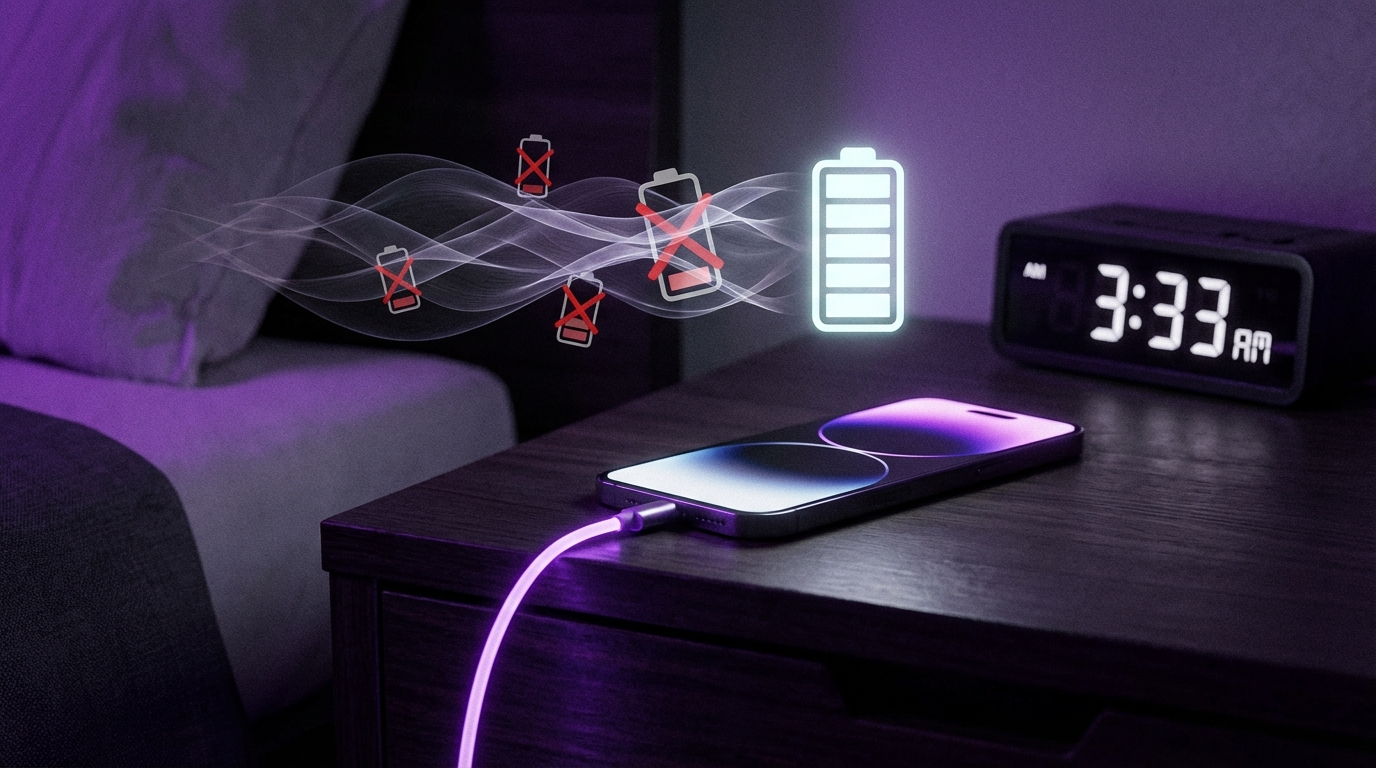

“You should never charge your phone overnight. It kills the battery.”
That sounds scary. It is also mostly false. Charging your phone overnight is not the battery killer people make it out to be. Modern phones are built to handle it. The real problem is how hot the phone gets, how low you let the battery run, and how you treat it over months and years. If you manage those parts, leaving it plugged in while you sleep is usually fine.
I might be wrong, but the bigger danger is not overnight charging. The bigger danger is believing the wrong myths and then doing weird things that actually hurt your battery more.
So let’s clear the fog.
Your phone’s battery is not fragile in the way old tech was. It is more like a stubborn machine that slowly wears out every time you charge and discharge it. That wear is called “cycle aging”. One full cycle is going from 100% down to 0%, then back to 100%. Do that enough times and your battery holds less charge.
Most people blame overnight charging for that loss. It feels intuitive. Phone keeps charging, so battery must be “overcharged”, right? Not quite.
Modern phones use lithium‑ion or lithium‑polymer batteries with advanced charging controllers. Once your phone gets to 100%, it does not keep pushing full power into the battery. The charging system slows down, stops, then occasionally tops up in tiny bursts when the level falls a bit. That is not perfect, but it is not the same as a constant “pressure” on the battery.
“Leaving your phone plugged in all night ruins the battery faster than anything else.”
This sounds confident. It also skips context. If overnight charging made batteries fail quickly, smartphone brands would be dealing with mass replacements. They know people charge while sleeping. They design for it. They are not perfect, but they are not ignoring such a common habit.
Where things get messy is the mix of three factors: state of charge, temperature, and time. If your phone stays at 100% for long periods while also staying warm, that does wear the battery down faster. Not instantly. Gradually.
So the better question is not “Is overnight charging bad?” A better question is “How can I charge overnight in a way that keeps my battery healthy for longer?”
We will get there. Before that, we should separate myths from reality.
“You must keep your phone between 20% and 80% at all times, or you are destroying the battery.”
You might have heard this rule. It is not completely wrong, but it is far too rigid for real life. Staying between 20% and 80% is helpful for long‑term health. Batteries age slower when they avoid the extremes. But if you stress over every extra percent, you trade sanity for a small gain.
Battery care is about better habits on average, not strict perfection every single day.
How modern phone charging really works
To judge overnight charging fairly, you need a basic sense of what is happening under the hood. Nothing too technical.
Modern phones use a two‑stage (sometimes three‑stage) charging pattern:
1. A fast phase at lower charge levels.
2. A slower phase as the battery gets close to full.
3. Maintenance at full.
In the fast phase, the phone fills the battery quickly. This usually happens up to around 60-80%. That is why the first half of the charge feels quick.
Near the top, the phone slows down. It reduces the current to protect the battery. That is why going from 80% to 100% feels slower. This is deliberate.
Once it hits 100%, the charging controller stops active charging. The battery starts to naturally drop a bit. When it falls a few percent, the phone quietly tops it up again. Small bursts. Not a heavy, constant push.
So when your phone stays plugged in overnight, it is mostly just sitting there, occasionally sipping power. The concern is that it may sit at full charge for many hours at a time. That state is stressful for lithium batteries, especially if the phone is warm.
Phones try to reduce that stress using features like:
– Battery protection or “optimized charging”.
– Smart charging schedules that learn your sleep pattern.
– Limiting peak charge to 80% in some modes.
These features are not perfect, and not all phones have them, but they show how brands think: people will charge overnight, so phones have to live with that.
Common myths about overnight charging
Myth 1: Overnight charging “overloads” the battery
The idea here is that electricity keeps flowing into a full battery for hours, causing damage. That was more of a risk with older battery types, not with modern lithium‑ion in phones.
Your phone and charger talk to each other. They control current and voltage. Once the battery is full, charging drops to almost nothing. There is no real “overflow”.
What still matters:
– Sitting at 100% for long stretches.
– Heat from the charger, case, or environment.
So the core myth is wrong. The nuance is that full charge plus heat accelerates wear.
Myth 2: Overnight charging causes “memory effect”
Memory effect was a problem with older nickel‑cadmium batteries. If you kept charging them before they were empty, they “remembered” a smaller range and lost capacity.
Lithium‑ion batteries do not behave like that.
Topping up from 40% to 80% or 60% to 90% does not create a memory effect. In fact, smaller top‑ups are better than full 0 to 100% cycles. So if you plug in your phone before bed at 40% and wake up at 100%, you did not add a memory problem. You added one cycle fraction.
The actual issue is age plus temperature plus time at high charge. Not memory.
Myth 3: Fast chargers are always worse for overnight charging
There is some truth here but also confusion.
Fast charging can raise battery temperature. Higher current, more heat. If the phone gets hot and stays hot, that is not great, especially near 100%.
But modern phones monitor temperature closely. If the battery heats up too much, they reduce charging speed. Also, many fast chargers only work at full speed at lower charge levels. As the battery fills, the phone slows things down.
If you charge overnight, your phone usually spends most of the night at or near full, with very low current flowing. The fast charge only matters at the start, not for the entire night.
So a fast charger is not automatically “worse” for overnight charging. What hurts the battery is consistent heat, not the label on the charger.
Myth 4: You must avoid overnight charging completely
This one is simple: if avoiding overnight charging stresses you or ruins your routine, you are pushing too hard.
The small gain from strict timing might not be worth the hassle. You want habits that you can keep over years, not tricks that only work for a week.
If you charge overnight:
– Keep the phone cool.
– Avoid thick or insulated cases while charging.
– Use quality chargers and cables.
These realistic habits help more than anxious micromanagement.
What actually hurts your phone battery
So if overnight charging is not the main villain, what is?
Three primary factors shape battery health:
– Depth of discharge (how far you drain it).
– State of charge (how high you keep it).
– Temperature.
1. Constant deep discharges
Regularly draining your phone close to 0% is harsh on the battery. Batteries prefer shallow cycles.
If you go from 10% to 100% daily, that is a heavy full cycle. If you hover between 30% and 80%, you still use the phone, but the battery stays in a gentler range.
Do not obsess over exact numbers. Just avoid pushing it to the last few percent every day if you can.
2. Sitting at 100% for long periods, while warm
This is where overnight charging can contribute.
A lithium‑ion battery at 100% is at a high voltage. High voltage plus long time equals faster aging. If the phone is also warm from the room, the bed, the pillow, or a case, that speeds things up.
Phones that offer “optimized charging” often charge quickly to around 80%, then pause, and only reach 100% near your usual wake‑up time. This reduces the hours spent at full charge. If your phone offers such a feature, turning it on makes sense.
3. Heat
Heat is the quiet enemy. Batteries age faster when hot, both while charging and while just sitting.
You want to avoid:
– Charging on a soft surface that traps heat, like a pillow or under a blanket.
– Leaving the phone in direct sun while charging.
– Gaming or running heavy apps while connected to a charger.
Cool environments are kind to batteries. I do not mean you should put the phone in a fridge; that is extreme and risky. Just do not smother it.
How to charge overnight without ruining battery health
Overnight charging can be part of a healthy routine if you handle it wisely. Here are practical steps that balance convenience with care.
Step 1: Use good quality chargers and cables
This sounds basic, but many people skip it.
Cheap, unregulated chargers may deliver unstable voltage or overheat. That is not just bad for the battery; it is a safety risk.
If possible:
– Use the charger from your phone brand or a trusted third‑party brand with proper certifications.
– Avoid extremely cheap no‑name chargers, especially if they feel hot or smell odd.
– Check cables for fraying, kinks, and loose connectors.
Phones can often manage bad power input, but they pay for it with stress and heat.
Step 2: Keep your phone cool at night
Charging itself warms the battery. Your job is to avoid extra heat.
Simple tactics:
– Charge on a hard, flat surface where air can move.
– Do not cover the phone with a blanket, pillow, or clothes.
– Remove heavy, bulky cases if they trap warmth.
– Keep the phone away from direct sun or heaters.
If you touch the phone while it charges and it feels only slightly warm, that is expected. If it feels hot to the point of discomfort, that is a warning sign.
Step 3: Enable battery protection features
Many newer phones have settings that help with overnight charging. Names differ between brands, but common options include:
– “Optimized battery charging”
– “Protect battery”
– “Charge to 80%”
– “Adaptive charging”
These features usually:
– Learn your sleep/wake schedule.
– Charge to around 80% quickly.
– Delay the last part of charging until close to when you normally unplug.
If you charge overnight most days, enabling such a feature is a simple win.
Step 4: Do not let your battery regularly hit 0%
If your phone often dies before you plug it in, that is harsh on the battery. You do not need to rush at 60%, but try to plug in before you hit the extreme low.
Instead of a single daily full drain, many people benefit from shorter charges:
– Evening top‑up before bed.
– Short plug‑in at work or while driving.
But if your routine is “plug in at night and forget”, that is fine too, as long as you avoid deep discharges first.
Step 5: Decide your personal balance
Some people want maximum battery life over years. Others just want the phone to work daily without stress.
You have options:
– If you want convenience: Charge overnight. Turn on any smart charging feature. Keep the phone cool. Do not worry too much.
– If you want more longevity: Aim to unplug around 80-90% when you can. Still charge overnight when needed. Focus on avoiding heat and repeated 0% drains.
Obsession hurts more than it helps. You want a balance you can keep with minimal friction.
Realistic scenarios: Is overnight charging bad here?
Sometimes examples help more than theory. Here are a few common situations and what they mean for battery health.
Scenario 1: Typical overnight charge on a bedside table
You plug in your phone at 25% at 11 pm. It charges to 100% by 1 am. Then it sits plugged in, occasionally topping up, until 7 am.
Is this harmful?
– Some wear: Yes. The phone sits for about 6 hours at or near full.
– Big problem: Not really, if the phone stays cool.
For most people, this pattern is acceptable. Over years, your battery will age, but not alarmingly faster than average.
Scenario 2: Overnight charging under a pillow while streaming
You play videos or audio all night, phone under your pillow or blanket, plugged in. It stays warm, maybe even hot, for hours.
Is this harmful?
– Yes, more than the previous case.
– The phone works hard, battery cycles tiny amounts, and heat builds up.
This combination of warmth, load, and high charge is rough on the battery and not great for safety either. If this sounds like you, changing this habit might significantly extend battery life.
Scenario 3: Charging to only 80% overnight with protection enabled
Your phone has an “80% limit” setting, and you leave that on. It charges to 80%, then stops. You wake up, still at 80%.
Is this harmful?
– It is one of the better patterns for long‑term health.
– You trade some daily runtime for slower aging.
If your schedule supports this and you do not need 100% every morning, this is close to ideal.
How much does overnight charging really shorten battery life?
People often ask for a direct number: “How many months of battery life do I lose by charging overnight?”
There is no single number that fits everyone. Battery life depends on:
– Your phone model.
– Your charging pattern.
– Your temperature conditions.
– Your daily usage intensity.
Still, you can think in broad ranges.
Batteries usually retain about 80% of their original capacity after 400-800 full cycles, sometimes more, sometimes less. That might mean:
– For a heavy user: noticeable decline within 1-2 years.
– For a light user: acceptable health for 3-4 years or more.
If you charge overnight in a cool room using a decent charger, your pattern is within what designers expected. You will still lose capacity over time, because that is how lithium batteries age, with or without overnight charging.
If you avoid overnight charging but keep the phone hot during the day with gaming and heavy apps, you may not gain much. Heat and deep cycles matter more.
I might be wrong, but many people blame the wrong habit. They fear nighttime charging while ignoring daytime heat and usage that hurts the battery more.
Wireless charging vs cable charging overnight
Another common question: does wireless charging at night damage the battery more?
Wireless chargers often create more heat because:
– Energy transfer is less efficient.
– Misalignment between phone and pad wastes energy as heat.
For overnight charging:
– If the phone stays only mildly warm, it is fine.
– If it gets quite warm and stays that way for hours, that adds extra stress.
If you like wireless charging for convenience, some tips:
– Use branded or certified pads.
– Make sure the phone is centered on the pad.
– Do not stack items between the pad and phone.
– Avoid very thick cases that trap heat.
If your phone feels hot in the morning, you might switch to a cable at night and keep wireless for quick daytime top‑ups.
Signs your charging habits are hurting your battery
How do you know if your habits, including overnight charging, are catching up with you? Watch for patterns, not just one bad day.
Common signs:
– Battery percentage drops quickly, even with light use.
– Phone gets warm during simple tasks or while idle.
– Large jumps in battery percentage (for example, 20% to 5% very fast).
– The phone shuts off while still showing charge left.
Many phones have a built‑in “battery health” or “maximum capacity” readout. It is not perfect, but it is a helpful guide. If you see capacity dropping sharply within a year, review your habits:
– Are you often running to 0%?
– Is your phone regularly hot during charging?
– Do you game or watch long videos while plugged in?
Overnight charging, by itself, is rarely the only culprit.
Best practical habits for battery health
To make this easier to remember, here is a simple way to think about it: keep your phone cool, avoid extremes, and use your tools.
Here are habits that matter in real life:
Daily charging habits
– Plug in before you hit extreme low (under 5-10%) when you can.
– Avoid keeping your phone at 100% for no reason, especially in heat.
– Use partial charges when possible; they are gentle on the battery.
Overnight habits
– Charge on a hard, open surface.
– Avoid covering the phone.
– Use smart charging or battery protection if offered.
– Remove thick or heavily insulated cases if they trap heat.
Usage during charging
– Light use while charging is fine.
– Avoid long gaming sessions or resource‑heavy apps while plugged in, especially if the phone feels hot.
Quick reference tables
To make this easier to skim, here are a few tables that summarize key points.
Myths vs reality
| Myth | Reality |
|---|---|
| “Overnight charging always kills your battery.” | Modern phones manage charging. Heat and long time at 100% matter more than the act of overnight charging itself. |
| “You should never leave your phone at 100%.” | Occasional full charge is fine. Constant 100% while warm speeds up aging but does not destroy the battery overnight. |
| “Fast charging is always bad.” | Fast charging can increase heat. If managed well and the phone stays reasonably cool, impact is moderate. |
| “Memory effect will ruin your battery if you do not fully drain it.” | Memory effect does not apply to lithium‑ion. Partial charges are actually better. |
| “You must stay 20-80% at all times.” | Staying in that range helps, but you do not need to be strict. Consistent reasonable habits matter more. |
Better vs worse overnight charging habits
| Habit | Effect on battery |
|---|---|
| Charging on bedside table, cool room, optimized charging on | Low to moderate wear; acceptable for everyday use over years. |
| Charging under pillow, phone warm all night | Higher wear; can noticeably reduce battery health faster. |
| Charging to 80% limit overnight | Gentler on battery; better for long‑term capacity. |
| Using very cheap charger that gets hot | Higher risk for both safety and battery health. |
| Phone idle while charging, case removed | Favorable; lower temperature and less stress. |
Simple do and avoid guide
| Do | Avoid |
|---|---|
| Use trusted chargers and cables | Using damaged or ultra‑cheap chargers |
| Charge on a firm, open surface | Charging under quilts, pillows, or clothes |
| Turn on battery protection features | Ignoring available smart charging settings |
| Keep battery away from 0% when possible | Daily deep discharges to near 0% |
| Accept some overnight charging for convenience | Stressing over every percent of charge |
When you are taking the wrong approach
Since you asked me to tell you when you are on the wrong track, I want to be direct here.
You are taking a bad approach if:
– You force yourself to wake up at night to unplug the phone, ruining your sleep, just to “save” the battery.
– You constantly let your phone drop to 1-2% before charging because you believe full discharges are “good exercise” for the battery.
– You buy extremely cheap chargers without safety marks just to have multiple at home.
– You leave your phone hot on soft surfaces while charging because convenience feels easier than moving it.
Those patterns create more harm than overnight charging in a safe setup.
A more balanced approach:
– Accept that batteries are consumables.
– Focus on low‑stress habits you can keep for years.
– Use built‑in battery tools your phone gives you.
– Protect against heat and extreme states, not every tiny detail.
If you get that balance right, charging your phone overnight can be part of a perfectly reasonable routine, not a mistake you need to fear.
