

“You need an expensive machine and barista training to brew real coffee at home.”
That line sounds confident, but it is false. You can brew barista-quality coffee at home without a huge budget, without a commercial machine, and without turning your kitchen into a cafe. You just need to control a few key variables: beans, grind size, water, ratio, and time. If you get those right, your coffee will be closer to a good cafe than you might expect.
I might be wrong, but most people do not have a “bad palate.” They just drink badly brewed coffee. Over-roasted beans. Stale grounds. Water that is too hot or too cold. Wrong grind size. Then they blame themselves and think they cannot taste quality. That is not fair to them.
So, this guide walks through how to get repeatable, high-quality coffee at home. Not competition-level. Just better-than-most-cafes level. The kind you look forward to each morning and do not rush to cover with syrup.
I will keep the gear list realistic. No rare gadgets. No obsession with laboratory precision. You will see some numbers and ranges, but think of them as guardrails, not strict rules. Coffee is quite forgiving when you get the basics under control.
“If my coffee tastes bad, I just need stronger beans or darker roast.”
That approach creates more bitterness, not more flavor. Stronger does not equal better. Darker does not equal more complex. Most of the time, if you want better flavor, you need fresher beans, correct grind, and a proper brew ratio. Strength comes from ratio and extraction, not from burning the beans.
So, if you have been chasing “stronger” instead of “better,” you are not alone. Many marketing messages push you in that direction. The goal here is different: clarity, balance, consistency.
The 5 pillars of barista-quality coffee at home
Before we talk methods like pour-over, French press, or espresso, it helps to see the whole picture. Every brew method is just a different way of controlling five things:
1. Beans
2. Grind size
3. Water
4. Brew ratio
5. Time and agitation
If one of those is off, your coffee suffers. If all five are in a good range, you get that cafe-level cup.
“Good coffee is all about the machine.”
The machine helps with comfort and repeatability. But the biggest gains come from the basics above. A modest kettle and a simple dripper, paired with fresh beans and a decent grinder, will outperform an expensive machine paired with pre-ground supermarket coffee.
Let us walk through each pillar, then we will plug them into common brew methods.
1. Beans: the foundation you cannot skip
Coffee quality starts long before you touch a kettle. If you start with bad or stale beans, no technique can fix that.
Here is what actually matters with beans:
Roast date vs “best before”
Freshness is not about “best before” dates. You want a “roasted on” date.
For filter coffee (pour-over, French press, drip), beans tend to shine between about 4 and 28 days after roast if stored well.
For espresso, many people like 7 to 35 days, because espresso reacts more to freshness.
These are not hard limits. Just ranges where aroma and sweetness tend to be stronger.
If your bag only shows “best before” and no roast date, that is a red flag. Those beans are likely roasted several months before you see them.
Whole bean vs pre-ground
This one is blunt: if you want barista-level coffee, grind your beans just before brewing.
Pre-ground coffee loses aroma quickly. You can still drink it, of course, but it will not reach that “wow” level.
If you only change one habit after reading this, make it this: buy whole beans and get a grinder that can handle consistent grind size.
Roast level and flavor
This is where personal taste matters. A rough guide:
| Roast level | Flavor profile (general) | Good for |
|---|---|---|
| Light | More acidity, more origin flavor, can taste fruity or floral | Pour-over, drip, Aeropress |
| Medium | Balanced sweetness and structure, softer acidity | Most methods, good all-round choice |
| Dark | More roast flavor, bitterness grows, less origin character | Espresso, moka pot, people who like strong chocolate notes |
If you are unsure where to start, try a medium roast from a local roaster. Something simple, like a Brazil or Colombia, not a rare “competition” coffee. Learn on that, then explore.
2. Grind size: your main control dial
Grinding is where many home setups fall apart. Wrong grind leads to under-extracted or over-extracted coffee.
Quick definitions:
– Under-extracted: sour, sharp, salty, thin, not sweet enough.
– Over-extracted: bitter, dry, harsh, empty, sometimes woody.
Grind size controls how fast water pulls flavor from the grounds.
Finer grind = faster extraction.
Coarser grind = slower extraction.
So, if your coffee tastes sour and thin, you likely need a finer grind or longer brew time. If it tastes harsh and bitter, you likely need a coarser grind or shorter brew time.
Grind size reference table
Here is a simple grind guide:
| Brew method | Approximate grind size | Texture guide |
|---|---|---|
| Espresso | Very fine | Powdery, like table salt or even finer |
| Moka pot | Fine | Between espresso and pour-over |
| Pour-over (V60, Kalita, etc.) | Medium | Like sand, maybe slightly finer |
| Aeropress | Medium to fine | Adjust per recipe |
| Automatic drip machine | Medium-coarse | Like coarse sand |
| French press | Coarse | Like sea salt |
| Cold brew | Very coarse | Like cracked pepper |
This is not rigid. It is a starting point. You will dial it in with taste.
If you have been relying on a blade grinder, that might be holding you back. Blade grinders chop beans unevenly. You get dust plus big chunks, so your extraction is all over the place.
A burr grinder, even an entry-level manual burr grinder, gives you more consistent particle size. That one change can lift your coffee quality more than jumping to a premium coffee machine.
3. Water: the silent ingredient that matters more than gear
Coffee is mostly water. So what you brew with has a big effect.
Water temperature
For most manual brewing:
– A good target is around 92 to 96°C (197 to 205°F).
If you do not have a kettle with a temperature indicator, a simple trick:
– Boil the water.
– Let it sit for about 30 seconds to 1 minute before pouring.
If your coffee often tastes dull or bitter, you might be using water that is too hot. If it tastes flat and sour, you might be too cool.
Water quality
Tap water can work if it tastes clean on its own. If you dislike the taste of your tap water, do not expect it to magically work for coffee.
A few points:
– Strong chlorine taste can ruin flavor. A simple filter jug can help.
– Very hard water can dull acidity and sweetness.
– Very soft or distilled water can make coffee taste hollow and sharp.
A practical solution for many homes is filtered water from a jug or a faucet filter. If you want to go deeper, there are mineral packets for “coffee water,” but that is optional for most people.
4. Brew ratio: how strong your coffee actually is
Brew ratio is the proportion of coffee to water. This is the main driver of strength.
Think in grams, not in scoops. Scoops vary. Scales do not.
A scale makes life easier. But if you do not have one yet, I will give both grams and spoon-based approximations.
Common brew ratios
| Brew method | Starting ratio (coffee:water) | Example |
|---|---|---|
| Pour-over / drip | 1:15 to 1:17 | 20 g coffee to 300 g water |
| French press | 1:13 to 1:15 | 30 g coffee to 450 g water |
| Aeropress | 1:10 to 1:15 (before dilution) | 16 g coffee to 200 g water |
| Espresso | 1:2 to 1:2.5 | 18 g coffee to 36-45 g espresso |
| Cold brew concentrate | 1:4 to 1:8 | 100 g coffee to 400-800 g water |
If you prefer a stronger taste, you can move closer to 1:15 for filter coffee. If you want something lighter, go to 1:17. Try to change ratio in small steps so you can feel the difference.
5. Time and agitation: how extraction finishes
Time is how long water is in contact with the coffee grounds. Agitation is how much you move or swirl the coffee while brewing.
Key idea:
– More time and more agitation both increase extraction.
If your pour-over runs through in 1 minute, your grind is far too coarse or your pour too aggressive. If your French press steeps for 10 minutes, you might get bitterness.
Here are rough target brew times:
| Brew method | Target brew time |
|---|---|
| Espresso | 25-35 seconds for the shot |
| Pour-over (single cup) | 2:30-3:30 minutes from first pour |
| French press | 3:30-5:00 minutes steep |
| Aeropress | 1:30-3:00 minutes including press |
| Moka pot | Brews as it bubbles, about 3-5 minutes on heat |
| Cold brew | 12-24 hours in the fridge |
If you stay roughly within those windows and pair them with the correct grind, you will be close to barista territory.
Brewing methods: how to get cafe-level cups at home
Now we plug the basics into actual methods. I will focus on four: pour-over, French press, Aeropress, and espresso-style drinks. Then add a quick note on cold brew.
You do not need all of them. Pick one that fits your routine.
“Pour-over is too fussy for everyday use.”
It can be fussy. But it does not have to be. With a simple recipe and a bit of practice, you can get reliable cups in under 5 minutes.
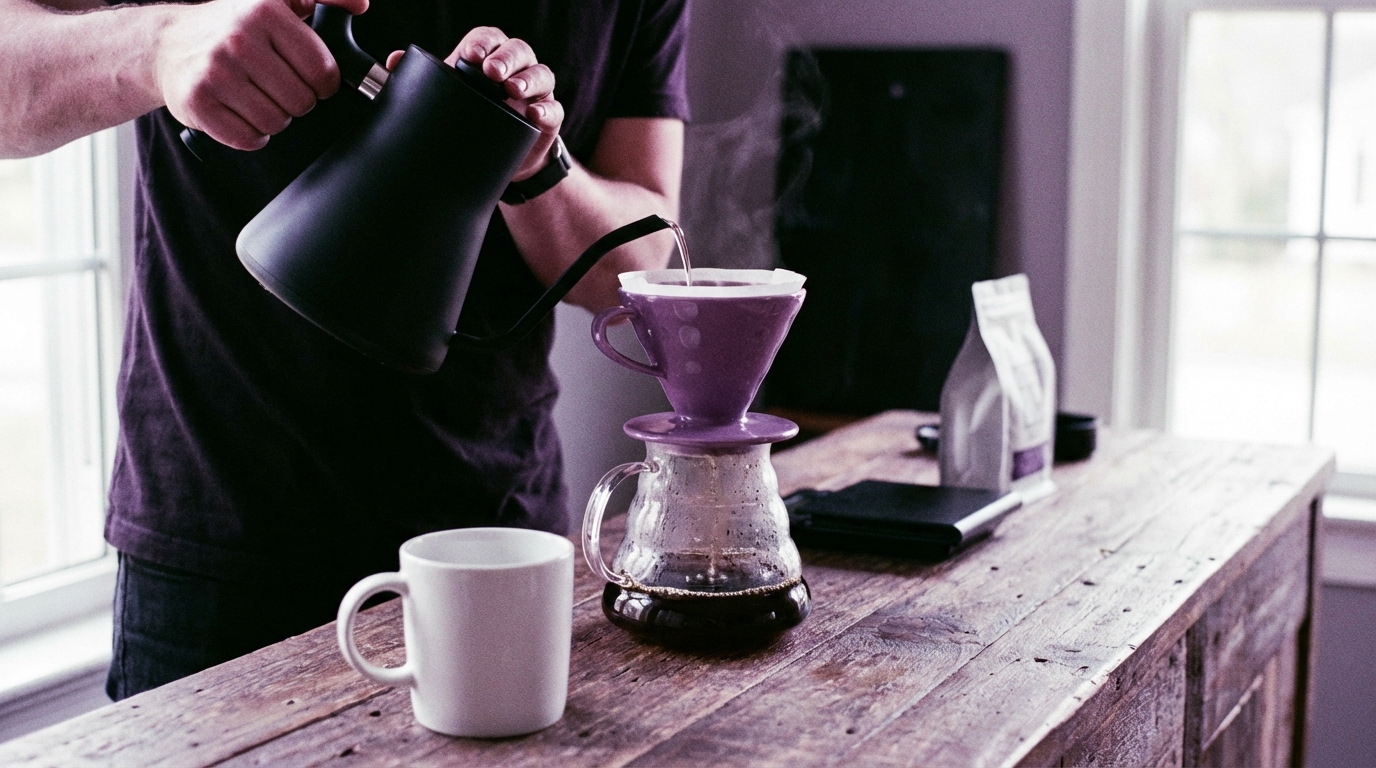
Method 1: Pour-over (V60, Kalita, or similar)
Pour-over gives clarity. You taste the coffee, not the method. That is why many cafes use it for single-origin coffee.
Gear checklist
– Pour-over dripper (V60, Kalita Wave, Origami, or similar)
– Paper filters that fit your dripper
– Kettle (gooseneck helps but is optional)
– Burr grinder
– Scale and timer (phone timer works if you do not have a dedicated one)
– Mug or carafe
Step-by-step basic recipe (1 cup)
Target: clean, sweet cup with balanced body.
– Coffee: 15 g
– Water: 240 g
– Ratio: 1:16
– Grind: medium, like regular sand
– Water temp: about 94°C / 201°F
– Total brew time: 2:30-3:00 minutes
Steps:
1. Heat water and rinse the filter inside the dripper. This removes paper taste and warms your dripper and mug. Discard the rinse water.
2. Add 15 g coffee to the dripper. Level the bed by gently shaking.
3. Start your timer. Pour about 40 g of water to wet all grounds. This is the bloom. Let it sit for 30-40 seconds. You should see bubbling as gas escapes.
4. At 0:40, pour slowly in circles until you reach 150 g total water. Try to keep the water level steady, not too high.
5. At about 1:20, pour again until you reach 240 g total.
6. Let it draw down. The water should pass through by around 2:30 to 3:00 minutes.
7. Taste. If it feels sharp and thin, next time grind a bit finer. If it feels harsh and dry, grind coarser.
That is it. No need to overcomplicate on day one.
Method 2: French press
French press has a reputation for heavy, sometimes muddy coffee. With a small tweak, it can taste surprisingly clear.
Gear checklist
– French press
– Burr grinder
– Kettle
– Spoon
– Scale and timer
Step-by-step basic recipe (2 cups)
Target: rich, full-bodied coffee without heavy sludge.
– Coffee: 30 g
– Water: 450 g
– Ratio: 1:15
– Grind: coarse, like sea salt
– Water temp: about 94°C / 201°F
– Total contact time: about 4:30-5:00 minutes
Steps:
1. Heat water. Preheat the French press with hot water, then discard.
2. Add 30 g coffee to the empty press.
3. Start timer and pour 450 g water over the grounds. Make sure everything is wet.
4. Quickly stir the surface with a spoon to break any dry pockets.
5. Place the plunger on top without pressing it down, to keep in the heat.
6. At 4:00 minutes, gently stir the crust that formed on top. Most of the grounds will sink.
7. Use two spoons to skim off the foam and loose bits at the surface. This keeps the final cup cleaner.
8. Now place the plunger back and press slowly, stopping just above the grounds.
9. Pour into cups or a separate carafe. Do not leave the coffee sitting on the grounds; it will keep extracting and get more bitter.
Taste. If it is too heavy or bitter, try a coarser grind or a bit less time. If it is too light or sour, try a finer grind or a slightly longer steep.
Method 3: Aeropress
Aeropress is flexible. It can make something close to espresso, or a clean filter-style cup. It travels well, it cleans fast, and the recipes are countless. I will give one simple “inverted” recipe that works for many medium roasts.
Gear checklist
– Aeropress
– Paper filters
– Burr grinder
– Kettle
– Stirrer and timer
– Scale (helpful but not strictly required)
Step-by-step inverted recipe
Target: balanced cup with clear flavor and medium body.
– Coffee: 16 g
– Water: 230 g
– Ratio: about 1:14
– Grind: medium-fine (finer than V60, coarser than espresso)
– Water temp: 90-94°C / 194-201°F
– Total time: ~2:15 minutes
Steps:
1. Put the plunger about 1 cm into the Aeropress and stand it upside down (on the plunger).
2. Add 16 g coffee.
3. Start timer. Pour 230 g water, covering all the grounds.
4. Stir gently 5-6 times.
5. Place the cap with a paper filter (rinsed) on top and lock it.
6. At 1:30, carefully flip the Aeropress onto a mug.
7. Press slowly for about 30-45 seconds. Aim to finish around 2:15.
Taste. If it is too intense, add a bit of hot water to your cup to “dilute to taste.” If it is sour, try a finer grind or slightly hotter water. If it is bitter and drying, coarsen the grind.
Method 4: Espresso-style at home
True espresso needs a machine that can hold stable pressure and temperature. But many people have “espresso machines” at home that are more like pressurized systems. That is fine. The goal is not perfection. It is a sweet, balanced shot that works on its own or with milk.
“If my espresso is bitter, I just add more sugar or milk.”
You can, but that hides the problem. If you fix grind, dose, and shot time first, your espresso will need less sugar and less heavy milk to taste pleasant.
Gear checklist
– Espresso machine or home machine with a portafilter
– Fine-capable burr grinder
– Tamper that fits your basket
– Scale and timer (helpful)
Classic “double shot” recipe
Baseline recipe for many machines:
– Dose: 18 g coffee (start between 16 and 20 g depending on your basket)
– Yield: 36-40 g espresso in the cup
– Ratio: about 1:2-1:2.2
– Brew time: 27-32 seconds from pump start
Steps:
1. Purge the group head with a quick shot of water to clear old grounds and stabilize temperature.
2. Grind 18 g of coffee into the basket.
3. Distribute grounds evenly. You can tap the side of the portafilter or use your hand to level.
4. Tamp once with firm, level pressure. No need to push extremely hard. Just make it flat and consistent.
5. Lock the portafilter into the machine and start the shot.
6. Start your timer. Aim to stop the shot when the scale reads 36-40 g or when it visually blondes and thins.
7. Taste. Ask yourself:
– Sour and sharp, with little body? Finer grind or slightly longer shot.
– Bitter and hollow, with heavy aftertaste? Coarser grind or shorter shot.
You might need a few rounds with a new bag of beans to find the sweet spot. That is normal. Baristas do the same.
Steaming milk at home
If you want lattes or cappuccinos, milk texture matters almost as much as the espresso.
Target:
– For latte: glossy, silky milk with small bubbles, like wet paint.
– For cappuccino: thicker foam, but still smooth, not chunky.
Basic steps with a steam wand:
1. Fill a pitcher about one-third with cold milk.
2. Purge the wand quickly.
3. Place the tip just below the surface, off-center.
4. Start steam. You should hear a gentle “tss-tss” sound, not loud screeching.
5. As the milk expands and warms, lower the pitcher slightly to keep the tip just under the surface until it reaches about 37-40°C (you can touch the pitcher; when it feels slightly warm, you are there).
6. Then bury the tip deeper to create a whirlpool and stop adding air. Stretch first, then mix.
7. Stop steaming when the pitcher feels hot but still touchable for a second or two, around 60-65°C.
8. Wipe and purge the wand.
9. Tap and swirl the pitcher to merge any small bubbles. The surface should look shiny.
10. Pour slowly into the espresso, first in the center, then with a slight wiggle for simple latte art if you want.
If you do not have a steam wand, you can heat milk on the stove or in a microwave and use a small hand frother. The texture will not match a cafe wand, but you can still get pleasant milk drinks. Just avoid overheating; scorched milk tastes dull.
Method 5: Simple cold brew
Cold brew is easy and forgiving. You can prep once and drink for days.
Gear checklist
– Jar or pitcher with lid
– Burr grinder
– Spoon or stir stick
– Fine mesh strainer and/or paper filter
Basic recipe
– Coffee: 80 g
– Water: 1 liter (1000 g)
– Ratio: 1:12.5 (makes a strong concentrate you can dilute)
– Grind: very coarse
– Brew time: 14-18 hours in the fridge
Steps:
1. Add 80 g coarse coffee to your jar.
2. Pour 1 liter of cold or room temperature water.
3. Stir to wet all grounds.
4. Cover and store in the fridge for 14-18 hours.
5. Strain through a fine mesh, then again through a paper filter for a cleaner result.
6. Store in the fridge for up to a few days.
7. To drink, dilute the concentrate with water or milk at about 1:1 or to taste. Add ice if you like.
If your cold brew tastes too strong and flat, dilute more. If it tastes weak, next batch use more coffee or less dilution.
Troubleshooting flavor: fix bad cups fast
You will still brew bad cups sometimes. So do baristas. The difference is they know how to fix them.
Here is a quick troubleshooting map.
| Problem | Likely cause | Simple fixes |
|---|---|---|
| Sour, sharp, thin | Under-extracted | Grind finer, use slightly hotter water, extend brew time |
| Bitter, dry, harsh | Over-extracted or too hot water | Grind coarser, shorten brew time, slightly cooler water |
| Flat, boring, no aroma | Stale beans or water quality | Use fresher beans, check water taste, store beans in airtight container |
| Very inconsistent cups | Uneven grind, random ratio | Switch to burr grinder, use a scale, keep same recipe for a while |
If you change too many variables at once, you will not know what helped. Adjust one thing at a time: grind, then ratio, then time.
Minimal gear upgrade path (without overspending)
Some people buy a premium machine first and think that solves everything. That is usually the wrong order. Here is a more sensible path.
Step 1: Start with what you have, improve technique
Before buying anything:
– Use better beans (whole, fresh).
– Control ratio with a simple kitchen scale.
– Pay attention to grind, time, and water.
You might be surprised how much this helps even with a modest setup.
Step 2: Get a burr grinder
If you are still using pre-ground coffee or a blade grinder, a burr grinder is the highest-impact purchase.
You do not need a luxury model. A manual hand grinder with decent burrs can outperform many electric blade grinders and last for years.
Step 3: Upgrade your brewer, not your machine
Before buying a large, expensive coffee machine, test these low-cost brewers:
– Pour-over dripper
– French press
– Aeropress
Each one costs far less than a machine and can already reach near-cafe quality with good technique.
Step 4: Only then think about an espresso machine
If you love espresso and milk drinks daily, and you already have a grinder and some experience, then consider a home espresso machine.
Even then, skip the very cheap “espresso-style” gadgets that cannot hold stable pressure. Either:
– Stay with moka pot + milk frother, or
– Save for a decent entry-level espresso machine that can grow with you.
Building your own “house coffee” recipe
Coffee can turn into a chase for endless novelty. That can be fun, but it can also distract you from mastering what you already have.
I think it helps to create a “house recipe”:
– One bean you like.
– One brew method you prefer.
– One stable recipe you can make almost in your sleep.
Then, once you have that baseline, you can experiment from a place of confidence.
Simple process to develop your house recipe
1. Pick one method
For example, V60 pour-over.
2. Pick one bean
Medium roast from a local roaster, maybe a Brazil or Colombia.
3. Pick a starting recipe
For V60: 15 g coffee, 240 g water, 2:45 minutes, medium grind.
4. Brew it three days in a row
Same recipe every time, same water, same everything.
5. Taste and write one short note each day
For example: “Day 1: a bit sour.”
Then adjust a single variable the next day.
6. After a week, you will have:
– A reliable recipe that fits your taste.
– A simple system to adjust new beans.
Over time, this saves you money and mental energy. You are not hoping for a miracle drink each morning. You are repeating a process that you know works, then making small, clear tweaks when something changes.
“Great coffee is for experts and hobbyists with too much time.”
I do not fully agree. Good enough to impress yourself and a guest is reachable with a few changes:
– Whole fresh beans.
– Burr grinder.
– Simple ratios and times.
– One or two trusted recipes.
You do not need to measure every degree or chase rare beans. If you enjoy that, fine. If not, it is still realistic to get barista-level quality at home by respecting the basics.
And if you find yourself adding more sugar to hide bitterness, that is a signal. Not that your taste is “wrong,” but that one of the five pillars needs attention.
Coffee can be a quiet, repeatable part of your day that you control. Not a coin flip each morning.
Start with the next bag of beans you buy. Treat it with a bit of care, adjust grind and ratio with intention, and your kitchen might quietly become your favorite cafe.
