
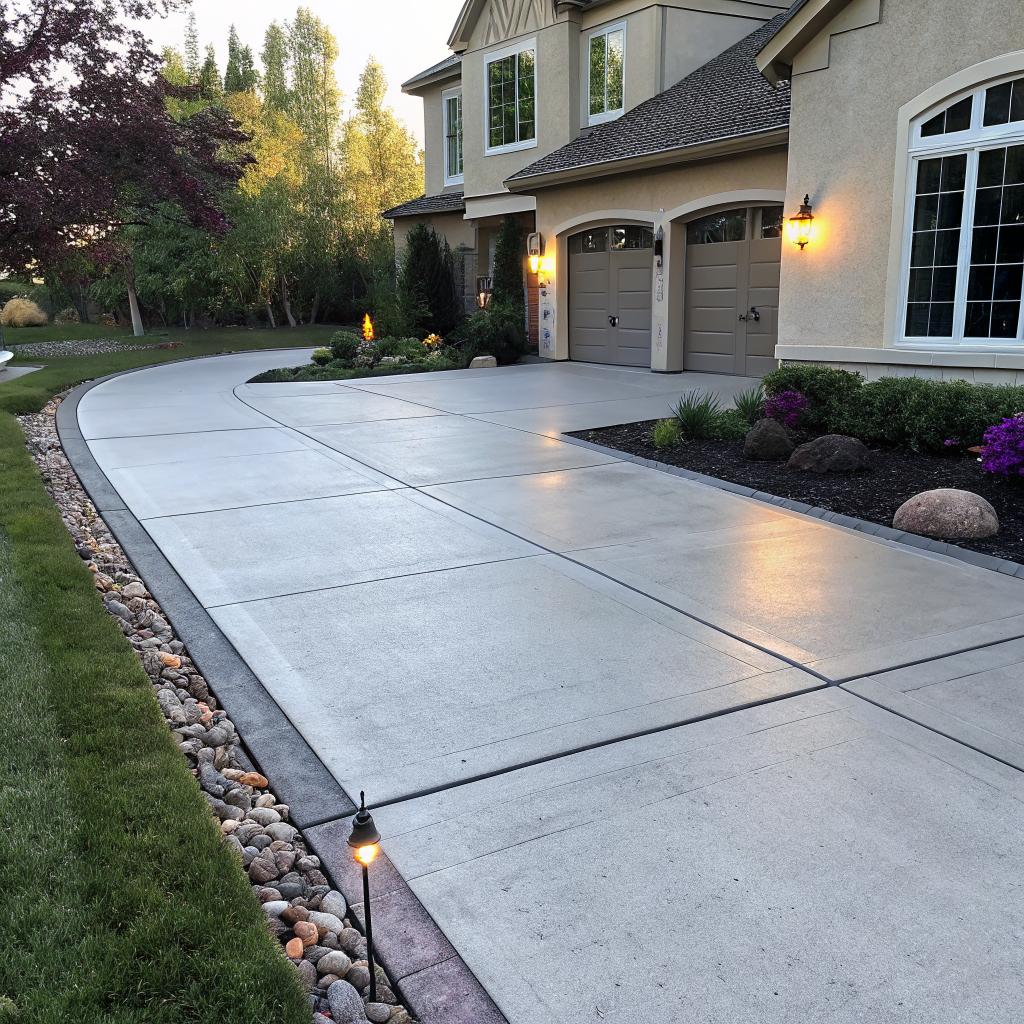

“A concrete driveway is simple: you just pour the concrete, let it dry, and you are done.”
That line is repeated a lot, and it is false. A good concrete driveway is not just poured, it is planned, measured, formed, reinforced, poured, finished, and cured with care. If you want a clear, step by step feel for the process, the short answer is this: you need solid ground, the right thickness, proper slope for drainage, strong edges, good reinforcement, and careful curing. If you want a quick visual walk through of the process, you can Visit Website, then come back here for more detail and context.
I want to walk through this like you and I are standing in the driveway area, looking at the space, and trying to work out what actually has to happen. Not theory. What a crew really does, and what you should watch for as a homeowner so the driveway lasts, instead of cracking and crumbling in a few winters.
You do not need to be a contractor to follow this. You just need a bit of patience and some basic interest in how things are built. I am going to keep the language simple and avoid technical terms when there is a plain word that works.
You will see that a concrete driveway is part science, part habit, and a little bit of judgment. Different soils, climates, and local rules all play a part. So do budgets. That is why you sometimes hear two different contractors give slightly different answers and both can still be reasonable.
Still, there are some steps that should almost never be skipped. When those are skipped, you get the classic story: the driveway looked fine the first year, then cracks got wider, the surface scaled off, or a car tire started sinking near the edge. That is not “just what concrete does.” That is what bad planning does.
Let us break it down in a way you can follow and check against what your contractor is proposing.
What a concrete driveway actually has to do
Before talking about tools and trucks, it helps to ask a simple question: what job will this driveway do every day?
It has to:
– Carry the weight of vehicles without sinking or flexing too much
– Handle water from rain and snow so it drains away, not into your foundation
– Put up with freeze and thaw cycles in colder areas
– Survive oil drips, occasional salt, and the odd dropped tool
– Look decent from the street, at least for many years
If the driveway fails at any of these, you feel it in your wallet later. So when you read about subgrade preparation, base gravel, thickness, and reinforcement, this is what those things are protecting.
I know it can sound like contractors are overcomplicating something simple to charge more. Sometimes that does happen. But more often, problems come from underbuilding, not overbuilding.
Planning the driveway before any soil is moved
Measure, layout, and local rules
A real installation starts with tape measures, stakes, and strings, not with concrete trucks.
You or your contractor should:
– Mark the driveway edges with stakes and string
– Check width at several points so it does not pinch in or bulge out
– Confirm where it meets the street or sidewalk
– Check property lines and easements
– Confirm local code: required thickness, distance from property lines, and any special rules for sidewalks or aprons
If you skip this and just “eyeball it,” you can end up with a driveway that is too narrow for two cars, or worse, one that crosses into a neighbor’s property or a city setback.
Slope and drainage
Water is the quiet enemy of concrete and of soil under concrete. So slope is not a small detail.
A typical driveway should slope away from the house. People often use about 1/4 inch per foot of run as a target, but that can vary a bit. The key point is simple: water should not run toward your garage or your foundation. It should find the street, a drain, or a safe area where it can soak into the ground without causing damage.
If the area is flat, the contractor may need to regrade soil, add low spots (swales), or include drains. This adds cost, yes, but ignoring drainage usually costs more later through heaving, settlement, or water in your basement.
Deciding thickness and reinforcement
Here is where a lot of confusion comes in.
You will hear numbers like:
– 4 inch slab
– 5 or 6 inch slab for heavy vehicles
– Wire mesh or rebar
– Fiber reinforced concrete
A simple way to think about it:
– Light use, small cars, mild climate: 4 inches of concrete can be enough if the base is good
– Heavier vehicles, larger trucks, or weak soil: 5 to 6 inches becomes safer
– Poor soil or long driveway: reinforcement and a thicker base matter more
If a contractor suggests 3 inches of concrete for a driveway that will hold cars, that is a red flag. That might work for a small sidewalk, not for repeated vehicle load.
Groundwork: subgrade and base preparation
Many driveway failures start before the first batch of concrete leaves the truck. The base and soil work decide whether the slab stays flat or turns into a patchwork of cracks.
I think this is the least “exciting” step to watch, but the most important one to get right.
Clearing and excavation
The crew first strips away grass, roots, soft topsoil, and any old pavement that is failing. They dig down to a depth that allows for:
– The planned gravel base thickness
– The concrete thickness
– The final surface height matching the street and garage floor
People sometimes want to save money by keeping the old broken concrete under the new slab. That is usually not a good idea. Old, cracked material can move and transfer those movements to the new slab above.
Compacting the subgrade
Once the soft material is removed, the remaining soil is shaped and compacted. This step reduces later settlement.
You will often see a plate compactor or a larger vibratory roller. The idea is to push loose soil particles closer together while adjusting the slope.
If the soil is very wet, work may need to pause or extra base material will be used. Pouring concrete on muddy or pumping soil is asking for trouble.
Adding and compacting the base
Over the compacted soil, a layer of granular material, often crushed stone or gravel, is placed. Typical depths range from 4 to 8 inches, sometimes more if the soil is poor.
The base layer:
– Spreads the load from wheels
– Helps with drainage
– Provides a stable surface for formwork and workers
Again, compaction is key. Loose gravel is not helpful under a slab. It should be compacted in lifts, not dropped in as a deep loose layer.
Here is a simple comparison table that many homeowners find helpful.
| Base Condition | What It Looks Like | Likely Outcome Over Time |
|---|---|---|
| No base, soft soil | Concrete poured directly on dirt, little or no compaction | Cracks, settlement, tire ruts, water pooling |
| Thin base, poorly compacted | 1 to 2 inches of loose gravel, not compacted | Random cracks, some sinking near edges, uneven surface |
| Proper base, well compacted | 4+ inches of crushed stone, compacted in layers | Stable surface, fewer cracks, longer service life |
If you visit the job site during this stage, do not be shy about asking how thick the base is and if they are compacting in layers. A good crew should be fine explaining this.
Forms, joints, and reinforcement
Once the ground is ready, the crew builds the shape that will contain the concrete.
Setting forms
Forms are often made of lumber or flexible boards for curves. They define the edges and final height of the slab.
Points you can watch for:
– Forms should be straight and well supported with stakes
– Top of the forms should match the planned finished height
– Corners should be square where they are meant to be square
– Slope should be visible, not “dead level” back toward the house
Loose, wobbly forms can bow out when filled and give you a driveway that waves in and out.
Reinforcement options
This part can get more technical, but we can keep it simple.
Common options:
– Wire mesh placed roughly at mid depth of the slab
– Rebar in a grid pattern, often #3 or #4 bars
– Fiber reinforcement mixed into the concrete
The main job of reinforcement is to hold cracks tight, not to make the slab magically unbreakable. Concrete wants to crack. Reinforcement limits how that looks and how wide those cracks get.
A problem you see often is mesh or rebar left at the bottom of the slab, lying on the base. That does not do much. It should be lifted slightly, or set on small supports, so it sits in the lower third to middle of the slab depth.
Control and isolation joints
Concrete will crack as it shrinks and moves with temperature changes. So instead of hoping it does not, installers guide those cracks into planned lines.
Two simple types:
– Control joints: cut or formed lines in the slab, often 1/4 of the slab depth
– Isolation joints: full depth separations from structures like garages, steps, or walls
A rough rule many use is to place control joints at spacing equal to 2 to 3 times the slab thickness in feet. So for a 4 inch slab, joints every 8 to 12 feet in both directions.
If a contractor says joints are not needed for a long, wide slab, that is usually a mistake. You will still get joints, but they will be random cracks.
Concrete mix, delivery, and placing
The driveway is only as good as the combination of mix, weather, and handling on the day of the pour. Good groundwork can still be spoiled by bad timing or rushed finishing.
Choosing the concrete mix
You may hear numbers like 3,500 psi or 4,000 psi. This refers to the compressive strength of the concrete. For most residential driveways, 3,500 to 4,000 psi mixes are common.
Things that matter in the mix:
– Strength rating
– Air content (air entrainment for freeze thaw climates)
– Slump, or how wet the mix is
A mix that is made too wet on site just to make it flow more easily will be weaker and more prone to surface problems. It is a simple trade: more water means easier work for the crew, but lower strength later.
If you see a lot of water being added at the site, ask why. Sometimes a little adjustment is normal, but heavy watering is not a good sign.
Timing and weather
Concrete reacts to temperature and wind.
Warm, dry, and windy days can make it set faster. Cold or rainy days slow it down and can harm the surface if rain hits at the wrong time.
Good crews adjust by:
– Starting early in hot weather
– Using curing methods that hold in moisture
– Protecting fresh concrete from sudden rain
– Pausing work during extreme heat, cold, or storms
You cannot control the weather, but you can avoid planning a big pour during an obvious heat wave or deep freeze, if you have that flexibility.
Placing the concrete
Once the truck backs up, things move quickly.
Steps you might see:
– Concrete is discharged into wheelbarrows, a pump, or directly into forms
– Workers spread it with shovels and rakes, without overworking it
– The surface is struck off with a straight board or screed
– They check thickness and rebar position as they go
Here is another simple table that helps you see what to expect.
| Action During Pour | Good Sign | Bad Sign |
|---|---|---|
| Adding water | Small, measured amount added with explanation | Large amounts dumped in, concrete looks soupy |
| Reinforcement | Mesh or rebar lifted or set on supports | Mesh lying on base, not moved as concrete goes in |
| Screeding | Steady motion with straight edge, checking level and slope | Rough, rushed passes, low spots left behind |
Finishing the surface
This part is where the driveway starts to look like something you will actually live with.
Float and trowel work
After screeding, the crew will:
– Bull float the surface to bring up fine material and flatten marks
– Let the concrete set slightly
– Possibly hand float edges and tight areas
They need to avoid pushing too much water and paste to the top. Working the surface while it is still very wet can weaken that top layer and cause later flaking.
Some contractors use power trowels on larger slabs, but for driveways a mix of hand tools and lighter equipment is more common.
Choosing a surface texture
You have options here, and this is where personal taste shows up a bit.
Common finishes:
– Broom finish: a simple broom is pulled across the surface for grip
– Exposed aggregate: surface paste is removed to reveal the stones
– Stamped patterns: concrete is pressed with molds to mimic stone or brick
For driveways, a broom finish is still the most common because it gives traction when wet or icy. A smooth, steel trowel finish can be slippery and is rare for outdoor vehicle use.
If you are tempted by stamped or exposed aggregate surfaces, think about the look next to your house and sidewalks, and also think about maintenance. Some textured surfaces need sealing more often.
Grooving joints
If control joints are formed instead of cut later, they will be laid out during finishing.
The key points:
– Joint lines should be straight and consistent
– Depth should be at least 1/4 of slab thickness
– They should match changes in shape, such as where the driveway narrows
Random joint lines that wander or stop abruptly can lead to random cracks as well.
Curing: the often ignored step
Curing is not the same as drying. It is the process that lets concrete reach its planned strength. Rushing this stage is one of the quiet causes of weak, dusty, or cracked driveways.
Many owners think once the truck leaves and the surface looks hard, the job is done. In reality, the first week is when the concrete gains much of its strength, and it still needs protection.
What curing does
Curing keeps enough moisture in the slab for the cement to react properly. If the surface dries too fast, the top becomes weak and more likely to crack or flake.
Good curing practices:
– Applying a curing compound spray
– Covering with plastic sheeting
– Using wet coverings such as curing blankets or wet burlap in some cases
Your climate and local practice will affect which method is used.
How long you should stay off it
People often want exact times, but they vary a bit. Still, rough ranges help.
| Use | Typical Wait Time |
|---|---|
| Walking on it | About 24 hours for light foot traffic |
| Light vehicles | 5 to 7 days, sometimes a bit longer in cold weather |
| Heavy trucks or moving dumpsters | Wait several weeks, often around 28 days |
It can feel annoying to leave your car on the street for a week, but shortening this time can cause tiny movements and micro cracks before the surface is ready.
Sealing the driveway
This is where opinions differ. Some professionals seal new driveways after the first curing period. Others wait a few months. A few prefer no sealer on basic broom finishes unless the climate is harsh or deicing salts are common.
Sealer can:
– Help resist water and salt
– Make cleaning oil spots easier
– Slightly deepen the color of the concrete
It is not a magic shield, though. Regular reapplication might be needed every few years depending on product and climate.
Common problems and how to avoid them
Even with good planning, you might see some changes in the driveway over time. Some are normal. Some are warning signs.
Hairline cracks
Thin, hairline cracks are almost expected in concrete. They often follow joints, edges, or small variations in base support.
These do not always mean failure. What you want to watch is:
– Width of the crack
– Vertical movement from one side of the crack to the other
– Growth over time
If they stay thin and do not lift, they are more of a cosmetic issue.
Wide or displaced cracks
If a crack reaches several millimeters wide or one side lifts above the other, then you might have:
– Poor base support
– Tree roots lifting the slab
– Frost heave
– Settlement in disturbed soil
Repairs can range from routing and sealing to partial slab replacement. Sometimes mudjacking or polyurethane lifting is used when the slab has sunk but is still intact.
Scaling or flaking surface
If the top layer of the concrete peels or chips away, reasons might include:
– Overworking the surface while wet
– Finishing while bleed water was still present
– No air entrainment in freeze thaw zones
– Early exposure to deicing salts
This can be frustrating because the slab might still be structurally sound but looks poor. Surface overlays or coatings can sometimes refresh it, but that is extra work that could have been prevented.
Settlement and puddles
Low spots that collect water point back to poor grading, base compaction, or both. Once a puddle exists, freeze thaw cycles can make it worse.
Repairs vary from grinding small high spots, to filling low areas with toppings, to full replacement of sections.
Talking to contractors in a clear, practical way
Since you are likely reading this to prepare for hiring someone, let us talk about the conversation.
You do not have to sound like an expert. In fact, pretending to be one can backfire. But you can ask simple, direct questions that show you care about quality, not just price.
Questions that actually help
Here are some plain questions that often lead to useful answers:
- How thick will the concrete be for this driveway, and how will you check that?
- What kind of base will you use, and how thick will it be?
- How will you handle drainage so water runs away from the house?
- What strength mix will you order, and will it be air entrained?
- How will you reinforce the slab, if at all?
- Where will you place control joints, and how deep will they be?
- How long before we can drive on the new driveway?
You will notice there is no fancy language here. Just straight questions. A contractor who gives clear, specific answers is usually a safer choice than one who brushes these off with “we will take care of it” and nothing more.
Comparing quotes fairly
Homeowners often make one big mistake: they focus only on total price, not what is included.
If one quote is much lower, ask yourself:
– Is the slab thinner?
– Is the base layer missing or thinner?
– Is reinforcement removed?
– Is curing not mentioned at all?
– Are joints spaced farther apart to save cutting time?
Sometimes a lower quote comes from lower overhead or a tight schedule, which is fine. But sometimes it points to missing steps that matter.
DIY vs hiring a pro
Some people are tempted to pour their own driveway. Maybe you are one of them. There is nothing wrong with being ambitious, but I do think this is one of those projects where you should be cautious.
A driveway is not just a big sidewalk. The weight it carries, the need for drainage, and the scale of the pour all raise the stakes.
Ask yourself:
– Do you have enough help to place and finish concrete before it sets?
– Can you get the right tools: plate compactor, screeds, bull floats, joint tools?
– Do you know how to judge slump and setting time on the fly?
– What happens if a truck is late or weather shifts suddenly?
For a small patio, DIY makes more sense. For a main driveway, most owners are happier having a crew that does this work daily. The cost of fixing a bad driveway is usually higher than the savings from doing it yourself.
Small choices that make a long term difference
Some details seem minor in the moment but matter over the years.
Thickness at the edges
Edges carry a lot of stress when tires run near them or over them. Thin edges are common failure points.
Ask your contractor if they:
– Thicken the slab at edges
– Use rebar around perimeters
– Provide any support where the driveway meets soft soil or grass
Driveway apron and transitions
Where your driveway meets the street or sidewalk, there can be rules about height and slope. These transition areas also take abuse from snow plows, delivery trucks, and moving vans.
Giving a bit of extra attention here, with slightly thicker concrete or better reinforcement, can prevent chipping and breakage.
Trees and roots
Large trees near the driveway add shade and curb appeal, but they can move concrete later.
Think about:
– Root barriers if permitted and practical
– Adjusting the driveway path slightly to avoid main root zones
– Accepting that some future root related movement may happen
This is one place where even contractors disagree, and I do not think there is a perfect answer for every case. Sometimes you protect the tree and accept more maintenance. Sometimes you favor the driveway and adjust landscaping.
Basic care for a new concrete driveway
After all the planning and work, you live with the driveway every day. Small habits can keep it in good shape longer.
Things that help
- Keep heavy trucks and equipment off it, especially in the first year
- Clean oil and chemical spills soon, before they soak in
- If you use deicing products, choose ones that are concrete friendly
- Check joints and edges every year for growing cracks and seal them when needed
Things that hurt
- Using harsh salts in the first winter after installation
- Parking heavy dumpsters or trailers on small blocks instead of wide pads
- Letting downspouts dump water right next to the slab
- Ignoring small settlement near the garage or street until it becomes a lip
None of this is complicated, but many people neglect the driveway once it is installed, then feel surprised when it looks tired in ten years.
Quick question and answer
Q: If I remember only a few things about concrete driveway installation, what should they be?
Strong concrete starts with strong ground, a clear plan for water, and enough thickness to carry the loads you put on it. Everything else builds on those three.
Here are the short points to keep in your head when you talk to any contractor or review any plan:
– The soil and base must be firm and well compacted
– The driveway needs a clear slope away from the house
– Thickness should match the vehicles you use, usually at least 4 inches
– Reinforcement and joints should be placed with a plan, not at random
– Curing and early care affect how long the driveway lasts
If you keep these basics in mind and ask direct questions, you are far less likely to end up with that familiar complaint: “It looked fine at first, then it started falling apart.”
