
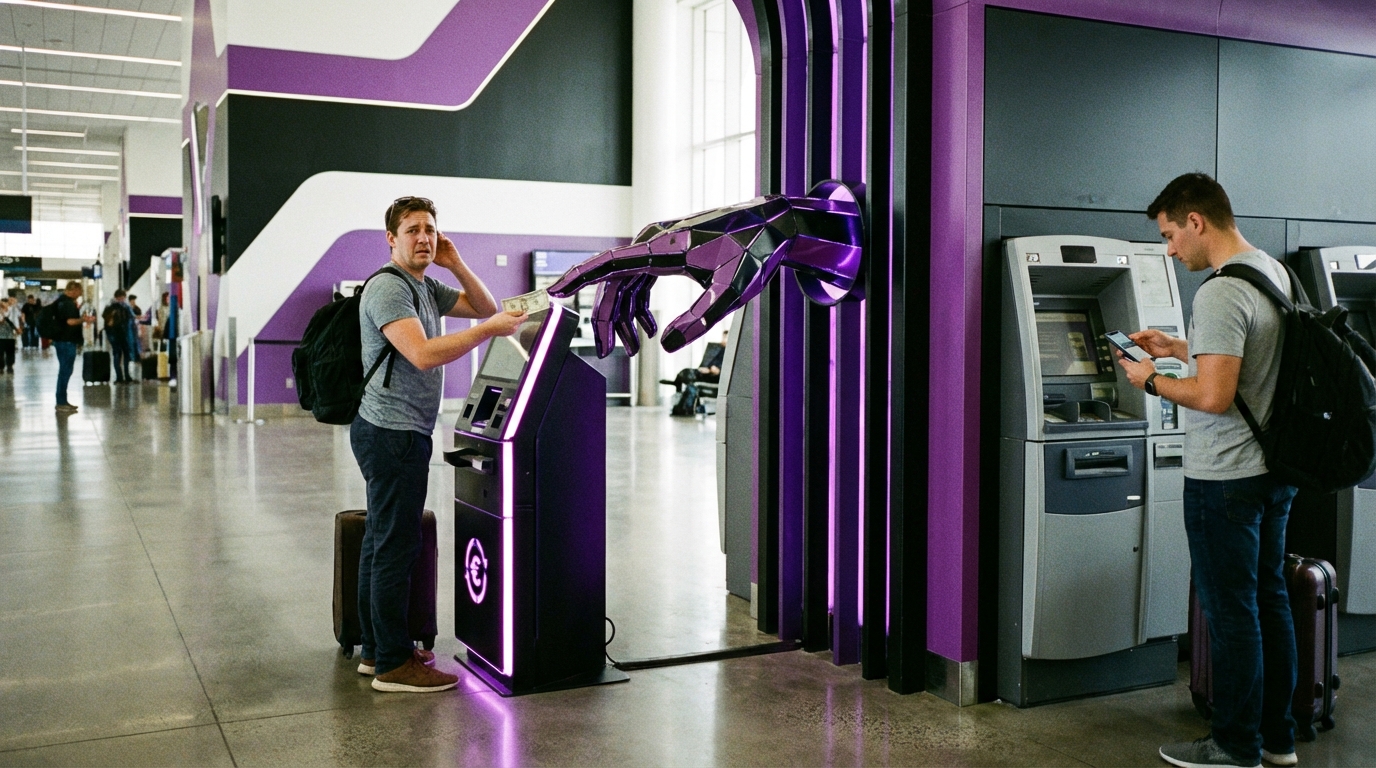

“Airport exchange rates are not that bad. You pay a little extra for convenience.”
That sounds reasonable. It is also almost always wrong. Airport currency exchange is usually the most expensive way to get foreign cash, and the “little extra” can quietly turn into 10 to 20 percent of your money gone.
You are not paying for convenience. You are paying because the airport kiosk knows you are tired, rushed, and maybe a bit nervous about a new country. They know you are less likely to compare numbers when your flight boards in 25 minutes.
I might be wrong about your exact situation, but if you have used an airport exchange desk without checking the real rate first, there is a good chance you overpaid.
What actually happens when you exchange money at the airport
When you hand over your dollars, euros, or any other currency at the airport, two things hit you:
1. A bad exchange rate.
2. Extra fees that are hidden or confusing.
At first glance, the screen might say something like “No commission” or “0% fee.” That sounds safe. It is not.
Here is what the kiosk usually does:
– It takes the real market rate (the one banks use with each other).
– It adds a big margin to that rate.
– It sometimes adds a flat fee on top, or wraps it inside nice marketing words.
You will see a board that says something like:
“1 USD = 0.82 EUR”
You might think, “I do not know the exact rate, that seems fine.” The problem: maybe the real live rate is 0.90 or 0.92. That gap is the profit.
“No commission” often just means “we hide the commission inside a bad rate.”
The trick is that airport exchange desks sell you two things at once:
– Cash right now.
– A feeling of safety.
If you do not prepare, you pay a high price for both.
The real rate vs the rate you get at the airport
There is something called the “mid-market rate” or “interbank rate.” That is the pure rate you see on Google, XE, or any serious currency site.
When banks trade with each other, that is the ballpark they use. You and I never get that exact rate, but we can get close.
Airport desks rarely stay close. They sit far away from that number, because you cannot walk to a competitor easily.
“If you cannot walk away, you do not have a fair price.”
Let me show you how the gap plays out with a simple example.
Say you are changing 500 USD to euros.
– Real mid-market rate: 1 USD = 0.92 EUR
– Airport rate: 1 USD = 0.82 EUR
Here is what you get:
| Scenario | Rate used | Euros you receive for 500 USD | Hidden cost vs mid-market |
|---|---|---|---|
| Fair rate (mid-market, before any small fee) | 0.92 | 460 EUR | 0 EUR |
| Airport kiosk “no commission” | 0.82 | 410 EUR | 50 EUR lost in the rate |
No commission? You just lost 50 EUR in one move, equal to a good dinner.
This is why the phrase “just a small airport fee” is misleading. It is not small when you place it on your full travel budget.
Why airports are so expensive for currency exchange
Airports are not normal locations. Rents are high. Licensing is strict. Security rules complicate everything.
The operator knows that:
– You often arrive with limited time.
– You might worry that your bank card will not work.
– You may be scared of getting stuck without cash for transport.
All that makes you less price-sensitive.
If you run that business, you have:
– High fixed costs.
– A captive audience.
– Little real competition inside the terminal.
So you set the rates where you can cover costs and still make a strong margin. That is rational on their side. On your side, it is painful.
The model is simple: lower volume, higher spread.
When airport exchange might be the least bad option
There are a few narrow cases where the airport desk is not the worst move. I do not recommend it as a habit, but I want to be realistic.
“Never exchange at the airport” sounds absolute. Real life is not always that clean.
Cases where the airport might be acceptable:
– The country is mostly cash-only, and you arrive at night with no working ATM in sight.
– Your bank card has very high foreign fees and strict limits.
– You only need a very small amount just to get into the city safely.
Even here, the idea should be: get a minimum amount, then move to a better option later.
For example:
– Take 50 to 100 USD worth of local cash at the airport.
– Accept that you are overpaying for that piece.
– Then use ATMs in the city or card payments for the rest of your trip.
If you are changing 1,000 or 2,000 units of your home currency at the airport, that is where it gets costly fast.
The better options: how to avoid getting ripped off
I want to walk through the main options, with the trade-offs. None of them are perfect. Still, some are far better than airport desks.
1. Use a debit card that has low foreign fees
If your bank card supports foreign withdrawals with low or no extra fees, this is often the sweet spot for cash.
Process:
1. Get a debit card with low foreign transaction fees and no extra ATM markup, if possible.
2. Before you travel, inform your bank about the countries you will visit.
3. On arrival, use a bank ATM in the airport, not a private “currency ATM” if you can avoid it.
4. Withdraw a reasonable amount, not tiny amounts multiple times.
The key risk is foreign ATM fees and poor conversion. Many ATMs will offer something called “dynamic currency conversion” (DCC). This is where they say:
“Do you want to be charged in your home currency?”
That sounds harmless. It is usually bad. They take control of the rate and add a margin.
“Always choose ‘charge in local currency’ on the ATM screen, not your home currency.”
Your bank then sets the rate, which is usually closer to the real one than what the ATM wants to use.
2. Use a credit card that handles foreign currency well
For many expenses, you do not need cash at all:
– Hotels
– Larger restaurants
– Major transport services
– Tickets and tours
If your credit card has:
– No foreign transaction fee, or a low one
– A fair exchange rate (most major networks are decent)
Then paying by card can be cheaper and safer than holding a lot of cash.
Issues you might face:
– Small shops may prefer cash.
– Street vendors may not accept cards.
– Some countries still lean heavily on cash for taxis or local markets.
So card-only is not always realistic, but for a large part of your spend, it can save you money compared to airport cash exchange.
3. Use online currency services before your trip
There are services and banks that let you:
– Hold balances in multiple currencies.
– Exchange at near mid-market rates with a known fee.
– Get a physical card linked to your balance.
You can then:
– Exchange part of your money days or weeks before you travel.
– Lock a rate you are comfortable with.
– Withdraw limited cash from ATMs abroad, using that card.
You need to check:
– Any monthly fees.
– ATM withdrawal limits.
– Margin on the exchange rate.
This takes some planning, but it cuts out that “rushed at the airport” moment.
4. Use your home bank’s foreign currency desk
Some banks let you buy foreign cash before your trip.
Pros:
– You can compare the rate calmly.
– You know how much cash you carry before leaving.
– No need to hunt for an ATM at arrival.
Cons:
– The rate may still have a margin, just smaller than airport desks.
– You might need to order in advance, so not ideal for last-minute trips.
– Carrying a lot of cash adds risk of loss or theft.
The best method here is to check:
– The bank’s rate.
– The airport kiosk’s online published rate (many list their rates on their site).
– The real mid-market rate from something like Google or XE.
You then see which gap you are more comfortable with.
How to look at the numbers without getting confused
Currency boards can be overwhelming. Many people just ignore the numbers and trust the brand.
That is where money gets lost.
Here is a simple way to judge quickly if a rate is bad, using just your phone and basic math.
Step 1: Check the real rate
On your phone, type into Google:
– “USD to EUR”
– “GBP to JPY”
– Or whatever pair you care about.
You see a number. That is your mid-market reference.
Step 2: Check the offered rate
Look at the airport desk board or website.
Suppose:
– Google says 1 USD = 0.92 EUR.
– The desk says 1 USD = 0.82 EUR.
Step 3: Calculate the hidden margin percentage
Use this formula:
Margin percent = (Real rate – Offered rate) / Real rate x 100
So in this example:
– Real rate = 0.92
– Offered rate = 0.82
(0.92 – 0.82) / 0.92 x 100
= 0.10 / 0.92 x 100
≈ 10.87%
So you are paying roughly 11 percent on that exchange.
Let us put this into a small table for clarity.
| Real rate (Google) | Offered rate (desk) | Margin % | Verdict |
|---|---|---|---|
| 0.92 | 0.91 | ~1% | Very good for consumer level |
| 0.92 | 0.88 | ~4.3% | Reasonable in many cases |
| 0.92 | 0.82 | ~10.9% | Expensive, avoid if possible |
You do not need perfect math every time. You just need a rough idea whether they sit very far from the real number.
If you see a double-digit gap, and this is not an emergency, walk away.
Common airport currency traps
Airport money changers and ATMs use recurring patterns. Once you see them, it becomes easier to protect yourself.
Trap 1: “No commission” signs
Big letters: “0% COMMISSION.”
Smaller impact: the rate is quietly 5 to 15 percent worse than the real rate.
How to respond:
– Ignore the word “commission.”
– Focus on the rate gap vs the real rate.
– Ask for the exact amount you will receive for your cash, then compare.
Trap 2: Dynamic currency conversion (DCC)
At ATMs or card machines, you may see:
“Do you want to be charged in:
– Your home currency
– Local currency”
The screen sometimes even highlights “Home currency” as “recommended.” That option often has a poor rate and an extra margin for the machine operator.
The safer habit:
– Always pick “charge in local currency.”
– Let your bank handle the conversion.
Here is a simple comparison:
| Option | Who sets rate | Typical margin | Better choice? |
|---|---|---|---|
| Charge in home currency (DCC) | ATM or card machine | High, often 5% or more | No |
| Charge in local currency | Your bank / card network | Lower, transparent bank spread | Usually yes |
Trap 3: Airport “guaranteed buyback” offers
Sometimes you see:
“We buy back unused currency at the same rate.”
That sounds fair, but there are two layers:
1. The original rate is weak, so locking it in is no gift.
2. There may be conditions: minimum amounts, fees, or limits on which notes they accept.
If you bought at a bad rate and sell at the same bad rate, you have still lost on both sides versus a fairer market.
Trap 4: Very visible brands and hidden fine print
Big international names often run airport desks. Their brand feels familiar and safe.
I might be wrong in your region, but often the brand comfort hides:
– Wide spreads.
– Extra service fees.
– Minimum transaction amounts.
Again, the brand name matters less than the number gap vs the real rate.
How much are you really losing?
Money loss at the airport feels abstract until you link it to real trip choices.
Take a simple budget:
– Trip budget: 1,500 USD
– Cash needs: 600 USD worth
– Airport rate gap vs real: 10%
Loss on that 600 USD worth of cash is about 60 USD. That could be:
– Several local meals.
– A museum pass for a family.
– A train ticket between cities.
If you travel a few times per year and each trip you lose 50 to 100 in silent fees, over a decade that is a sizable number for something you could reduce with a few steps.
How to plan before your next trip
I want to be practical here. No theory, just a simple prep routine.
Step 1: Estimate how much cash you really need
Ask yourself:
– What tends to require cash in the destination?
– Do taxis accept cards?
– Do restaurants take card payments, or is it mixed?
– Are tips given in cash?
You can check recent travel blogs, local sites, or ask people you know who have been there.
If it seems to me you are someone who always carries a large stack of cash “just in case,” you might be overdoing it. That habit pushes you into expensive exchanges.
Aim to:
– Use cards for bigger, predictable costs.
– Keep cash for transport, small food spots, markets, and tips.
Step 2: Check your current cards
Look at your bank and credit card conditions:
– Foreign transaction fee percentage.
– ATM withdrawal fee abroad.
– Extra “currency conversion” fee.
If they are high, you might be taking a bad approach by relying only on them and then panicking at the airport. Look for an account or card with lower travel costs before your trip.
Step 3: Decide where to get the first batch of local currency
You have a few realistic paths:
| Method | When you get the cash | Typical cost level | Good for |
|---|---|---|---|
| Airport exchange desk | On arrival or departure | High | Emergency small amounts only |
| Bank ATM at airport | On arrival | Low to medium (depends on bank fees) | First set of cash when card fees are fair |
| Home bank foreign cash | Days before trip | Medium | Peace of mind, planned amount |
| Online multi-currency service | Before and during trip | Low to medium | Frequent travelers, tech-comfortable users |
If you handle this before you leave, you avoid that “I have no idea what I am doing” moment in front of the airport counter.
What to do if you already exchanged at the airport
If you are reading this after you used an airport kiosk, that is fine. You cannot change what happened, but you can adjust your next moves.
Steps:
1. Stop exchanging more cash at the airport. Use it only for the minimum you need right there.
2. For the rest of the trip, move to ATMs, cards, or city exchange offices with better rates.
3. When you go home, resist the urge to reconvert leftover cash at the airport again. You would be hit twice.
You can keep small leftover amounts for your next trip or exchange them at your home bank, which might still be cheaper.
How to find better exchange points in the city
Not every city has good independent exchange offices, but many do. The problem is that tourists often pick the first visible one in a heavy tourist street.
Criteria for better spots:
– Clear, up-to-date board with both “buy” and “sell” rates.
– Little or no extra commission line.
– Rate that sits closer to the real mid-market number.
A simple check:
1. Take a photo of the rate board.
2. Check the real rate on your phone.
3. Do the quick margin percentage calculation from earlier.
If the gap is small and there is no extra fee, that is usually safer than airport desks.
Be careful with small offices that:
– Do not clearly display rates.
– Refuse to write the final amount before you hand over money.
– Try to pressure you to decide fast.
If something feels off, walk away.
When your fear of not having cash is costing you money
A lot of airport exchange use is based on fear:
– Fear the card will not work.
– Fear there will be no ATM.
– Fear of standing in a new place with no money at all.
These fears make sense. Still, they can push you into choices that harm your budget without improving safety much.
In many countries, the airport itself has:
– Bank ATMs.
– Multiple options to pay for transport by card.
If you take 10 minutes before your trip to check:
– Does the destination airport have ATMs?
– Does the main transport (train, bus, taxi) accept cards?
You can calm some of that fear.
A small habit: screenshot one or two backup options before flying:
– An image of the airport ATM locations.
– The website of the licensed taxi desk and their payment methods.
This way, when you land tired, you still have a reference, not just your nerves.
Edge cases: tricky countries and unstable currencies
There are certain places where:
– The local currency is unstable or tightly controlled.
– ATMs can be limited or unreliable.
– Card networks are less accepted.
In those cases, the answer is not simple. You might need to:
– Carry more foreign cash (like USD or EUR) as a buffer.
– Use licensed exchange offices in the city, not just airport kiosks.
– Accept some higher fees as the cost of entry.
Still, even in these places, checking the real rate and the local alternatives matters.
If you often travel to such regions and still rely on last-minute airport exchange, I would say that approach is risky and expensive. Planning ahead becomes more important in those conditions, not less.
Simple rules you can remember under stress
When you are jet-lagged, you will not remember every detail, so it helps to have a short set of rules.
Here is a compact set:
- Rule 1: Check the real rate on your phone before accepting any deal.
- Rule 2: Treat “no commission” signs as marketing, not protection.
- Rule 3: Use airport exchange desks only for small, urgent amounts.
- Rule 4: At ATMs and card machines, always choose to pay in local currency.
- Rule 5: For larger sums, use ATMs or city exchanges with posted rates close to the real rate.
If you follow just these, you already avoid the worst traps.
Final thought: you do not need to be perfect, just less exposed
You do not need to chase every last cent. That can turn travel into a spreadsheet contest.
The real goal is simple:
– Avoid the most expensive options.
– Move your bigger decisions to calmer moments, before you stand at the airport counter.
– Be aware of how the numbers work, so you are not relying only on marketing words.
If you are someone who usually walks off a plane and heads straight to the nearest currency kiosk, that habit is probably costing you real money every single trip.
Change that habit, and you keep more of your cash for what you actually care about on the road: experiences, food, and the freedom to say yes to something interesting without thinking about the last airport receipt.
