
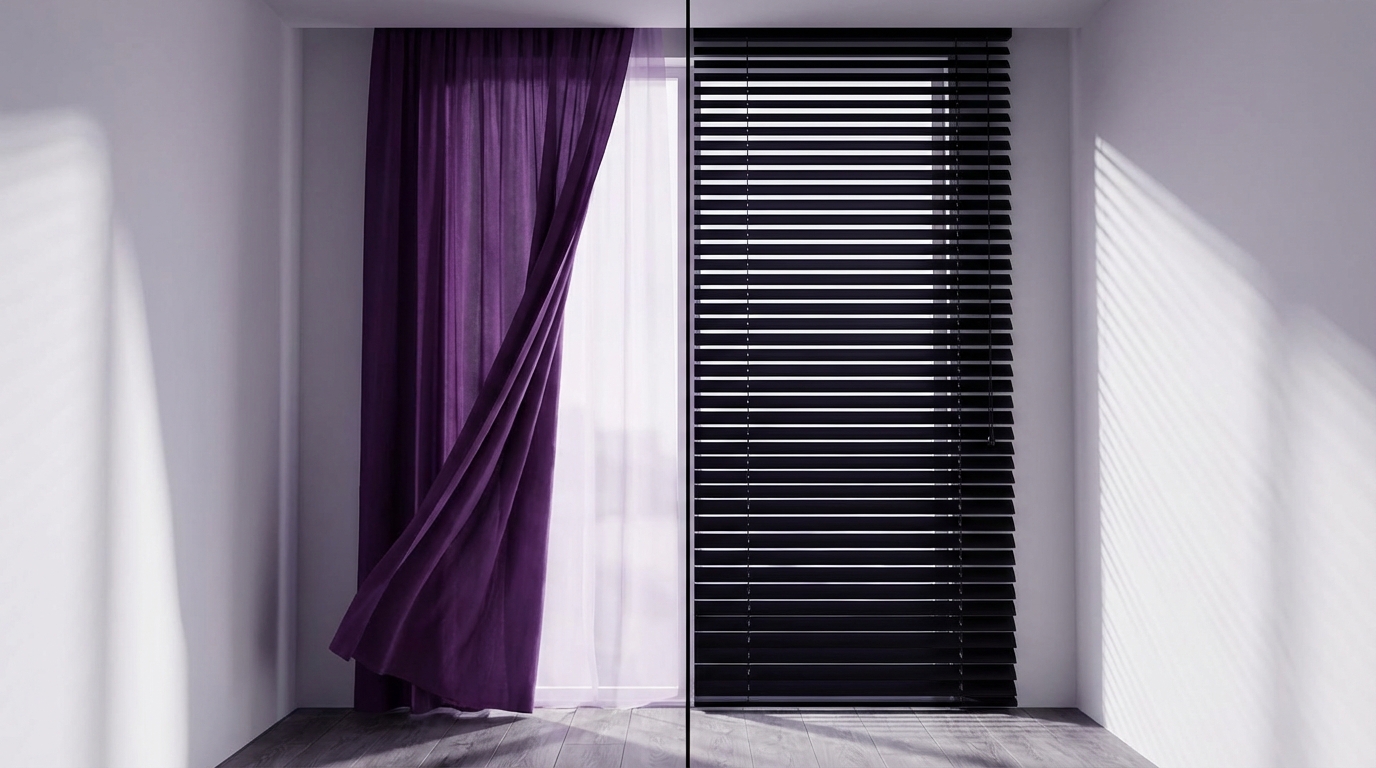

“Curtains are cozy, blinds are practical. If you want real privacy, just get blinds.”
That sounds convincing, but it is not always true. Blinds are not automatically better for privacy. Curtains can be far more private in some rooms and terrible in others. The real answer depends on how your windows face, how you use the room, and how much light you are willing to sacrifice for privacy. If you want a fast rule: for pure, no‑shadow, no‑silhouette privacy at night, thick curtains usually win. For daytime privacy without sitting in the dark, blinds often do better. The best setup? Often a smart mix of both.
I might be wrong, but most people do not ask, “What is the privacy level of this window treatment?” when they buy. They think about color, price, and whether it “looks alright.” Then they move in, turn on the lights at night, and see their own silhouette on display like a puppet show.
So I want to walk through this like a real decision, not a decoration choice. Because if someone across the street can see straight into your bedroom or home office, it stops being about style and becomes about comfort and safety.
Curtains and blinds behave very differently during the day and at night. That is where most mistakes happen. A window that feels private at noon can feel exposed at 8 p.m. with the lights on. That shift is what catches people off guard.
Another thing that trips people up is the difference between “I feel private” and “I am private.” Sheer curtains are a perfect example. They soften the light. They feel like a barrier. During the day, they often give good privacy from a distance. At night, with the lights on, many sheers turn into near‑invisible screens. People trust them too much.
“If I cannot clearly see out, they probably cannot see in.”
That sounds logical, but it is often wrong. Human eyes adjust to contrast. At night, if your room is bright and outside is dark, someone outside can see in more than you can see out. Curtains, blinds, shades, all follow that basic rule. Any choice you make has to work with light, not fight it.
Let us break the comparison down room by room, and also by time of day, because that is how privacy really works in daily life.
How privacy actually works with windows
Before picking curtains or blinds, it helps to understand three simple factors:
1. Light direction
2. Distance from neighbors
3. Your own behavior (lights on, device screens, where you stand or sit)
No fancy theory here, just a few realities that affect whether curtains or blinds help you or not.
“Thick fabric means privacy, thin material means risk.”
Close, but not quite. Thickness helps, but weave, color, and how tight something sits near the frame also matter.
Day vs night privacy
Privacy during the day is mostly about how visible you are from the street or from nearby windows while there is natural light. At night, the rules flip.
Here is how they differ:
| Time | Goal | Biggest risk | What usually works best |
|---|---|---|---|
| Day (bright outside) | Stop casual views in, keep some daylight | People at angles (sidewalk, opposite building) | Blinds tilted up/down, sheer curtains, or a combo |
| Evening (dim outside, lights starting inside) | Reduce silhouettes, keep comfort | People seeing outlines and movement | Layered: blinds + medium curtains |
| Night (dark outside, lights on inside) | No silhouettes, no clear viewing in | Full exposure through gaps or thin fabric | Blackout or thick curtains, or very tight blinds |
So the question “curtains vs blinds” is really three different questions:
– Which is better for privacy in the day?
– Which is better at night with lights on?
– Which is easier to keep consistent so you do not forget and expose yourself by accident?
Now, let us look at how curtains and blinds behave across those situations.
Curtains for privacy: strengths and weak spots
Curtains are simple. Fabric on a rod. Pull them shut, light drops, view drops. That simplicity is both a benefit and a limitation.
“If I close my curtains, nobody can see in, right?”
That can be true, but only if the fabric, color, and coverage are right.
How curtains protect privacy
Curtains work by blocking light and view with fabric. The more opaque and darker they are, and the less gap they leave around the edges, the more privacy you get. Pretty basic.
Where curtains often do well:
– Bedrooms, where full darkness at night is a plus
– Street‑facing living rooms where you do not need much daylight
– Sliding glass doors and wide windows that blinds struggle to cover evenly
Curtains can also hide shadows and shapes better than many blinds. If the fabric is thick and not backlit, your silhouette usually disappears.
Common privacy issues with curtains
Curtains feel safe, but here is where they fall short:
– **Light fabric at night**: Thin, pale curtains can become almost transparent with a strong ceiling light or floor lamp behind them.
– **Gaps at the sides**: If the curtain rod is not wide enough, you get light leaks and side views.
– **No flexibility**: Curtains are basically open or closed. There is not much fine control.
Here is a simple overview of how different types of curtains handle privacy:
| Curtain type | Daytime privacy | Night privacy (lights on) | Light control |
|---|---|---|---|
| Sheer curtains | Good from a distance, weak up close | Poor, silhouettes visible | Plenty of light, hardly any blocking |
| Light fabric, unlined | Decent, especially with darker colors | Medium to poor, shapes can show | Softens light, some glare control |
| Blackout / thick curtains | Strong, but can feel too dark | Very strong, often total privacy | Blocks most or all light |
| Layered (sheer + blackout) | Flexible: sheer for day, blackout for night | Very strong with blackout drawn | Flexible: choose between light and dark |
If you want privacy as the main goal and still prefer curtains, layered panels often solve most gaps.
When curtains are usually better than blinds for privacy
You are not wrong if you feel curtains “hide more” in certain rooms. They do, in some cases.
Curtains are usually better when:
– You stand close to the window often (getting dressed, working out, nursing a baby). Fabric hides movement more softly.
– You need near total block‑out at night.
– You want less chance of accidental exposure from tilted slats or crooked mechanisms.
There is also a subtle thing: curtains can feel more “forgiving.” You pull them shut, and that is it. With blinds, one wrong tilt leaves thin light stripes that people can see through.
Blinds for privacy: strengths and weak spots
Blinds are more adjustable. That is their biggest strength for privacy in the daytime and their biggest risk at night if you use them carelessly.
“If I tilt the blinds, nobody can see in, but I still get light.”
Sometimes yes. Sometimes no. The angle matters, and so does where people are viewing from.
How blinds protect privacy
Blinds rely on slats or panels that you can tilt or lift. When tilted smartly, blinds can:
– Block direct views into the room
– Let daylight filter in
– Give you more control over privacy based on time of day
Where blinds tend to work well:
– Street‑facing windows where you want light but no direct eye contact
– Home offices where computer glare matters
– Bathrooms where you cannot risk full exposure but still want light
Types of blinds and privacy levels
Not all blinds are equal for privacy. Here is a quick comparison.
| Blind type | Daytime privacy | Night privacy (lights on) | Notes |
|---|---|---|---|
| Venetian (horizontal slats) | Strong when tilted correctly | Medium; gaps can reveal strips of view | Tilt slats up, not down, for better privacy from below |
| Vertical blinds | Medium; good when fully closed | Medium to poor; gaps between panels | Common on sliding doors, but not the best for full privacy |
| Roller blinds (single sheet) | Good, if fabric is dense | Strong, if blackout; weak if “screen” style | No slats, fewer gaps; fabric choice is key |
| Honeycomb / cellular shades | Good to strong | Strong with opaque fabric | Nice balance of light control and privacy |
Common privacy mistakes with blinds
This is where many people get privacy wrong with blinds:
– **Slats tilted the wrong way**: If your window faces a busy street and your slats tilt down, someone standing below can see straight in through the gaps.
– **Gaps at the sides**: Inside‑mount blinds often leave a thin line of visible space at each side of the window. From an angle, this can be a clear view.
– **Semi‑transparent fabrics**: Some roller blinds or “screen” materials look opaque in daylight but are almost see‑through at night when your room is bright.
For strong privacy, many people end up layering blinds with curtains or adding a second blind.
When blinds are usually better than curtains for privacy
Blinds often win when:
– You want privacy during the day without blocking most of the natural light.
– Your window faces a neighbor directly, and you want to “break” the line of sight but still use the room fully.
– You need regular fine‑tuning: sometimes you want more view, sometimes more privacy, sometimes less glare.
If you often adjust your window covering based on mood or task, blinds respond more easily than curtains. Curtains tend to be all or nothing.
Room‑by‑room: curtains vs blinds for privacy
The “best” choice shifts by room. You are not wrong if you feel that blinds make sense in a kitchen but not in a bedroom. That instinct has reasons behind it.
Bedroom privacy: what works best
For bedrooms, privacy is both visual and psychological. You do not want to feel watched while getting dressed or waking up.
Here is a simple comparison:
| Option | Daytime privacy | Night privacy | Comfort factor |
|---|---|---|---|
| Just curtains (thick) | Strong when closed, none when open | Very strong | Cozy, but can feel cave‑like in the morning if kept shut |
| Just blinds (opaque) | Good with tilt control | Good if closed tight | More control, but risk of small gaps |
| Blinds + curtains | Very flexible | Very strong with both closed | Best of both, if you do not mind the extra cost |
If you value privacy highly in a bedroom, I would lean toward:
– Opaque or blackout blinds inside the frame
– Plus curtains outside the frame to cover gaps and soften the look
If that feels like too much, thick curtains alone, mounted wider than the window, can still give strong privacy. Just be honest about whether you will remember to close them every night. Some people forget.
Bathroom privacy: no room for error
Bathroom windows are a different story. Here, “mostly private” is not enough.
Common approaches:
– **Frosted glass + blinds**: The glass handles basic privacy, blinds add control.
– **Blinds only**: Not ideal if there are neighbors at direct view level.
– **Water resistant curtains**: Harder to keep clean, but workable with small windows.
For bathrooms, blinds that resist moisture, like PVC or treated aluminum, often work better than fabric curtains. Curtains near steam and splashes can mold.
From a pure privacy angle, a good combo is:
– Frosted or patterned glass
– A simple roller blind with dense fabric
If the bathroom faces a neighbor’s window directly, layering a roller blind with a light, washable curtain can add a second barrier.
Living room privacy: view vs exposure
Living rooms often face the street. People want privacy, but they do not want to feel closed off in the daytime.
Curtains alone can make you choose between privacy and daylight. If they are open, people can see in. If they are closed, you sit in a dim room.
Blinds usually win here, especially:
– Horizontal blinds you can tilt based on sun and privacy
– Light‑filtering roller blinds that block clear views but let light through
If you like the look of curtains, you can hang light sheers across the window and add blinds behind them. During the day, you tilt the blinds for privacy and still get light through the sheer. At night, you can add a heavier curtain layer if needed.
Home office privacy: screen glare and background control
Home offices have two special factors:
– People might see your screen from outside at night.
– People on video calls see your background.
Blinds with tilt control help reduce glare and protect what is on your screen from outside view. Curtains can work, but they tend to block more light.
If your desk faces the window, blinds are usually more practical. If your desk is sideways to the window and you want a calm background behind you, curtains can be better.
Daytime: curtains vs blinds for privacy
To answer the question more directly: during the day, blinds are usually better for privacy without sacrificing light. Curtains can be, but only if you are willing to accept a darker room.
“If I want privacy during the day, I just close everything.”
You can, but then you miss out on free daylight and sit under artificial light for no real reason.
Here is a quick look at how each behaves in daytime:
| Feature | Curtains | Blinds |
|---|---|---|
| Fine control over view | Low | High |
| Keep natural light while blocking direct view | Possible with sheers, but weak privacy up close | Strong with tilted opaque slats |
| Protection from casual street views | Good if mostly closed | Very good when adjusted often |
If your windows face a busy area, blinds with careful tilting give you privacy with less “cave” feeling. Curtains alone often make you choose privacy over daylight.
Nighttime: curtains vs blinds for privacy
At night, the story flips. Thick curtains often do better, especially if you keep lights on inside.
Blinds can leave:
– Small lines and shapes of view
– Tiny edge gaps
– Shadow outlines if people stand close to the window
Curtains, if they are thick and wide enough, cover the whole frame more smoothly.
“Blinds closed means full privacy at night, right?”
Not always. It seems safe, but small gaps can still reveal movement, color, or clothing.
Here is a clear night privacy comparison:
| Night condition | Curtains | Blinds |
|---|---|---|
| Light on directly near window | Thick/blackout: blocks almost all view | Can show slices of light and movement |
| People walking close outside | Safe with dense fabric and good coverage | Risky if slats not fully tight or fabric is thin |
| Streetlights behind viewer | Still strong; viewer eye is on fabric only | Some see‑through lines if blinds are old or warped |
For strong night privacy, especially in bedrooms and bathrooms, curtains have an edge, or you should layer blinds with curtains.
Layering curtains and blinds: often the real best option
If you want a simple final answer, it is this:
– For day privacy: blinds have the advantage.
– For night privacy: curtains have the advantage.
– For all‑day, all‑night privacy without thinking too hard: use both.
That might sound like a sales pitch, but I think it is just realistic. Most homes that feel both private and comfortable use some form of layering.
A common and effective setup:
– Inside mount: blinds (venetian, roller, or cellular)
– Outside mount: curtains that extend beyond the frame on each side
This gives three levels of control:
– Blinds slightly open: daylight, reduced view in
– Blinds closed: good privacy
– Blinds closed + curtains drawn: strong privacy, less light and sound
You do not need this on every window. Focus on:
– Street‑facing windows
– Rooms where you change clothes
– Rooms that stay lit at night while others are dark
How to choose based on your situation
If you want a practical filter to help you decide, ask yourself:
1. How close are my neighbors or the street?
2. Do I want to keep natural light during the day?
3. Do I often have lights on at night in that room?
4. Do I stand or sit close to that window regularly?
Now match your answers:
| Situation | Better choice | Reason |
|---|---|---|
| High‑rise, far from neighbors | Blinds alone or sheers | Distance reduces direct view; light control matters more |
| Street‑level living room | Blinds, maybe with sheers or light curtains | Daylight + regular privacy during the day |
| Bedroom facing another building close by | Blinds + thick curtains | Strong night privacy plus flexible mornings |
| Small bathroom with neighbors nearby | Frosted glass + blinds or roller shade | No chance of exposure, easy to clean |
| Home office with screen facing window | Blinds (venetian or cellular) | Control glare and partial privacy |
If your current plan is to put only sheer curtains in a ground‑floor living room that faces the street and keep them as your main privacy layer, that is a bad approach. You will feel fine during the day and very exposed at night once the lights come on.
Common myths about privacy, curtains, and blinds
I want to call out a few beliefs that lead to privacy problems.
“Dark fabric is always more private than light fabric.”
Not always. A dark but loosely woven curtain can reveal more detail when backlit than a tighter, lighter fabric. The weave and thickness matter as much as the color.
“Double glazing or tinted glass means people cannot see in.”
Tinted glass helps during daylight when outside is brighter. At night, with indoor lights on, tint helps far less than people think. Curtains or blinds are still needed.
“Top‑floor apartments do not need privacy coverings.”
They often do. Nearby taller buildings, roof terraces, or higher roads can give people direct lines of sight into top‑floor windows.
If you have been planning based on any of those beliefs, you are not alone, but they can lead to awkward situations.
Curtains vs blinds: making a clear decision for privacy
To sum up everything into a practical guide without using a formal summary:
– If you care most about **daytime privacy with plenty of light**, pick blinds first.
– If you care most about **nighttime privacy with strong coverage**, pick thick curtains or blackout curtains.
– If you want to “set and forget” privacy for both day and night, and the window faces a busy or close area, layer both.
One last check you can run at home:
1. At night, turn on the main room light.
2. Go outside and stand where a passerby or neighbor might be.
3. Look at your windows for 1 to 2 minutes, not just a quick glance.
If you can see shapes, colors of clothing, or any detail you would not want a stranger to see, your current setup is weak. In that case:
– If you have **curtains only**, consider thicker fabric, lining, or adding blinds.
– If you have **blinds only**, check for gaps and think about adding curtains.
– If you have **sheers only**, you are exposed at night; add a solid layer.
Curtains vs blinds is not about which is “better” in theory. It is about which covers your real life at the times you actually use each room. If you keep that in mind, you will make a smarter, more comfortable choice.
