
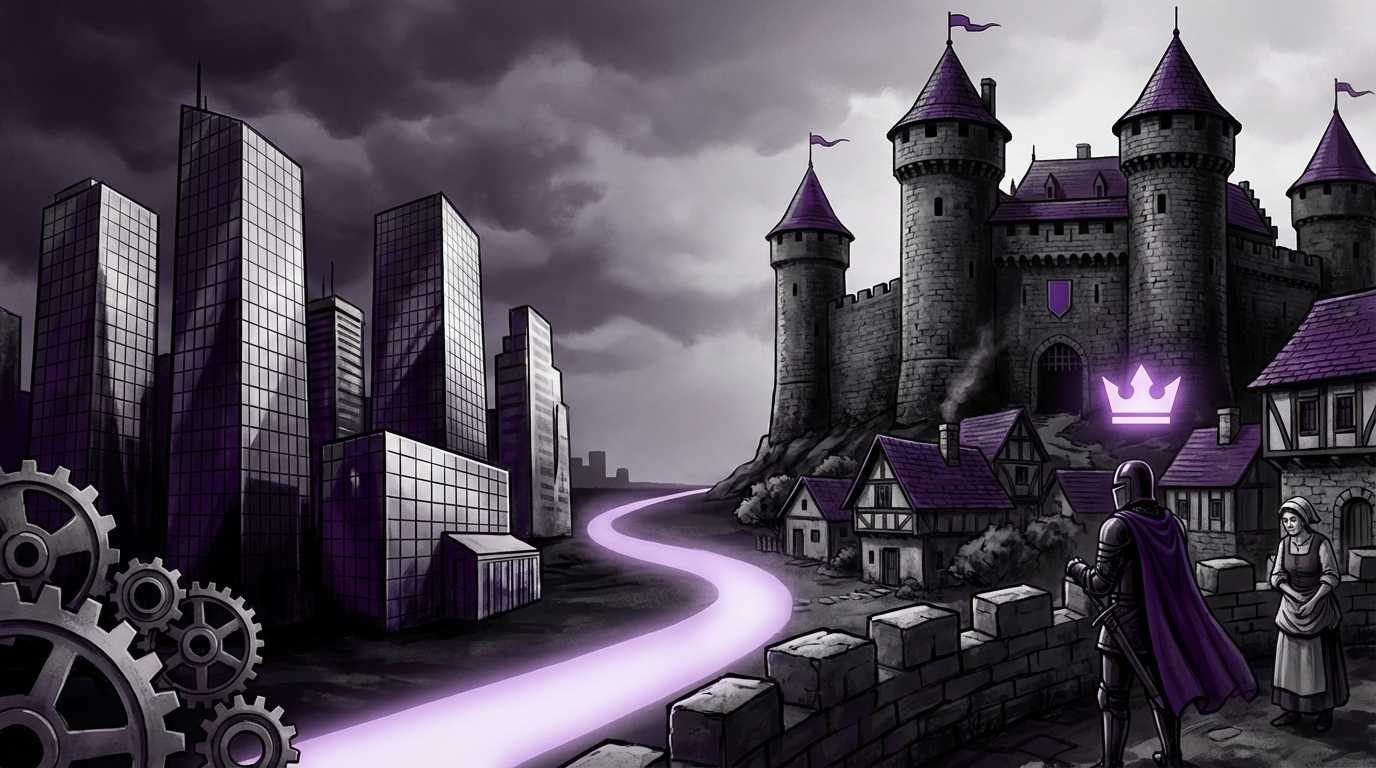

“Capitalism is the end of history. There is no going back to feudalism.”
That sounds confident, but it is not obviously true. If anything, it looks like we are already sliding toward a softer, digital version of feudal life. Not with knights and castles, but with platforms, landlords, and gatekeepers who own the roads everyone has to use. If you read anything on Sunday Best Blog, the thread that keeps coming back is simple: systems change when power and ownership change. That is exactly what is happening now.
I might be wrong, but the more I look at how money and control work today, the more it feels like we are reversing some of the gains people thought were permanent under capitalism. You can still start a business. You can still own things. That is not gone. Still, a growing share of life is spent renting access from owners you never meet, on terms you never really negotiate. You just click “agree.”
That is the quiet bridge from capitalism to something that behaves a lot like feudalism.
The question is not “Will we wake up one day in a medieval village again?” We will not. The real question is: are we building economic rules that trap most people into permanent dependency while a shrinking group collects rents on assets they already own? If that pattern keeps growing, feudalism is not a metaphor. It is a useful description of who owns, who works, and who decides.
So to unpack this shift, we need to slow down and be precise. Capitalism and feudalism are not just labels people throw around on social media. They describe different ways of organizing land, labor, and power. Once you see how those pieces moved in the past, the present looks less random and more like a repeat with new tools.
I will walk through the basics, then compare them, then go into where we are heading: housing, work, tech platforms, and the state. At points I will sound alarmed. At other points, more cautious. Real life is messy that way.
What feudalism actually was
“Feudalism means peasants, castles, and knights. That was just chaos, not an economic system.”
That view misses the structure that held medieval Europe together for centuries. Feudalism was not random. It had rules, and those rules were clear enough that most people knew their place for life.
At its core, feudalism rested on three pillars:
1. Land was the main source of wealth.
2. Ownership of land was concentrated in a small elite.
3. Most people were tied to that land through obligations they could not easily escape.
Here is a simple map of the key players.
| Group | What they owned | What they owed | What they got |
|---|---|---|---|
| King | Nominal claim on all land | Protection of realm, granting titles | Loyalty, military service, taxes from lords |
| Lords / Nobles | Large estates, rights over people on land | Military support to king, counsel, tribute | Rents, labor, legal authority over peasants |
| Knights / Vassals | Fiefs (land grants) | Military service to lords, local enforcement | Income from land, status, some autonomy |
| Peasants / Serfs | Tiny plots (often no formal ownership) | Labor, part of harvest, various dues | Right to live and work, limited protection |
Work was not free in a modern sense. Serfs could not just decide to “switch jobs” and move to another field. Their obligations passed through generations. Staying put was not just common. It was enforced by custom and law.
Rights flowed downward from the top. You did not start with universal rights. You started with a status. Your status then defined what was possible for you.
Under feudalism, markets existed, but they were small and limited. A farmer might sell surplus grain at a local fair, but his life did not revolve around global prices. His main relationship was to a lord, not to an anonymous market.
One more detail that matters for today: feudalism had a personal feel. You knew who your lord was. You might see him. You could resent him. Power had a face.
What capitalism actually is
“Capitalism is just greed. That is all it is.”
Greed exists under every system. What makes capitalism different is not human nature. It is the set of rules that channel that nature.
Under capitalism, wealth is not tied only to land. It includes factories, machines, software, brands, data, and financial claims. Economists call these “capital” because they produce income over time. People invest in them, then collect profits, interest, or dividends.
A few core ideas:
– Most people are legally free to sell their labor to any employer who will hire them.
– Property can be bought and sold on open markets.
– Firms compete for profit, and prices move with supply and demand.
– States still matter, but in theory they do not own or direct all production.
That is the textbook version. In practice, capitalism has never been pure. Governments pass laws, regulate, tax, and sometimes own parts of the economy. Families and networks shape who gets what chance. Culture shapes what is acceptable.
Still, there are real shifts compared to feudal life:
| Feature | Feudalism | Capitalism |
|---|---|---|
| Main source of wealth | Land | Capital (land, factories, finance, tech) |
| Labor status | Bound to land / lord | Legally free, can change employers |
| Hierarchy | Birth-based estates | Class-based, more mobility on paper |
| Key relationship | Lord and vassal | Employer and employee; lender and borrower |
| Role of markets | Limited, local | Central, global, price-based |
Capitalism opened space for merchants, traders, and entrepreneurs to grow beyond their birth station. That shift broke the tight bond between land and power. That is why many historians see capitalism as a break from feudalism.
Yet that break was not clean. Some feudal lords turned into modern landlords or industrial owners. Old power learned new rules, rather than vanish.
How capitalism grew out of feudalism
“Feudalism ended, capitalism started. One system died, another appeared out of nowhere.”
That story is too simple. The shift took centuries and looked different in each region.
A few turning points keep showing up in the research:
Enclosure and the loss of common land
In parts of Europe, peasants once relied on common fields, forests, and pastures. They grazed animals, collected wood, and grew food on land they shared.
Over time, rulers and landlords fenced these commons and turned them into private property. Peasants lost access. Many were pushed into wage work or migration.
The pattern looks familiar:
– Take a shared resource.
– Turn it into a private asset.
– Charge for access.
That move is at the heart of both capitalism and feudalism. The difference is the legal form and the story told to justify it.
Urban growth and merchants
As towns grew, merchants gained strength. Trade routes expanded. Money flowed beyond the control of rural nobles.
City life broke some old ties:
– Guilds formed around skills, not birth.
– Cash wages became more common.
– Contracts replaced many personal obligations.
That did not mean equality. It did mean more people had tools other than land to build a life.
States, taxes, and central power
Kings needed money for wars and courts. Relying on feudal levies was not enough. So they taxed trade, property, and production. They raised armies directly, not only through nobles.
This shift weakened feudal lords and strengthened central states. Markets and property rights often grew under this new protection, but they also served state goals.
What matters for our topic is that capitalism did not erase hierarchy. It rearranged it. Old elites often kept power by investing early in new opportunities.
Where capitalism starts to rhyme with feudalism
Let us move to the present.
You might think: “We have markets, elections, and rights. How can anyone talk about feudalism with a straight face?” Fair question. Using that word can be lazy if we ignore real gains over the last few centuries.
Still, there are some patterns that echo the past:
– Rising concentration of ownership.
– Growing role of “rents” over wages.
– People locked into long-term obligations they cannot realistically avoid.
– Private rule-making by big owners, beyond direct public control.
This is where the idea of “neo-feudalism” comes from. Not a return to medieval farming, but a shift back toward life shaped by powerful owners who control the infrastructure of daily existence.
I might be wrong, but our current path points in that direction.
Digital lords and platform feudalism
“Tech platforms are just tools. If you do not like them, do not use them.”
That sounds reasonable on the surface. In practice, walking away is not so easy.
Think about a few core platforms:
– Search engines and app stores
– Social networks and content platforms
– Cloud hosting and payment systems
– Rideshare and delivery services
– Large online marketplaces
These are not small sites. They function like roads, markets, and town squares combined. They decide who sees what, who trades with whom, and who gets paid.
Here is where the feudal pattern shows up:
| Feudal era | Platform era |
|---|---|
| Lord controls access to land | Platform controls access to users and data |
| Serf works land, owes dues to lord | Creator / seller works on platform, pays fees and follows opaque rules |
| Lord runs local courts, sets customs | Platform sets terms of service, moderates content, can ban at will |
| Leaving estate means losing livelihood | Leaving platform means losing reach and income |
You do not sign a fealty oath. You click “I agree.” Still, the structure is similar:
– You work on someone else’s property.
– You do not negotiate rules one-on-one.
– The owner can change terms without your consent.
– Your “freedom to leave” is limited by network effects and sunk effort.
When creators lose a channel overnight because of an algorithm tweak, it feels arbitrary. Under feudalism, peasants feared extra dues or changes in custom. The shared fear is that your basic conditions get changed above your head.
I am not saying platforms are evil by nature. Many give real value. The problem is the power imbalance. When a handful of firms control key digital “land,” they start to look like new lords.
From owning to renting: the new serfdom?
“Ownership is alive and well. People own phones, cars, houses, stocks. How is that feudal?”
On paper, ownership exists. The trend that worries many researchers is not that ownership has vanished. It is that ownership is concentrating at the top, while the rest get more and more of life on a rent-based model.
Think about a few big shifts:
Housing and landlord power
In many cities, buying a home is out of reach for large parts of the population. Prices move faster than wages. Big investors buy blocks of homes and apartments. Younger people rent longer, often for life.
So you get:
– Owners who collect rent month after month.
– Tenants who pay large shares of income just to stay put.
– Limited paths to build equity, even for people who work full-time.
In feudal times, serfs did not own their fields. They had “use rights” tied to obeying rules. Many modern tenants feel something similar. They can be pushed out by rent hikes or redevelopment. The place they live is a revenue stream first, a home second.
Subscription life
Software used to be a one-time purchase. Now it is mostly subscriptions. The same pattern pops up with media, fitness, storage, and even cars and smart devices that need ongoing payments for full function.
This is not evil by itself. Recurring payments can fund ongoing updates. The deeper issue is that more of daily life becomes a series of “tolls” to access things you do not really own.
Short version:
– Under capitalism at its best, you work, save, and buy durable assets.
– Under a more feudal flavor, you work and pay ongoing tribute to asset owners.
The more you rent, the less independent you are when things go wrong.
Debt as modern bondage
Student loans, credit cards, medical debt, mortgages: these shape life choices for decades. Some debt enables growth. Some traps people in a loop of payments, fees, and stress.
Feudal serfs owed labor and produce. Modern workers often owe cash flows that feel just as binding. You may not be legally tied to a job, but practically you cannot leave, because the bills will not wait.
Again, the echo is not perfect. You can restructure, refinance, or declare bankruptcy in some places. Still, a long-term obligation to distant creditors looks more feudal when the gap in power and information is huge.
Work, precarity, and the vanishing middle
One promise of capitalism was that growth would lift many people into stable, middle-income lives. For some decades in some countries, that did happen. Steady jobs, pensions, and rising home ownership spread.
In recent years, several trends are eroding that stability:
– Gig work with minimal protections
– Contract roles instead of permanent positions
– Automation and software replacing routine tasks
– Outsourcing and global supply chains
For businesses, flexible labor lowers costs. For workers, constant churn makes planning very hard.
The feudal echo here is about security. Serfs lacked freedom but had a kind of certainty: as long as they met obligations, they had some claim to land and protection. Modern gig workers have freedom to log in, but little security if they get sick, old, or less “valuable” to the algorithm.
This is not an argument to go back to serfdom. It is a reminder that stable lives need some floor. When the floor erodes, freedom on paper starts to feel hollow.
The new castles: wealth concentration at the top
Let us anchor this with some numbers, kept simple.
In many countries now:
– A small share of people hold a very large share of total wealth.
– The top of the distribution gains wealth faster than the rest.
– Inheritance plays a growing role in who ends up well off.
That combination matters. Capital income (from owning assets) tends to grow faster than wage income, especially when returns compound over time. If you already own a lot, it is easier to buy more. If you own little, you are busy paying for rent and basic needs.
Here is a simplified comparison:
| Aspect | Feudal society | Late capitalism today |
|---|---|---|
| How elites stay on top | Title and land pass through bloodlines | Assets, firms, and networks pass through families and funds |
| Barriers to entry | Birth status and law | Capital requirements, education, social ties |
| Path for outsiders | Very rare promotion, military or church service | Some entrepreneurial paths, but narrowing for many |
I want to be careful here. Modern society still has far more mobility than medieval Europe did. Saying “it is all the same” would be false. The worry is direction, not identity. If more power sits with people who inherit control over key assets, the logic of feudal hierarchy starts pushing through the cracks.
The role of the state: referee or feudal overlord?
Under feudalism, states as we know them barely existed. Power was fragmented among lords, each with private rights to rule.
In modern capitalism, the state is supposed to act as a referee: set rules, protect rights, step in when private power harms the public.
Reality swings between two poles:
– At times, states tame private power: antitrust laws, social safety nets, labor rules, public services.
– At other times, states align more with asset owners: weak enforcement, tax loopholes, friendly regulation.
When states withdraw from key roles, private powers fill gaps:
– Private security and gated communities where public safety falters.
– Corporate arbitration instead of open courts.
– Private education and health where public services erode.
This looks like a patchwork of mini-jurisdictions shaped by money, not shared citizenship. That pattern leans toward a new kind of feudal patchwork, with different rules depending on which “lord” you fall under.
Is the shift from capitalism to feudalism inevitable?
You are not wrong to ask whether talk of “neo-feudalism” is overblown. Some people use it more as a slogan than as an analysis. Still, the core concern is grounded in visible trends:
– Ownership concentration
– Rent-based business models
– Platform control over key infrastructure
– Declining security for many workers
– Weaker public counterbalance
Nothing about that is automatic or fixed. Economic systems are shaped by law, policy, culture, and technology. They cycle. They react to conflict and crisis.
I might be wrong, but I do not see a straight, smooth line from capitalism into some stable feudal endpoint. What I see is a tug-of-war:
– One side pulls toward more enclosure, more private control, more rent extraction.
– The other side pulls toward wider access, stronger public institutions, and a bigger share of ownership for regular people.
Where we land depends on choices, not fate.
What keeps us from sliding all the way back
If this all sounds bleak, it helps to look at the tools that still exist to push against feudal patterns.
Law and regulation
Rules shape markets. Always.
Some examples of levers that matter:
- Antitrust enforcement to limit excessive platform dominance
- Housing policy that expands supply and curbs predatory practices
- Labor protections for gig and contract workers
- Tax rules that address extreme wealth concentration and loopholes
These are not magic fixes. They are guardrails. Without them, capital tends to pool at the top, and feudal patterns harden.
Shared infrastructure
Public infrastructure limits the need to pay private tolls for every aspect of life. Think of:
– Public transit instead of only private cars and ride-hailing.
– Public broadband that keeps everyone connected without monopoly pricing.
– Libraries and open digital archives.
When shared options are strong, private owners cannot dictate terms so easily. That makes a feudal drift weaker.
Ownership for more people
Direct ownership changes incentives. When more people hold:
– Shares in firms
– Stakes in housing cooperatives
– Membership in local credit unions
– Rights in data trusts or platform co-ops
they move from pure tenants to partial owners.
This is not a romantic call for everyone to be an entrepreneur. It is a push for more democratic structures of ownership, so returns from capital do not flow only to a narrow elite.
What you might be getting wrong about “burn it all down”
It is tempting to say: “Capitalism leads to feudalism, so we need a totally new system.” You may feel that strongly. The risk with that stance is twofold:
1. It can ignore real improvements achieved within mixed capitalist systems: shorter workweeks, safer workplaces, expanded rights, and more chances for many groups.
2. It can underplay how hard it is to design and run a large-scale alternative without new kinds of hierarchy emerging.
History is not kind to pure revolutions that erase everything. Often, some form of elite simply reappears with new titles.
A more grounded approach looks at:
– Where current capitalism is tilting toward feudal structures.
– What concrete moves reduce dependency and widen real freedom.
– How policy, tech design, and local choices can bend trends without fantasy resets.
That is less dramatic, but more likely to work.
How technology can push both ways
Tech often shows up as the hero or villain in these debates. In reality, it sits on both sides of the table.
On the feudal side:
– Centralized platforms lock in users.
– Surveillance tools give owners deep insight into behavior.
– Proprietary formats and walled gardens keep people dependent.
On the anti-feudal side:
– Open-source software lets anyone inspect and build.
– Decentralized protocols reduce single points of control.
– Encryption protects privacy from both states and firms.
A simple table helps:
| Design choice | Trend | Feudal effect? |
|---|---|---|
| Closed, proprietary platform | Centralization | Stronger lords, weaker users |
| Open protocol, many clients | Decentralization | Harder to lock in subjects |
| Opaque algorithms | Information asymmetry | Users obey rules they do not understand |
| Transparent, auditable systems | Shared understanding | More balanced power |
So the key question is not “Is tech good or bad?” It is “Who controls this tech, and on what terms?”
Culture, story, and what people accept
Feudalism survived as much through belief as through force. People internalized ideas about rightful rule and hierarchy. Challenges came when those ideas cracked.
Today’s systems rely on culture too:
– If people accept that renting forever is normal, ownership keeps concentrating.
– If people believe public goods are always wasteful, private tolls rise.
– If workers see themselves purely as individual “brands,” they are weaker in collective negotiations.
I might be wrong, but the most powerful shifts often start at the level of what people think is normal and fair. Numbers matter, laws matter, but stories glue them together.
Where this leaves you, practically
Without trying to give life advice, there are a few practical angles worth sitting with.
Understand which “lords” you depend on
For your own situation:
- Where do you rely on single platforms for income, reach, or tools?
- How exposed are you to one employer, one landlord, or one creditor?
- What small steps could reduce single-point dependence over time?
You do not need perfect independence. That is rare. You do want fewer chokepoints that someone else can tighten without warning.
Look for real ownership, even in small forms
That can mean:
– Building your own email list instead of relying only on social feeds.
– Joining a local co-op where you are a member-owner.
– Saving for assets that hold value, not only for consumption.
The idea is not to hoard. It is to create slices of life where you are not just a tenant on someone else’s digital or physical estate.
Pay attention to rules, not just personalities
It is easy to focus on individual billionaires or politicians. It is more useful to watch:
– How antitrust cases go.
– What rights gig workers gain or lose.
– How housing and zoning decisions change your city.
– What happens to privacy and data regulation.
These are the levers that shift the whole system either toward more shared power or more feudal concentration.
A clearer way to think about “from capitalism to feudalism”
So, are we moving from capitalism to feudalism?
In strict historical terms, no. We are not rebuilding medieval Europe. Land is not the only core asset, and birth status is not written into law in the same way.
In structural terms, parts of modern life are becoming more feudal:
– Dependency on a few large owners for basic functions.
– Long-term obligations that limit real freedom of movement.
– Rules set privately, with limited recourse for those below.
– Wealth and power thickening at the top, then passing down family lines.
You were not wrong if you sensed this in housing, in tech, or at work. Where many people go wrong is in assuming it is natural, or that the only answer is a total break with capitalism.
A more precise view sees this:
– Capitalism always had feudal remnants inside it.
– Current trends can push those remnants to the surface, or shrink them.
– Law, culture, tech design, and everyday choices all tilt the balance.
That is less dramatic than a clean “end of capitalism” story. It is also more honest about how change usually happens: gradually, with push and pull, through specific fights over land, platforms, labor, and rules.
If you keep that frame in mind, you can read news about housing, tech, debt, and work through a new lens:
“Does this make more people owners, or more people tenants on someone else’s property?”
The answer to that question, repeated across millions of decisions, is what decides how far we really move from capitalism toward something that looks and feels like a new feudal age.
