
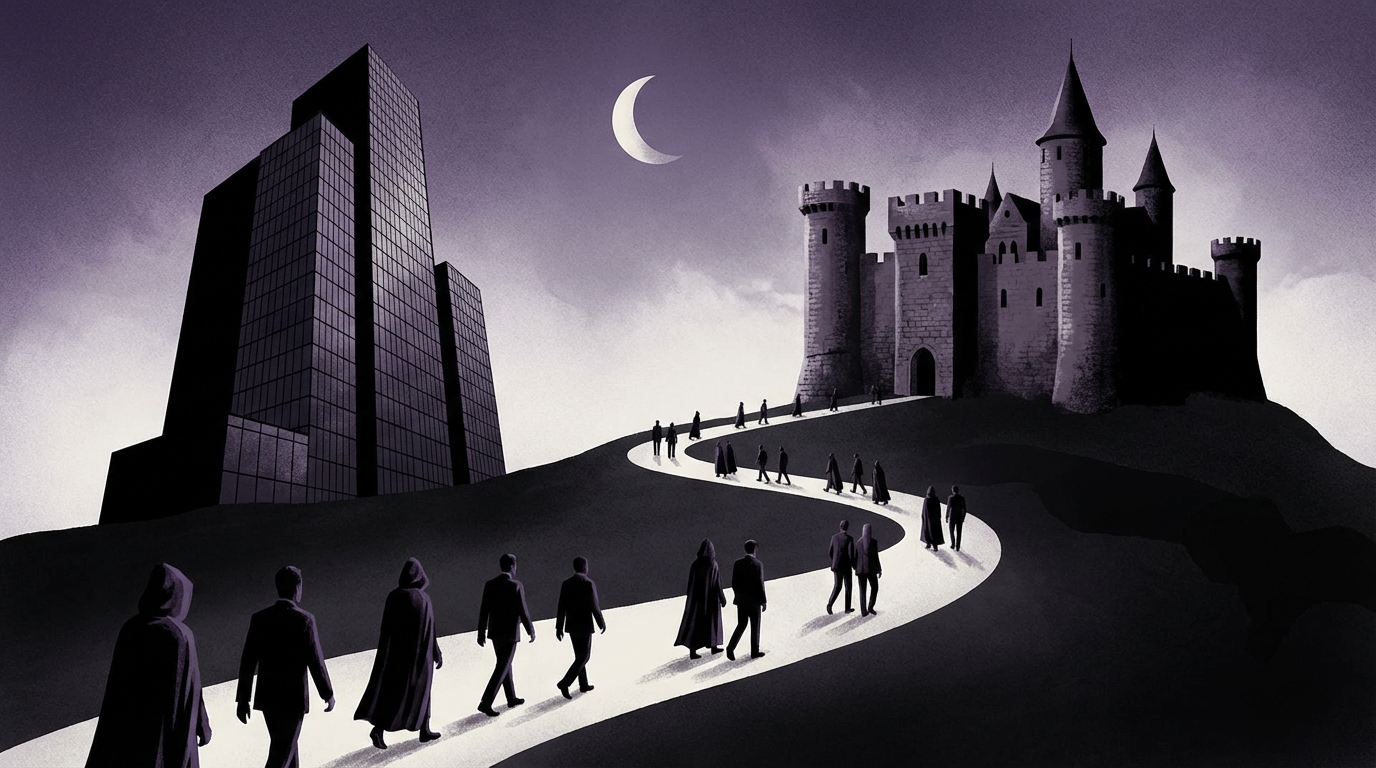

“Capitalism is just modern feudalism with better branding.”
That sounds sharp. It also sounds lazy. It is not true in any careful sense, but it points at something many people feel. Power is concentrating. Wealth is harder to reach. Your boss can feel more like a lord than a peer. So the better question is not “Are we back in feudalism?” but “Where are we drifting toward feudal patterns, and where is that just a bad analogy?”
I might be wrong, but when people say we are moving from capitalism to feudalism, they are usually trying to express a mix of fear and frustration. Wages feel stuck. Housing feels out of reach. A few giant companies seem to set the rules for everyone else. It is tempting to grab the first dramatic phrase that fits that feeling and run with it.
That shortcut is the problem.
Capitalism and feudalism are very different systems. Mixing them up does not help you plan your career, your business, or your investments. It just muddies your thinking and makes you angry without giving you any handle on what to do.
So in this article, I want to walk through what feudalism really was, what capitalism really is, and why people keep claiming one is turning into the other. I will also point out where that claim is on to something and where it becomes misleading. If you care about your own future, that part matters more than abstract theory.
You do not need an economics degree for this. You just need a clear head and a bit of patience with some uncomfortable facts.
What Feudalism Actually Was (Not the Meme Version)
“Feudalism was when peasants worked the land and lords took everything.”
That sentence shows up in a lot of social media posts. It misses most of the structure that made feudalism what it was.
Let me keep it tight and concrete.
Feudalism, in its classic European sense, had a few key features:
1. Land was the main source of wealth.
2. Political power and economic power were tied together.
3. Rights were personal, not universal.
Peasants were often bound to the land. They did not pick employers. They did not move cities for better offers. Their life was mostly decided by birth. A lord had rights over them not because of a contract, but because of tradition, law, and force, all wrapped together.
There was no free labor market in our modern sense. There was service, obligation, and hierarchy. If you refused, the issue was not a broken contract. It was rebellion.
That is harsh, but it is clear.
So when someone says “We are going back to feudalism,” the question is: are we really heading toward a world where:
– Power is inherited.
– Movement is blocked.
– Law mainly protects status, not equal rights.
In some countries, parts of that picture are already visible. In others, it is more of a risk than a reality. Lumping everything together under one dramatic label hides those differences.
What Capitalism Actually Is (Beyond Buzzwords)
“Capitalism is just greed systematized.”
Again, catchy, but off the mark.
Capitalism is not about greed. People were greedy long before stock markets. The system is defined more by how productive activity is organized.
Several traits stand out:
– Most production is done by private firms.
– Most people get income by selling their labor, not by owning land.
– Prices and wages are shaped by markets, not fixed by tradition or central command.
– Law recognizes people as equal in contracts, at least in theory.
You can have more or less regulation. You can have social insurance or almost none. You can have heavy state presence or a lighter one. As long as those basic points hold, you are still in capitalism.
Is capitalism perfect? No. It has cycles, crises, unfairness, and plenty of room for abuse. But it is different from feudalism in structure. That difference matters if you want to change anything in a realistic way.
If you treat capitalism as “modern feudalism,” you skip the hard work of knowing where your leverage points are. You start fighting ghosts.
Why People Say We Are Drifting Toward Feudalism
I do not think most people using that phrase care about medieval history. They are trying to describe patterns they see around them that feel “feudal” in spirit.
Here are a few of those patterns.
1. Extreme Wealth Concentration
When a tiny share of people owns a huge share of wealth, and that ownership starts to look permanent across generations, people see an echo of old aristocracies.
Children of the rich can:
– Buy homes early.
– Get the best schools.
– Take unpaid internships.
– Start companies with family money.
Children of the poor:
– Take on debt.
– Work while studying.
– Have no cushion for failure.
That gap can harden over time. If it reaches a point where birth predicts destiny more than talent or effort, you get something close to a class system. Not full feudalism, but it rhymes in a way that feels unfair.
2. Housing as a Gatekeeper
When housing costs outpace wages for long periods, owning a home shifts from a normal life stage to a kind of membership badge.
Some people end up paying rent to landlords their entire life. That itself is not feudal. The key question is: do they have options?
– Can they move somewhere cheaper?
– Can they realistically buy if they save for years?
– Are there policies that make housing supply responsive?
If those paths close, and you have stable groups of owners vs permanent renters for generations, the mood starts to resemble lord and tenant. Not the same legal structure, but the same feeling of dependence.
3. Corporate Power That Feels Like State Power
When one or two companies dominate a sector, they can:
– Shape wages.
– Set terms of service that act like private law.
– Influence politics through lobbying.
You do not swear loyalty, but you may feel like you do. That is especially strong where one platform controls your social graph, your income stream, and your reputation. One ban or one policy shift can sink your livelihood.
That starts to feel like a private lordship over your economic life.
4. Digital Platforms as “New Land”
“Data is the new oil.”
That line is overused, but replace oil with land in your mind for a second.
In feudalism, whoever controlled the land controlled people. In the digital economy, whoever controls access to users and data has similar leverage. They are the gate for discovery, for search, for distribution.
You can think of:
– App stores.
– Ad networks.
– Search engines.
– Social platforms.
Many creators, small brands, and even local shops feel like tenants on land they do not own. Algorithm changes are their weather. Policy changes are like new taxes.
This is one of the strongest reasons people reach for feudal language. The power imbalance is visible and personal.
Where the “New Feudalism” Claim Goes Too Far
It is easy to stop here and say “See, capitalism has just become feudalism again.” That leap is where the analysis breaks.
Several core differences still hold.
Markets Still Exist and Matter
Under real feudalism, markets were limited and heavily constrained by guilds, charters, and status. Many people could not legally trade or move without permission.
Today:
– You can start a business without being born into a noble family.
– You can switch jobs without asking your lord.
– You can move cities or countries with less friction, even if it is not easy.
Markets may be skewed, but they matter. They create opportunities, especially for those with skills that are in demand. That is not how feudal society worked.
Legal Rights Are Not Tied to Birth (In Theory)
Feudal law treated different groups differently by design. Nobles had rights peasants did not. Clergy had their own courts.
Current legal systems claim equal rights before the law. In practice, rich people can buy better representation and outcomes. Still, the structure is different:
– Contracts can be enforced across class lines.
– Voters, at least on paper, have equal weight.
– You can sue your employer. That was nonsense under feudal relations.
The gap between law in the books and law in practice is real, but the baseline matters when you think about reform or activism.
Workers Own Their Labor, Not Their Lords
This is one of the biggest differences.
Feudal ties were personal and hereditary. If you were born on a certain estate, you might be bound to serve that lord. Leaving without permission could be treated as a crime.
In current systems:
– You have the right to quit.
– You have the right to seek other employers.
– Employers compete, at least in theory, for your labor.
There are issues like non-compete agreements, visa traps, and employer-tied health insurance that erode this freedom. Those are serious. But even then, the starting principle is different from a formal lord-vassal bond.
Blurring these lines makes it harder to target the specific policies that erode freedom.
Why the Feudal Analogy Still Has Some Use
So the claim “we are going from capitalism to feudalism” is false in a strict sense. Still, people keep using it. There is a reason.
It helps name feelings around:
– Dependence.
– Lack of control.
– A sense that the game is rigged across generations.
If you are a gig worker juggling platforms that fix your pay rates, monitor your behavior, and can block you without warning, describing them as “lords” might feel emotionally accurate.
If you are a homeowner renting out properties to people who cannot buy, you might feel like a mini-lord, even if you do not want that role.
The analogy can be a starting point, not an end point. It can prompt real questions:
– Where do we see long-term dependence with little say?
– Where are rights tied to status instead of being universal?
– Where does economic power bleed into unaccountable political power?
If you use the feudal frame to poke at those questions, it can be helpful. If you use it as a catch-all attack on capitalism or business in general, it turns into noise.
From Capitalism To Feudalism: What People Really Fear
“We are not living in late capitalism, we are living in early neo-feudalism.”
You might have seen a line like that on a blog or in a comment thread. Under that slogan, there are some specific fears.
Fear 1: Permanent Class Lock-In
Many people worry their starting point in life is becoming destiny again.
They see:
– Elite schools passing advantages to children of graduates.
– Internship pipelines favoring those who can work without pay.
– Social circles forming around wealth and pedigree.
If you grow up outside those zones, you might feel that no matter how hard you work, you will never “catch up” in wealth or security. That is what class lock-in feels like.
Steps that move a society toward a more feudal pattern include:
– Weak public education and strong private education gaps.
– Estate and inheritance rules that let vast fortunes pass untaxed.
– Zoning and housing rules that keep poor people out of rich areas long term.
Those are policy levers, not fate. Treating them as signs of a grand “return to feudalism” can hide their concrete, fixable nature.
Fear 2: Losing Control Over Work
Capitalism once sold a story: you sell your time, but what you do with your life is still up to you.
Recently, people feel their work is more monitored, fragmented, and unstable.
– Call center workers tracked by the second.
– Warehouse staff guided by scanners for every move.
– Gig workers rated by customers, apps, and algorithms.
That control structure can feel like a digital manor: someone unseen watches, records, and can punish. You work “for yourself,” but the platform owns the terms.
The right lesson is not “we are feudal now,” but “we have let managerial control get ahead of worker rights.” Different problem, different tools.
Fear 3: Private Governance Without Accountability
When large companies run:
– Payment rails,
– Cloud infrastructure,
– The main channels for speech,
their internal rules start to function like private laws.
You can get:
– Deplatformed with unclear appeals.
– Shadow-banned without explanation.
– Priced out by new “fees” that act like taxes.
This feels feudal because it mirrors the idea of a lord’s private justice. The obvious fix is not to scrap markets, but to ask: when do companies become so central that they need democratic oversight similar to utilities or public spaces?
How Close Are We To a “Neo-Feudal” Economy?
To avoid vague talk, it helps to compare some dimensions side by side.
| Dimension | Feudal Model | Current Capitalist Trend | Feudal Drift? |
|---|---|---|---|
| Basis of wealth | Land ownership | Capital, tech, intellectual property, platforms | Partial (platform power echoes land) |
| Mobility | Low, birth-based, bound to estate | Higher, but blocked by money, visas, skills | Risk of decline where costs trap people |
| Legal status | Group-based (noble, serf, clergy) | Formally equal individuals | Drift where money buys different law outcomes |
| Political power | Hereditary, tied to land | Representative systems influenced by money | Drift where lobbying dominates |
| Work relation | Personal obligations, limited exit | Contractual jobs, theoretical free exit | Drift via non-competes, visas, platforms |
| Security | Customary rights, local protection | State welfare, markets, private insurance | Drift where safety nets erode |
| Information control | Local elites, church, slow spread | Global platforms, fast but filtered | New forms of “soft” control |
You can see the pattern. We are not “back” in feudalism. But certain changes can tilt specific dimensions in a more feudal direction if they go unchecked.
How This Affects Your Personal Strategy
If this all stayed at theory level, it would be interesting but not very useful. I think the real value is in how you adjust your own choices.
If power is concentrating around:
– Platforms,
– Large asset holders,
– Credential-heavy gatekeepers,
then you need to think carefully about dependence.
1. Reduce Single-Platform Dependence
If most of your income, traffic, or audience comes from one platform, you are a tenant on land you do not own.
To reduce that:
– Build direct channels: email lists, your own site, maybe a community space you control.
– Diversify platforms: be present where your audience is, but avoid one-point failure.
– Keep copies of your content and contacts: never rely on a platform as your only archive.
You will still depend on systems. Everyone does. The point is to spread that dependence so one private decision cannot upend your life overnight.
2. Understand Asset vs Labor Dynamics
Under feudalism, owning land gave you power over labor. Under capitalism, owning assets (stocks, property, businesses, IP) plays a similar structural role.
If all your wealth is in your own labor, you are more exposed to:
– Job loss,
– Health shocks,
– Automation.
Again, I might be wrong, but most people underestimate how much more fragile a pure-labor position is in a world where wealth concentrates. You do not need to become a landlord or a speculator. But you need a plan for:
– Savings that grow,
– Skills that raise your bargaining power,
– Some share of assets that generate income beyond your hours.
3. Treat Credentials as Tools, Not Identity
Feudal systems tied identity to rank: knight, peasant, cleric. Current systems risk doing something similar with elite schools, brands, and corporate titles.
If you lean too hard on:
– Company names,
– School names,
– Job titles,
you may lock yourself into a track that depends on gatekeepers to renew your status.
Better approach:
– Focus on skills that transfer between employers and sectors.
– Build a public body of work: content, code, projects, case studies.
– Grow a network that is not limited to one company or school.
That way, if part of the structure shifts in a more feudal direction, your personal exposure is lower.
What Policy Choices Move Us Away From Feudal Patterns
I know you asked for a general blog tone, not policy advocacy. Still, saying “we are going from capitalism to feudalism” is partly a political claim. It is fair to ask: what moves us in the other direction?
A few levers matter a lot.
Tax and Inheritance Rules
If large fortunes can pass through generations with almost no friction, the logic of birthright strengthens.
Policies that limit extreme dynastic wealth do not kill capitalism. They shape its long-run structure so that:
– Wealth can still form,
– But it does not harden into an untouchable hereditary class.
Ignoring this topic while worrying about “new feudalism” is a mismatch.
Housing Supply and Zoning
Locked-in housing shortages raise prices, which:
– Reward current owners,
– Trap renters,
– Freeze mobility.
That slide looks more like a feudal order than a free one. Easing rules around building, improving rentals, and expanding transit all weaken feudal-style local control.
If you live in a city with high rents and strong neighborhood resistance to new housing, you are watching a key piece of “neo-feudal” drift play out right there.
Competition and Antitrust Policy
When companies grow so large that they are gatekeepers for markets, they start to act like lords over their sectors.
Tools that limit monopolistic behavior:
– Keep entry routes open for new firms.
– Reduce dependence on a few private platforms.
– Make labor markets more competitive.
If you care about avoiding feudal-style power concentrations, you cannot ignore this area.
Stronger Worker Protections
Feudalism relied on weak, dependent peasants. Capitalism can tilt in that direction if workers have:
– Little bargaining power,
– No security,
– Many legal constraints on exit.
Improving:
– Collective bargaining rights,
– Health care access outside employment,
– Rules around non-compete clauses,
can keep the labor market closer to a free system than a bound one.
How to Think More Clearly Than “Capitalism vs Feudalism”
The core risk in the “from capitalism to feudalism” line is that it turns a range of specific issues into a vague story about system collapse. That might feel sharp, but it does not guide action.
Here is a cleaner frame.
| Question | Bad Feudal Framing | More Useful Framing |
|---|---|---|
| Housing is too expensive | “Landlords are new lords” | “What rules block supply and fair tenancy?” |
| Platform risk | “Big Tech is feudal overlords” | “Where do we need standards, portability, or limits on dominance?” |
| Wealth gaps | “Billionaires are new nobility” | “How do we balance incentives with limits on dynastic power?” |
| Work surveillance | “Workers are digital serfs” | “What rights to privacy and autonomy should exist on the job?” |
| Education gaps | “Elite schools are feudal courts” | “How do we widen access and build alternative paths?” |
The second column vents. The third column helps.
Where You Might Be Taking a Wrong Turn in Your Own Thinking
If you are drawn to the phrase “from capitalism to feudalism,” you might be making one of these mistakes. I say this gently, but directly.
Mistake 1: Treating Systems as Monoliths
You might talk about “capitalism” like it is one uniform thing. In practice, different countries run different versions, with different outcomes.
– Nordic models vs more laissez-faire models.
– Strong unions vs weak unions.
– Strong safety nets vs fragile ones.
You can change those parameters without scrapping markets or property rights. If you call the whole thing “feudal,” you erase that space for improvement.
Mistake 2: Confusing Anger With Clarity
Anger is understandable when life feels stuck. But anger is not a map.
If you jump straight from feeling trapped to sweeping historical claims, you risk picking the wrong battles.
For example:
– Blaming “capitalism” for local zoning rules that restrict housing.
– Blaming “feudalism” for student debt structures tied to specific policies.
– Blaming “the system” for issues that come from a narrow group of decision makers.
Naming the wrong cause keeps you stuck longer.
Mistake 3: Romanticizing the Past or the Future
Some people talk about a move from capitalism to feudalism as if:
– There was once a pure, fair capitalism that is now gone, or
– There will be a complete collapse that resets everything.
Both stories skip over messy details. What you have instead is a constant tug-of-war:
– Between concentration and diffusion,
– Between privilege and merit,
– Between security and risk.
Your choices and votes influence where that tug-of-war lands. There is no automatic script that takes you straight back to serfs and lords.
Practical Questions To Ask Yourself Right Now
To bring this down to a personal level, step away from “capitalism vs feudalism” and ask things you can act on.
1. Where am I overly dependent on one gatekeeper?
This could be:
– A single employer,
– One platform,
– One client,
– One landlord.
If that entity removed you tomorrow, how exposed would you be? If the answer is “very,” you are in a tenant position. Plan small moves to reduce that exposure.
2. Am I building any ownership, or only selling time?
This does not mean you must buy property or stocks right away. It can also mean:
– Skills that compound over time,
– A network that gives future options,
– Projects that build reputation beyond a current job title.
Over years, these forms of ownership matter as much as financial ones.
3. Do I understand the rules that shape my constraints?
Instead of saying “the system is feudal,” ask:
– Which law or policy affects my housing options?
– Which platform terms affect my reach or income?
– Which practices at my employer affect my stability?
If you cannot name those, your picture of the problem is still too abstract. Start by learning the real constraints before attaching a historical label to them.
Why the Title “From Capitalism To Feudalism” Still Has Some Use
You titled the post “From Capitalism To Feudalism” for a reason. It grabs attention. It expresses a real worry: that freedom and opportunity are shrinking, and that power is freezing at the top.
Used carefully, the phrase can act like a spotlight:
– On forms of dependence that feel unfair,
– On new hierarchies that hide behind neutral-sounding language,
– On the gap between legal equality and real power.
Used loosely, it turns into a fog machine. Everything starts to look like feudalism, which means nothing does.
So if you keep that title, pair it with precision in the body:
– Name which features of feudalism you mean.
– Point to where those features appear in current systems.
– Be honest where the analogy fails.
That balance respects your reader more than a one-note rant.
“We are not condemned to repeat history, but we are very good at repeating patterns when we do not name them clearly.”
Capitalism is changing. Power is shifting. You are not wrong to feel uneasy. The risk is not that we wake up one day and find ourselves legally back in the 13th century. The risk is that step by step, we accept more dependence, more inherited advantage, and more unaccountable power, while telling ourselves it is just how things are now.
Seeing where that pattern overlaps with feudalism can sharpen your insight. Saying we are already in feudalism only dulls it.
