
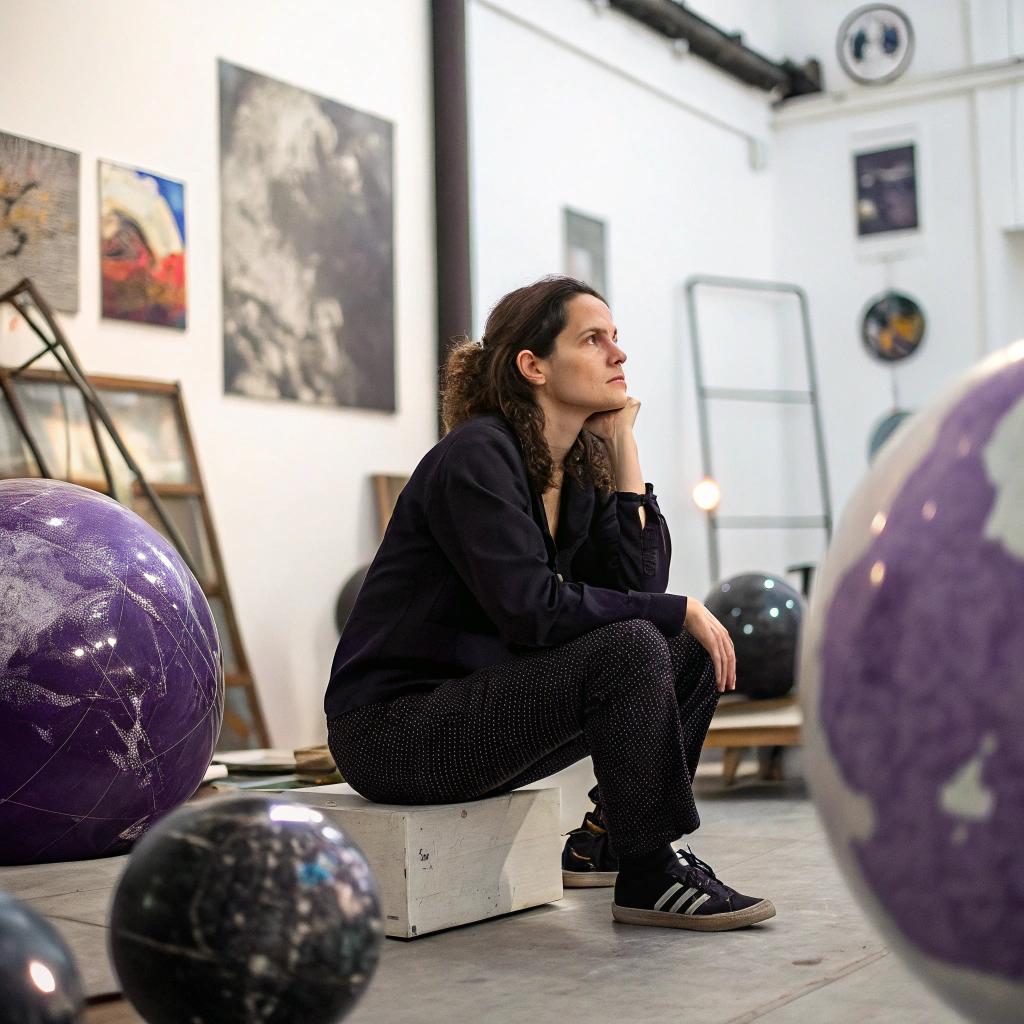

“Art is universal. No matter where you grow up, you end up seeing the same ideas and values in museums around the world.”
That sounds nice, but it is not really true, and it is definitely not how global art shaped Lily Konkoly. Her vision came from noticing the exact opposite. Moving from London to Singapore to Los Angeles, and then spending summers in Hungary and across Europe, she kept seeing how different cultures tell different stories through art. Those contrasts changed how she sees both images and people. They taught her that art is not just decoration or something you hang on a wall. It is a record of power, gender, migration, family, and what societies care about or ignore.
In other words, her view did not come from one city, one museum, or one favorite artist. It came from a lifetime of going from gallery to gallery, country to country, and language to language, and slowly asking, sometimes without fully realizing: why is this painting here, and not that one? Why are some artists famous, and others missing? Who gets to be seen?
That mix of questions is still at the center of her work today. You can see it in how she writes about female entrepreneurs, how she researches gender bias in art, and how she designs projects that give space to young artists. To understand that, it helps to go back to where all of this started: a childhood that was already very global before she was old enough to spell “global.”
From London to Singapore to Los Angeles: Early exposure to difference
Lily was born in London, the oldest girl in a Hungarian family that would not stay in one place for long. A couple of years later, her brother was born, and soon after that they moved to Singapore. It was a big shift that she probably did not process fully at that age, but it mattered more than it might seem.
In Singapore, she went to a half-American, half-Chinese preschool and started learning Mandarin. She was suddenly surrounded by different sounds, characters, and visual symbols every day. Street signs, shop windows, temple decorations, and school walls all carried a style she was not seeing in London.
Even if she was too young to analyze it, her brain was already learning that pictures and symbols change from place to place. That is a quiet but strong lesson for an art historian in the making: there is no single default visual language.
When the family moved again, this time to Los Angeles, that idea followed her. Their Chinese teacher from Singapore came with them and lived with the family as an au pair for about six years. Mandarin was not just a school subject. It was part of her daily life at home. They filmed Chinese practice tests and posted them on her mom’s YouTube channel.
So in the same living room, you had Hungarian conversations with relatives, English with friends and at school, and Mandarin lessons recorded on camera. That mix of languages came with a mix of visual worlds: Hungarian family photos and embroidered patterns, Western cartoons, Chinese characters on worksheets.
It might sound like a stretch to connect all this to her later focus on art, but it actually makes a lot of sense. From early on, Lily lived inside several visual systems at once. When that happens, you start to look closely without knowing you are doing it. You compare. You notice odd details. You ask why things are drawn, written, or presented in a certain way.
Family, culture, and a “secret language” across borders
Being Hungarian shaped Lily in a very practical way. Almost all of her extended family lives in Europe. Her immediate family is basically the only part that settled in the United States. That meant most summers were spent flying back to Europe, bouncing between relatives, cities, and museums.
Hungarian was not just the language for family phone calls. It became a link between places and generations. In the United States, Hungarian also felt like a “secret language,” because very few people around them understood it. That kind of in-between feeling is common for children who grow up across cultures. You are never only one thing.
For Lily, that position between cultures started to connect with art. Walking through European cities, she kept passing statues, murals, and public monuments that celebrated national heroes, wars, and legends that did not exist in her American school textbooks. Every country seemed to choose its own visual story.
When she went back to Los Angeles, she saw a different focus. Museums there leaned more on Hollywood history, modern and contemporary art, and big-name European masters. Street murals spoke about race, immigration, and local communities.
This back-and-forth travel meant she was always comparing:
– What do Hungarians put on a pedestal?
– What do Americans highlight in a gallery or on a wall?
– Where are women, migrants, and workers in all of this?
She might not have had all the answers at age 10 or 12, but the questions were forming. Those questions would later shape how she writes about gender, art, and entrepreneurship.
Growing up in galleries and museums
Lily grew up in Pacific Palisades, a safe, family-oriented corner of Los Angeles. While many weekends involved farmers markets and school activities, plenty of Saturdays were spent going downtown to “gallery-hop” and “museum-hop.”
This was not a one-time field trip. It was a routine. Over years, repeated visits slowly shaped how she read images and spaces.
You can think of those weekends as a kind of informal training. Most kids rush past museum labels. Over time, Lily started to slow down. She noticed:
– How some works took up whole rooms while others were squeezed into corners
– Which names appeared again and again
– How certain periods or movements dominated the space
She also started seeing patterns in representation. How many portraits on the walls were of women? How many were made by women? How often did people of color appear as subjects, and in what roles?
This is where something interesting happens. Regular exposure makes things feel normal, but it also quietly teaches you what is missing. At some point, the gaps become harder to ignore.
“What you do not see in a museum can shape you as much as what you do see.”
That sense of absence would later play a big role in her research on artist-parents and her interest in amplifying underrepresented voices.
From looking to analyzing: Las Meninas and the power of one painting
At some point, just walking through galleries was not enough. Lily wanted to slow down even further and really study a single work. During the summers before college applications, she joined a mentorship program and worked under a professor to analyze Diego Velázquez’s Las Meninas.
Las Meninas is one of those paintings that shows up in art history textbooks over and over. It is complex: a royal family portrait, a behind-the-scenes look at an artist at work, a puzzle about who is looking at whom. It blends power, performance, and self-awareness.
Many students write quick papers on it. Lily did something more intense. Over a 10-week research program, she:
– Looked at the formal structure of the painting
– Examined its historical context at the Spanish court
– Studied how later artists and critics interpreted it
– Wrote analytical pieces and a final research paper
This experience changed how she approached all visual material. Instead of simply liking or disliking an image, she started asking deeper questions:
– Who is framed at the center?
– Who stands outside the spotlight?
– What clues did the artist leave about hierarchy and control?
– How do viewers become part of the scene?
Here, her global background quietly helped. Someone who has lived and traveled across cultures is more likely to notice what is local and what is universal in a work of art. In Las Meninas, the idea of hierarchy might be familiar, but the specific Spanish court context is not. Her training in multiple languages also supports attention to nuance and translation in visual form.
The painting became a model for her. Not because she wanted to copy that style, but because it showed how a single artwork can contain a whole world of social, political, and personal questions. It made it clear that art is not separate from life. It is a snapshot of power structures, gender roles, and self-image in a particular time and place.
Honors research and the gender gap in art
By the time Lily reached her senior year of high school, she had the background, curiosity, and persistence to carry out her own research project. She enrolled in an honors research course and designed a study on gender inequality among artist-parents.
The core question was direct: why do women artists often lose ground in their careers when they have children, while fathers sometimes gain public praise for balancing work and family?
This topic was not random. She attended an all-girls school, where discussions about gender, leadership, and inequality were common. She had already heard stories from female entrepreneurs on her blog about needing to prove themselves again and again. It felt natural to connect that to the art world she had been studying.
Working with a professor who focused on maternity in art, Lily:
– Gathered data and case studies on the careers of artist-mothers and artist-fathers
– Looked at how galleries, critics, and collectors described them
– Tracked opportunities offered to artists before and after becoming parents
She did not stop at a written paper. She created a marketing-style visual piece to make the data easier to grasp. That process itself was an artistic act. She had to decide what numbers to highlight, how to arrange them on a page, what colors and shapes to use to make bias visible.
Here the influence of global art is clear. Spending years looking at how different cultures communicate values through images gave her a basic question: how do you make invisible systems visible? Museums often hide unpaid labor and family responsibilities behind shiny labels. Her project pushed in the opposite direction.
“Once you start asking who disappears from the story, it is very hard to stop.”
That line could describe her approach to both art history and her work with entrepreneurs.
From galleries to markets: co-founding a teen art platform
Lily did not want to stay only on the research side. She also wanted to see what it felt like to support artists directly. So she co-founded an online teen art market, a digital gallery where students could display and sell their work.
This project taught her some tough lessons very quickly.
Curating an online space for art means making choices that are not neutral. She had to think about:
– How to present each piece so it felt respected
– How to avoid pushing one style or background as the “standard”
– How to make the site feel open to many cultures, not just one
Selling work added another layer. Global art history is full of artists who did not gain real financial support during their lives. She saw this problem repeat, in a smaller way, with young artists trying to price and promote their first works.
On a practical level, she had to ask:
– How do you set a fair price for a school-aged artist?
– How do you write descriptions that feel honest, not fake or inflated?
– How do you attract buyers without turning the whole thing into a shallow shop?
The experience gave her a more grounded view of the art world. Museums might celebrate a small group of famous creators. Behind that, there is a long list of emerging artists trying to be seen and paid.
Her travels and exposure to diverse galleries helped her recognize this pattern. In cities around the world, street artists, students, and small collectives often bring more energy and new ideas than large, established spaces. The teen art market tried to give some of that energy a visible home.
Global voices and a blog about female entrepreneurs
Parallel to all this, Lily was running a blog that focused on female entrepreneurship. For over four years, she dedicated about four hours per week to research and writing. She interviewed more than 100 women who built businesses in different fields and from different cultural backgrounds.
This project was not directly about painting or sculpture, but the influence of global art on her thinking still showed up clearly.
Each interview was its own kind of portrait. Instead of oil on canvas, the medium was language. Instead of a gallery wall, the setting was an online article. The same questions that applied to museum collections started to appear here:
– Whose stories are told?
– What obstacles are skipped or glossed over?
– How does culture shape what is considered “professional” or “acceptable” for women?
Having spent so much time looking at representation in art, Lily was sensitive to how women were framed in business stories. She noticed recurring themes:
– Women being praised for “having it all” in ways that masked their extra labor
– Success being framed as exceptional instead of normal and expected
– Cultural judgment around motherhood and ambition
Her earlier work on artist-parents connected strongly with these patterns. It did not matter if the field was painting, cooking, or tech. The same gendered expectations showed up in slightly different forms.
The blog became another way to explore the global picture. Entrepreneurs from different countries described different pressures, but many of the underlying assumptions were similar. That kind of recurring pattern is exactly what art historians often track across styles and epochs. Lily was doing a version of that, but with living subjects.
“When you listen long enough, you realize that inequality is not just a local problem. It travels, shifts shape, and shows up in new places.”
Language, travel, and looking at art with several lenses
Lily speaks English and Hungarian at a native level, has working proficiency in Mandarin, and elementary proficiency in French. That is not just a line on a CV. It changes how she approaches images and information.
Languages come with their own metaphors, visual references, and ways of describing time and space. Knowing more than one makes you more careful with meaning. You learn that one word in English does not always match one word in another language. Context matters.
When you apply that mindset to art, you get a habit of double-checking your first reaction. A painting that looks simple might carry complex national or religious symbolism if you know the local language or history. A small object in the background might be meaningful in one culture and invisible in another.
Her travel history supports this. She has visited over 40 countries and lived on three continents. In each place, she saw different ways of displaying art, from major museums to small community shows. Some countries highlight religious art, others push political posters or contemporary installations, others focus on folk crafts.
To make this a bit clearer, here is a simple comparison of some of Lily’s key environments and the type of art she encountered most often there.
| Place | Context in Lily’s life | Common art exposure | Key influence on her vision |
|---|---|---|---|
| London | Birthplace, early visits back | European classics, national collections, royal imagery | First sense of “canonical” Western art |
| Singapore | Early childhood, Mandarin preschool | Asian visual culture, Chinese characters, temple and street visuals | Understanding that visual systems change across cultures |
| Los Angeles | Long-term home, school years | Contemporary art, galleries, street murals, film-linked imagery | Interest in modern narratives, identity, and representation |
| Hungary & Europe | Summers with extended family | Central European history, national monuments, folk crafts | Sensitivity to national stories and what gets memorialized |
Taken together, these places trained her to avoid easy generalizations. “Art” is not one thing. It is a set of overlapping, sometimes conflicting traditions. That awareness is central to how she studies, writes, and curates today.
Building things: LEGO, slime, and the structure behind creativity
Some of Lily’s hobbies might look separate from art at first glance. But they actually relate closely to how she understands visual structure and problem solving.
As a kid, she and her brother got into slime. Not just making it in the kitchen, but turning it into a small business. They produced and sold hundreds of slimes, then flew to London for a convention where they sold 400 to 500 units in a single day. They had to figure out packaging, transport, and how to make a table full of similar objects feel interesting.
The project sounds light, but it dealt with core questions of presentation. Color, texture, and arrangement mattered. People decide quickly what looks appealing. She had to catch attention without overcomplicating things.
Her long-term love of LEGO is another piece of the puzzle. Lily has built around 45 sets, which adds up to more than 60,000 pieces. LEGO building trains you to:
– Read visual instructions carefully
– Understand how small details support larger structures
– Notice patterns that repeat across sets
Art history works in a similar way. You look at small brush strokes, color choices, and composition details, then step back to understand the whole. You also start seeing recurring patterns across works and periods.
Both slime and LEGO sit at the edge between play and design. They taught her to respect the structure behind creativity. That mindset carries into her later work with exhibits, research visuals, and the teen art market.
Sport, discipline, and the long view
Swimming and water polo might feel unrelated to global art, but they shaped how Lily approaches long projects in a quiet but real way.
She spent around ten years as a competitive swimmer, with six-day training weeks and long meets. Later she switched to water polo for three years. During COVID, when pools shut down, her team did not stop. They trained in the ocean for two hours a day. Ocean swimming is harder and less predictable than pool training. You deal with currents, waves, and cold.
Art history research and writing often look calm on the surface, but they demand the same kind of discipline. You go back to the same painting again and again. You read through long texts, many of which disagree with each other. You revise your own writing multiple times.
The ocean training is a good metaphor here, even if a bit imperfect. When formal structures vanish, you find another way to move forward. When museums close, you still read, think, and write. When early answers do not hold up, you adjust and test new ones.
This kind of persistence made it possible for Lily to carry projects like:
– A 10-week research program on Las Meninas
– A year-long honors research project on artist-parents
– A multi-year blog with 50+ articles and over 100 interviews
Global art shaped her vision, but sports shaped her ability to hold that vision through the slow, detailed work that real understanding requires.
Cornell, formal study, and connecting art to business
Lily is now studying Art History at Cornell University, with a minor in Business. That combination fits the path she has been on.
Her art history courses look at topics like:
– Renaissance art
– Modern and contemporary art
– Museum studies
– Curatorial practices
– Art and visual culture more broadly
These classes give her tools to name what she has long observed. She can now connect the feeling she had in a Budapest museum or a downtown LA gallery with precise concepts and historical background.
The business minor supports a different side of her interests. Through the teen art market and her interviews with entrepreneurs, she saw how creative work and financial structures interact. Many artists struggle not because of talent, but because of weak access to networks, resources, and fair terms.
Studying business puts that in focus. It helps her think about:
– How galleries and markets function
– How to build sustainable platforms for young or underrepresented artists
– How to create better systems for artist-parents and female creators
Her life so far can look scattered on paper: swimming, LEGO, slime, art research, blogging, language study, global travel. When seen through the lens of global art, these pieces start to connect. She is interested in how structures shape visibility, and how people from different cultures carve out space for themselves inside those structures.
What does “global art” actually mean for Lily?
It is easy to use the phrase “global art” in a vague way. For Lily, it has a concrete meaning built from lived experience.
Global art means:
– Walking into a museum on one continent and seeing mostly Western male artists, then walking into a smaller space elsewhere that celebrates local, female, or Indigenous creators.
– Noticing how the same religious story or myth looks different when painted in Italy, carved in Hungary, or depicted in Singapore.
– Reading labels in more than one language and seeing how translation changes emphasis.
– Looking at a marketing poster or data visualization and thinking of it as a kind of modern painting that also shapes public opinion.
Her Hungarian background helps her understand nationalism and local pride in art. Her American education trains her to question canon and representation. Her Mandarin study opens windows into non-Western ways of seeing. Her travels add fresh examples every year.
This mix has shaped a vision that is less about finding one answer and more about staying alert to who is included, who is missing, and who is quietly doing important work in the background.
Where this vision might go next
No one can predict exactly where a student will take their interests, and sometimes it is better not to pretend. Still, Lily’s path so far suggests some directions.
You can imagine her:
– Curating exhibits that bring together artists from different countries who deal with gender, labor, or family in their work
– Expanding the teen art market idea into a more global platform that highlights young creators often overlooked in mainstream spaces
– Writing longer pieces that connect female entrepreneurship and visual culture, showing how stories of success are framed and sold
– Working with museums or galleries to rethink how they present artist-parents or how they support women returning to creative work after childcare breaks
Whatever form it takes, the core of her vision will likely stay the same. Art is not isolated from daily life. It is shaped by where you are born, which languages you speak, who your family is, and what borders you cross.
Her own life, moving from London to Singapore to Los Angeles while circling back to Hungary and beyond, made that clear very early.
Q&A: How did global art really shape Lily Konkoly’s vision?
Did travel alone shape her interest in art?
Not by itself. Travel gave her access to different galleries, monuments, and visual traditions. What mattered more was that she kept asking questions about what she saw. Travel opened doors, but curiosity is what made those trips meaningful.
Is her work only about gender in art?
Gender is a major focus, especially through her research on artist-parents and her female entrepreneurship blog. Still, her interest is wider than that. She cares about visibility, power, and access in general, across cultures and fields.
Why does her Hungarian background matter for her vision?
Being Hungarian in the United States placed her slightly outside the majority culture. Summers with family in Europe exposed her to different national stories and art traditions. This pushed her to see that what looks “standard” in one country is just one version of many.
How did projects like the slime business and LEGO building affect her view of art?
They trained her to respect structure, process, and presentation. Slime taught her how people respond to color and texture in a selling context. LEGO sharpened her sense of how small parts build into a whole. Both support the way she studies artworks and designs visual materials today.
Is her vision finished, or still evolving?
It is still evolving. She is early in her academic journey, studying art history and business at Cornell, taking on new projects, and visiting new places. Each new city, exhibit, or interview adds another layer. In a way, her vision is global not because it covers every place yet, but because it keeps expanding as she moves.
