
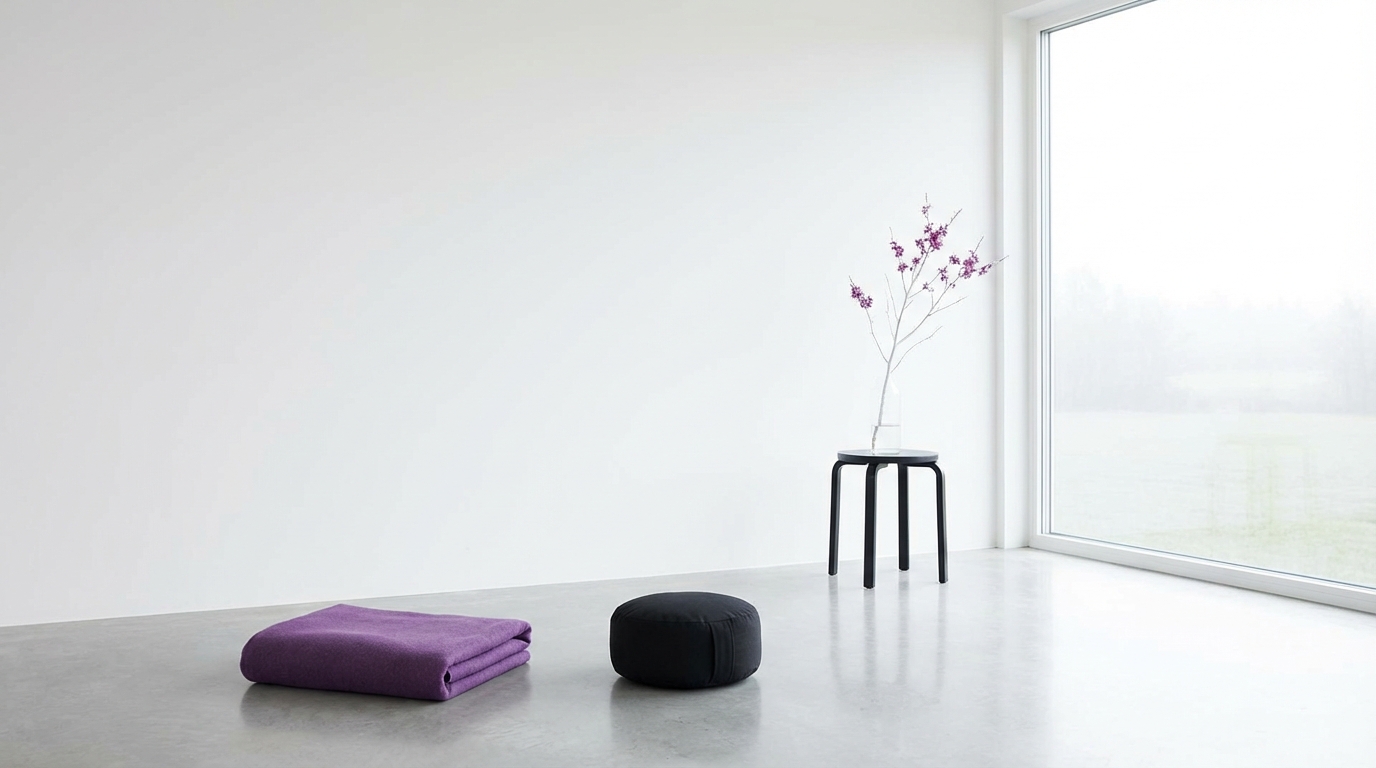

“Minimalism is about owning almost nothing and living in a white, empty room.”
That quote sounds dramatic. It is also wrong. Real minimalism, especially for beginners, is much more about what is going on in your mind than about how many shirts are in your closet. If your goal is to declutter your mind, you do not need a perfect capsule wardrobe. You need fewer mental tabs open. Fewer worries on loop. Less noise. That is the whole game.
When people ask me how to get started with minimalism, they often want a checklist of items to throw away. It feels concrete. Tidy room, tidy mind, right? Sometimes that helps. Sometimes it just turns into another project that eats your time and attention. If your brain still feels crowded after you declutter your desk, there is a reason. The clutter was never only physical.
So I want to flip the usual script. Physical stuff matters, but your mental environment comes first. If your thoughts are scattered, if your calendar is packed, if your phone is calling you every 3 minutes, no closet clean-up will fix that. I might be wrong, but I have seen this pattern over and over: people clean their space, feel better for a week, then slide back into the same stress because the internal habits did not change.
Minimalism for the mind starts with one question: “What can I remove that does not need to be here?” Not “What can I add to feel better?” Not a new app, not a new planner, not a new system. Removal. Subtraction. Taking things off your plate until you can actually breathe.
That can feel weird, even a bit uncomfortable. We are used to adding. More tools. More tips. More content. Yet the mind does not need more. It needs space. Space to rest, to focus, to notice what is actually important to you instead of reacting to everything that pops up.
You might already feel some resistance. Thoughts like: “If I do less, I will fall behind” or “If I say no, I will disappoint people.” That tension is exactly where mental clutter hides. It is not just the number of tasks, it is the emotional weight you carry about those tasks. Minimalism for beginners is as much about expectations as it is about objects.
So in this guide, I want to walk through practical ways to declutter your mind, starting with your attention, your calendar, your digital life, and your environment. Not to turn you into a minimalist guru. Just to give you a calmer, clearer baseline so you can think and live more deliberately. If that sounds vague, stay with me. We will get concrete, step by step.
“Once my house is minimal, my mind will finally be calm.”
That idea has a small slice of truth. A clear space often supports a clear head. But it is not a one-way street. A cluttered mind recreates clutter around it, even after you clean up. So if you want change that lasts longer than a weekend, you start inside.
What mental clutter actually is
Let me define mental clutter in simple terms. Mental clutter is everything in your mind that:
– You keep revisiting without making progress.
– You do not really need to hold onto.
– You have not decided about, so it loops.
This includes:
– Unfinished decisions: “Should I change jobs?” that lives in your head for months.
– Loose ends: tasks you mean to do, but never schedule.
– Information overload: too many articles, videos, and opinions in your head.
– Emotional carryover: old grudges, regrets, and “what if” scenarios.
– Constant self-criticism: that inner voice that reviews every mistake in detail.
You do not need a diagnosis for this. If your brain feels “full” and scattered, if you struggle to focus on one thing at a time, you are already feeling the cost.
The mind has limited working space. When that space is crowded, your stress rises, your patience drops, and your decisions get weaker. You might notice that you scroll more, snack more, or avoid the hard tasks, simply because you are tired before you even start.
So if you want to declutter your mind, you work with these sources of clutter directly. Less rethinking the same worries. Fewer open loops. Cleaner inputs. Gentler self-talk.
“My mind is just like this. I cannot change how I think.”
I do not buy that. There are limits, of course. If you live with anxiety or depression, things can feel especially heavy, and professional help makes a real difference. Still, within those limits, your mental habits are trainable. Not overnight. Through small, repeatable changes.
The 3 pillars of mental minimalism
To keep this grounded, I like to group mental minimalism into three pillars:
1. Attention: where your focus goes.
2. Commitments: what you agree to do.
3. Inputs: what you let into your mind.
You can think about them like this:
– Attention is your daily lens.
– Commitments are your ongoing “open files.”
– Inputs are the raw material your brain has to process.
If you clear out even one of these areas, you feel a shift. Tackle all three and your mental world starts to feel lighter in a very real way.
Here is a simple table to keep these pillars straight:
| Pillar | Main question | Common clutter source | Simple starting move |
|---|---|---|---|
| Attention | What am I focusing on right now? | Task-switching, notifications | Turn off non-urgent alerts for 24 hours |
| Commitments | What have I agreed to carry? | Too many projects, vague “maybes” | List all projects and drop at least one |
| Inputs | What is flowing into my mind? | News, social feeds, email overload | Set 2 fixed times for checking messages |
Let me unpack each pillar and show you how to declutter them without turning your life upside down.
Decluttering your attention
Mental minimalism starts with attention, because attention is the front door of your mind. Every notification, every conversation, every “quick check” of your phone is a knock on that door.
If your attention is constantly pulled in different directions, your brain has to reset over and over. That reset cost feels small in the moment, but it adds up. You feel “busy” all day while getting less real work done. That drives stress. You can sense something is off, but you cannot quite see the leak.
There is research on this, but you do not need the studies. Just try to read a dense article while checking your messages every two minutes. You will feel the drag.
Step 1: Turn down the noise
Before you try fancy focus methods, start with the noise level:
– Put your phone on “Do Not Disturb” during one chosen block of time.
– Turn off notifications from social apps and non-urgent email.
– Move your phone out of reach while you focus on one task.
Aim for one honest hour of reduced noise. Not a full day. One hour.
You might think: “That is too small to matter.” It is not small. It is the first time your mind gets to see what focus feels like again. Once you taste that, you can extend it.
Step 2: Focus on one thing at a time
Single-tasking sounds simple. It is not easy if you are used to switching. But it is the core of mental minimalism.
A practical way to start:
1. Pick one clear task you can describe in one line.
2. Decide how long you will give it (for example, 25 minutes).
3. Remove other tabs, tools, and tasks not needed for this.
4. Work on only that task until the time is up.
If another idea pops up, do not fight it. Jot it down on paper and return to the main task. That brief note tells your brain “I heard you, we will handle this later.” With practice, the urgency of those side thoughts eases.
Step 3: Create a simple daily focus ritual
You do not need a huge morning routine. Just a short check to ask: “What are the 1 to 3 things that actually matter today?”
Try this:
– In the morning, write down up to 3 “must-do” tasks for the day.
– Put a star next to the single most important one.
– Block the first deep-focus window you can for that task.
Compare that to a long to-do list with 18 items. The long list feels productive but spreads your attention. A short, honest list forces you to choose. That choice is mental minimalism in action.
Here is a quick comparison:
| Long scattered day | Minimalist focus day |
|---|---|
| Check email first thing | Pick top 1 to 3 tasks before email |
| Switch between 5 tasks | Work in blocks on one task |
| Respond to every notification | Batch responses at set times |
| Go to bed with open loops | Review day and park tasks for tomorrow |
If this feels restrictive, remember: you are not taking away freedom. You are removing random distractions so you can actually follow your own priorities.
Decluttering your commitments
Attention is about the moment. Commitments are about the ongoing load. Together, they shape your inner world.
Mental clutter grows when you say “yes” faster than your life can handle. That is how you end up with:
– Half-finished projects.
– Social plans you secretly dread.
– Work tasks you accepted even though you did not have time.
– Personal goals that float around with no timeline.
Each commitment takes mental energy, even when you are not working on it. Your brain stores it as “something we should not forget.” With enough of these, your background stress never fully drops.
“I just have to get through this busy period, then it will calm down.”
Sometimes that is honest. More often, that “busy period” stretches out for years. If you feel like you are always catching up, your real issue is not time management. It is over-commitment.
Step 1: Do a commitment inventory
You cannot declutter what you have not seen. So start with a simple inventory. Grab a notebook or a blank document and write down:
– Every ongoing work project.
– Every personal project (health, home, learning, side business).
– Regular responsibilities (family, community, recurring meetings).
– Self-imposed goals (daily habits, challenges, courses).
Do not worry about perfect categories. The point is to see the full picture in one place. You might feel nervous doing this. That discomfort is useful. It shows how much you have been trying to carry in your head.
Step 2: Label, then cut
Next to each item, add two labels:
1. Importance: High / Medium / Low.
2. Timing: Now / Later / Never.
Be honest with yourself. A project can be meaningful and still belong in “Later.” Some goals were never truly yours and belong in “Never.”
Then, make three moves:
– Drop at least one “Low / Never” item entirely.
– Move at least two “Medium” items into “Later” with a concrete date to review (for example, in 3 months).
– Choose one “High / Now” project to make your main focus for the coming weeks.
You might resist dropping anything. You might think, “But I already started.” That is sunk cost. Keeping an unwanted project alive just to avoid feeling waste is exactly how mental clutter grows.
Step 3: Practice saying honest no’s
Minimalism for the mind needs one skill: saying “no” or “not now” without guilt swallowing you whole.
A simple script can lower the friction. For example:
– “I do not have the capacity to take this on and still do my current work well.”
– “I appreciate the invite, but I am keeping my schedule light this month.”
– “I cannot commit to that, but I hope it goes well.”
You do not have to over-explain. You are allowed to protect your time and attention.
Here is a useful table of “mental clutter” replies vs “minimalist” replies:
| Cluttered reply | Minimalist reply |
|---|---|
| “Maybe, let me think about it.” | “Thank you, but I have to say no.” |
| “I will try to squeeze it in.” | “I do not have room for this right now.” |
| “I am busy, but I guess I can.” | “I am keeping my plate light, so I will pass.” |
If you currently say “yes” by default, this will feel harsh at first. Over time, you realize you are making space for what you already said matters.
Decluttering your inputs
The third pillar is what you allow into your mind every day. If attention is the door, inputs are the visitors. Some visitors are welcome. Many are not.
Think of:
– Social media feeds.
– News cycles.
– Group chats.
– Email lists.
– Endless online articles and videos.
There is no need to treat any of these as evil. The mind just cannot process all of them constantly without getting overloaded. Minimalism here means being more selective and more deliberate.
Step 1: Audit your daily inputs
For one day, keep a simple log. Every time you consume content for more than a minute, note:
– What it was (for example, “Instagram,” “news site,” “YouTube,” “podcast”).
– Rough time spent.
At the end of the day, ask three questions:
1. What gave me real value or joy?
2. What left me more anxious, distracted, or tired?
3. Where did I go out of habit more than choice?
You might notice that a small set of sources give you the most value, while many others just fill gaps in the day without helping you.
Step 2: Put your inputs on a “diet”
This is not about quitting everything. It is about setting limits and priorities.
You can:
– Unfollow or mute accounts that trigger stress, envy, or constant comparison.
– Leave group chats that rarely matter but ping all day.
– Unsubscribe from email lists you skip every time.
– Choose one or two main news sources and stop checking five others.
Think in terms of “fewer, better” sources. Choose the content that fits your goals or genuinely relaxes you, and let go of the rest.
Step 3: Add boundaries around consumption
The mind needs off-hours from constant input. Try:
– Setting fixed times for social media (for example, 15 minutes after lunch, 15 minutes in the evening).
– Leaving your phone outside the bedroom.
– Having one screen-free meal each day.
– Ending the day with something slow: a book, a walk, or simple stretching.
Even one or two of these boundaries can reduce background noise. Your brain is less busy processing, and you free up room for your own thoughts instead of reacting to everyone else’s.
“If I stay informed and connected all day, I will be more successful.”
That sounds reasonable. Yet there is a point where more information just adds confusion and stress. Success usually comes from applying a few key ideas with focus, not from browsing everything.
How physical decluttering helps your mind (without taking over)
You came here for mental minimalism, so I do not want to turn this into a house tour. Still, your physical environment influences your mind enough that we should touch it briefly.
A crowded room gives your eyes hundreds of small signals to process. Papers, objects, random items on each surface. Your brain keeps scanning these, even when you think you are ignoring them. That takes energy.
At the same time, turning your entire home upside down is a big project. Big projects create their own mental load. So if you are a beginner, keep physical decluttering targeted and light.
Step 1: Choose one “clear zone”
Pick one small area that you see every day and turn it into a calm, clear spot. For example:
– Your desk.
– Your nightstand.
– A small table in the living room.
Your rule: only items that have a clear purpose and are used frequently stay there. Everything else gets moved, stored, or removed.
You are not going for magazine-level neatness. You are aiming for a space your mind reads as “simple and under control.”
Step 2: Use simple containers for visual calm
If you have items you often need but do not want to see scattered, put them into simple boxes, trays, or drawers. The fewer categories, the better. For example:
– One tray for daily work tools.
– One small box for keys, wallet, and phone.
– One drawer for misc household items.
The goal is to reduce what your eyes have to scan, not to build a perfect organizing system.
Step 3: Connect a tidy space to a mental cue
Link your clear zone to a mental state. For instance:
– Clear desk = “now we focus on one task.”
– Clear nightstand = “now we wind down, no scrolling.”
By repeating these associations, you help your brain shift modes faster. That is mental minimalism supported by your environment, not controlled by it.
Handling emotional clutter
So far we have looked at practical clutter: tasks, inputs, schedules. There is another layer: emotional clutter.
This includes:
– Old grudges and resentment.
– Guilt about mistakes.
– Shame about not doing “enough.”
– Fear of what others think.
I am not saying a few tips will resolve deep emotional wounds. That would be careless. Therapy, counseling, or trusted support can be very valuable when you are dealing with heavy experiences.
Still, for many people, a share of mental clutter comes from smaller, daily emotional leftovers that never get processed. You carry them forward day after day. That makes your mental space feel crowded.
Step 1: Name what you are carrying
Take 10 to 15 minutes and write freely about what is weighing on you. No structure. Just write. For example:
– “I am still annoyed about…”
– “I keep replaying…”
– “I feel guilty that…”
The point is not to create a perfect journal. It is to name the emotional clutter. Often, once named, it feels a little less sticky.
Step 2: Separate facts from stories
Pick one recurring thought, like “I always mess things up” or “People do not respect me.”
Ask:
– What are the raw facts here?
– What story am I layering on top?
For instance:
– Fact: “I missed two deadlines this month.”
– Story: “I am lazy and will never get my life together.”
The story is mental clutter. It usually goes far beyond the facts. When you see this, you can soften the story, or at least question it. That frees up some space.
Step 3: Create a simple “closure” ritual
For smaller emotional leftovers, a small ritual can help your brain let go. For example:
– Write a short letter you never send, expressing what you wanted to say.
– Create a “worry list” in the evening, then close the notebook and place it in a drawer.
– Pick one regret and write one constructive step you can take, even if tiny.
The message to your brain is: “We have acknowledged this. We are not ignoring it. We also do not need to replay it all day.”
“If I forgive or let go, I am saying what happened was fine.”
Letting go does not mean approval. It means you stop letting an old event occupy your current mental space without limit. That is different. It is an act of protection, not endorsement.
Building a minimalist mind routine
So far, we have covered a lot:
– Attention control.
– Commitment pruning.
– Input limits.
– Physical support.
– Emotional clearing.
You might be thinking, “This is too much to change at once.” You are right. Trying to do everything in one week is a bad approach. It turns minimalism into another overloaded project.
A better path is to design a small routine that fits your life and then grow from there.
Here is a sample minimalist mind routine you can adapt.
Morning: set focus and reduce inputs
– Before checking your phone, pick 1 to 3 key tasks for the day.
– Decide one focused time block for your top task.
– Avoid social media and news for the first 30 to 60 minutes.
This sets your mind to lead the day, instead of reacting from the first moment.
Midday: one reset
– Take 5 minutes to step away from screens.
– Ask: “Am I working on what I said matters?”
– If not, gently switch back without judgment.
This prevents full-day drift into busywork.
Evening: close loops and clear residue
– Review what you did. Move remaining tasks to another day instead of keeping them in your head.
– Write down worries or thoughts that keep circling.
– Do one small act of physical clearing (for example, clear your desk or table).
This tells your mind, “Today is wrapped up enough. We do not need to keep everything spinning.”
Here is a simple table summarizing:
| Time | Action | Goal |
|---|---|---|
| Morning | Pick top tasks, delay social media | Start with intention |
| Midday | 5-minute screen break & check-in | Prevent drift |
| Evening | Move tasks, note worries, clear one space | Close loops, signal rest |
You do not need this to be perfect. If you miss a day, you just start again the next. Minimalism is less about strict rules and more about consistent subtraction.
Common mistakes beginners make (and better options)
Since you asked me to tell you when you are heading in a bad direction, let me call out a few patterns I see often.
Mistake 1: Treating minimalism as an aesthetic project
If your main focus is on how your room looks in photos, you might end up with:
– Clean shelves.
– Stylish containers.
– Hidden mental chaos.
Looks are secondary. If your mind still feels crowded, you have not touched the real problem.
Better option: Aim for a functional calm. Ask, “Does this space make it easier to focus or rest?” not “Does this match an image I saw online?”
Mistake 2: Decluttering everything in a single weekend
Big sprints create short-term relief and long-term relapse. You are high on progress for a few days, then life returns to normal and old habits refill the space.
Better option: Make your changes small and repeatable. One drawer a day. One commitment cut each week. One new input limit at a time.
Mistake 3: Using minimalism as self-criticism
Some people treat minimalism as another way to feel guilty:
– “I should have fewer things.”
– “I should not get distracted.”
– “A real minimalist would not watch TV.”
This turns a helpful idea into a new mental burden.
Better option: Use minimalism as support, not judgment. You are not chasing a label. You are testing what gives you more clarity and ease. If a practice helps, keep it. If it makes you tense or rigid, adjust.
Mistake 4: Expecting a clutter-free mind forever
Your mind will always generate new thoughts, worries, and ideas. That is its job. Minimalism does not stop that. It just gives you tools to handle the flow with less overload.
Better option: Think of mental decluttering as a regular habit, like brushing your teeth. You do not brush once and declare your teeth fixed. You maintain.
How to know your mind is getting less cluttered
You might ask, “How will I know this is working?” The signs are often subtle at first. You may notice:
– You can sit with one task a bit longer before reaching for your phone.
– You say “no” to something small and feel only mild discomfort, not panic.
– Your evenings feel a little quieter, even if your schedule is similar.
– You wake up with fewer thoughts already rushing in.
Over time, the bigger shifts show up:
– You stop agreeing to projects out of pure fear.
– You have more energy for the few things that truly matter.
– You can be present with people instead of half-checking your device.
If this is not happening at all after some weeks of honest effort, you might need to adjust your approach, or you might benefit from extra support, especially if you are dealing with intense anxiety or ongoing stressors you cannot change alone.
Minimalism for beginners is not about perfection. It is about removing what you can control, little by little, so your mind has space to handle what you cannot control.
You do not earn clarity by being tough on yourself. You create clarity by making gentle, repeated choices:
– Fewer open tabs.
– Fewer vague “maybes.”
– Fewer empty inputs.
– More honest “no.”
– More present “yes.”
If you start there, mental minimalism stops being a trend and becomes something much simpler: a way of living with a lighter mind.
