
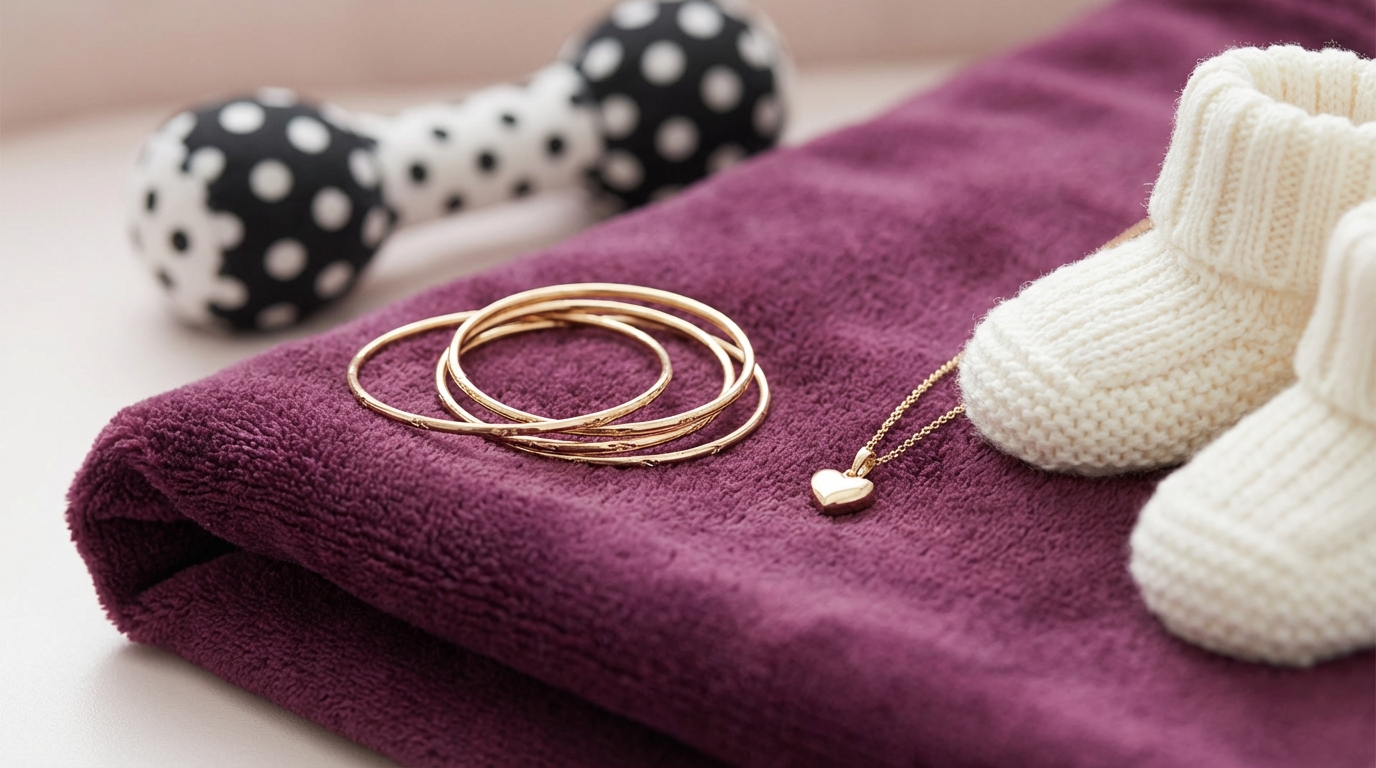

“Newborn baby jewelry is just cute and harmless. Gold is safe for every infant, right?”
Not exactly. Gold jewelry for newborns can be meaningful and beautiful, but it can also be risky if you get the size, design, or timing wrong. If you want gold jewelry for your baby, you need to think about safety first, comfort second, and style last. Not the other way around.
I might be wrong, but many parents seem to start with the design they like, then try to fit that onto a tiny baby. That is where problems start. Red marks on the skin. Anklets getting caught. Earrings that can be pulled and swallowed. These are real issues, not overprotective worries.
The good news is that you do not have to skip gold jewelry for your infant. You just have to be intentional. If you approach this like a long-term decision, not a quick gift, you get pieces that look good, carry meaning, and stay safe as your child grows.
You are also not wrong if you feel a bit confused. Family, culture, tradition, doctors, and friends often say different things. One person says “pierce the ears on day 7.” Another says “wait until the child can decide.” Someone else says “only 22K gold is pure enough.” Then another warns you about high-karat softness. The mix of advice can feel messy.
So let us bring some order to it.
Think of newborn gold jewelry as three big questions:
Why are you buying it?
When will the baby wear it?
How will you keep it safe and practical?
Once those are clear, the type of jewelry becomes much easier to choose.
“Anything that looks small enough will fit a baby.”
That line is wrong. Babies grow fast. Faster than you expect. Necklaces and bangles that look “tiny” in the store can be too tight in a few months. Or your baby starts chewing them or trying to yank them off. So it is smarter to buy pieces that adjust, or that are meant to be keepsakes more than daily wear during the newborn months.
Let us walk through the main options for infant gold jewelry, the safety rules that matter, and some design ideas that work in real life, not just in store displays.
How Safe Is Gold Jewelry For Newborns, Really?
“If it is real gold, it cannot cause any problem for a baby.”
This is only half true. Pure gold (24K) is generally non-reactive. But jewelry almost never uses 24K for daily wear, especially not for tiny, fragile designs. It is too soft. It bends, dents, and breaks.
Most baby jewelry is 18K, 20K, 21K, 22K depending on region. That means it has other metals mixed in. Sometimes copper, silver, nickel, zinc, or palladium. Those extra metals can cause skin reactions in some babies.
So the safety question is not just “Is it gold?” but “What alloy is in this piece, and how does my baby react?”
Here are the key areas to think about:
Skin Sensitivity & Allergies
Newborn skin is thin and sensitive. If there is a reaction, you will probably see:
– Redness under the jewelry
– Dry or flaky patches around contact points
– Tiny bumps or rash
If that happens, remove the jewelry immediately and give the skin time to recover. Do not assume the skin “will get used to it.” That is a common mistake.
For most families, 18K to 22K works better than lower karat gold. Lower karat usually means more alloys and higher chance of reaction. But this is not a strict rule. Some babies react even to higher karat because of the metals used.
If you can, ask the jeweler for:
– Exact karat
– Whether any nickel is in the alloy
– Country of origin or standard
Nickel is a common trigger. If your family has history of nickel sensitivity, stay away from alloys with nickel.
Choking, Pulling, and Tangling Risks
This part is straightforward but often ignored.
Babies grab things. They twist, pull, and chew. They do not care that it is gold. They care that it is close to their hands or mouth.
Risky areas:
– Anything that can break into small parts
– Clasps that can loosen
– Beads or charms on thin chains
– Anklets or bracelets that can catch in bedding or clothing
If you want daily wear jewelry, keep designs simple. Smooth surfaces. Few or no dangling parts. Strong joints. This is less “fun” in the design stage, but much safer in the real world.
Timing: When Should a Baby Start Wearing Gold Jewelry?
This topic gets emotional. Some families gift gold on the day of birth, or on a specific religious or cultural ceremony. That is completely fine as long as you separate two things:
– When to buy or gift
– When to actually put it on the baby
The gifting can be at birth.
The wearing can start later.
Many pediatricians prefer waiting at least a few weeks before the baby wears any jewelry regularly. You need time to:
– Watch for jaundice, rashes, or other skin issues that are already there
– Adjust to feeding and sleep without extra snagging risks
– See how fast the baby gains weight, so you do not buy tight sizing
Some parents choose to use gold pieces only during special photos or ceremonies in the early weeks. Then remove them right after, keep them safely stored.
That approach often works well. You still honor tradition, but your baby does not sleep or roll with jewelry on.
Main Types of Gold Jewelry for Newborns
Now let us go piece by piece. I will cover what works, what to avoid, and some design ideas that give you both style and safety.
Gold Earrings for Infants
Earrings are probably the most debated item for babies.
Some cultures pierce ears as early as the first week. Others say to wait until the child can consent. I will not tell you which tradition is “right.” That is your decision. But I can lay out what usually works better if you do choose early ear piercing.
Key points:
– You want tiny, flat designs
– You want secure backs that do not poke the head
– You want high-karat posts if possible
Good choices:
– Simple gold studs with rounded edges
– Small flat discs
– Tiny balls without stones
Avoid:
– Large hoops
– Dangling earrings
– Sharp prong settings
Try to get screw-back or covered clutch backs, not open butterfly backs that can scratch the neck or loosen.
If you want a visual guide to choose, this table may help.
| Earring Type | Good for Newborn? | Main Risk | Better Use Case |
|---|---|---|---|
| Tiny gold studs (flat) | Yes, if pierced under medical guidance | Mild skin reaction, catching on fabrics | Daily wear under supervision |
| Small gold ball studs | Usually yes | Baby pulling, twisting | Short events, photos |
| Hoops | No for newborns | Finger getting caught inside, tearing lobe | Older children, when they stop pulling |
| Dangling earrings | No | High pulling and choking risk | Not suitable for infants |
| Studs with sharp prongs | Not recommended | Scratches, irritation, infection | Later childhood |
One more thing. Ear piercing itself should be done carefully.
Safer approach:
– Go to a medical clinic or trained professional, not a random mall kiosk
– Ask about sterilization of their tools
– Clean the area for days, follow care instructions
– Watch for redness, discharge, or swelling
If you see signs of infection, remove the earrings and talk to a doctor. Gold jewelry is not more important than ear health.
Gold Bangles and Bracelets for Newborns
Gold bangles are very common newborn gifts. They photograph well. Grandparents love them. Many families keep them forever as a memory anchor of how small the baby once was.
Functionally, they are safer than long chains, as long as you get sizing and shape right.
You will see two main styles:
– Solid bangles
– Adjustable bracelets with a chain or sliding mechanism
Solid bangles:
– Should be smooth inside and outside
– No sharp edges, no rough engraving that can scratch
– Slightly loose so they can move but not slip off easily
Adjustable bracelets:
– Give you more flexibility as the baby grows
– Should not have dangling ends long enough for the baby to chew or wrap
Here is how you can think about bracelet options.
| Bracelet Type | Pros | Cons | Best Use |
|---|---|---|---|
| Thin solid gold bangle | Simple, strong, good for keepsake | Outgrown quickly, risk if too tight | Ceremonies, short wear, memory piece |
| Adjustable chain bracelet | Grows with the child for years | Loose end can catch on fabric | Occasional wear, supervised |
| Engraved name bangle | Personal, great as heirloom | More edges if engraving is deep | Gift that becomes keepsake later |
| Bangle with charms | Visual appeal | Charms can be chewed or pulled off | Not ideal for newborns |
If you are buying from a jeweler who often works with baby pieces, ask them to:
– Round every edge
– Avoid any sharp corners around clasps
– Make inner surfaces as smooth as possible
One smart idea is to get slightly larger bangles intentionally. The baby might not wear them daily right now, but they can fit better at 6 or 12 months, and still stay as a newborn memento.
Gold Anklets for Newborns
Gold anklets are another classic item, especially in South Asian and Middle Eastern traditions. Many have small bells, black beads, or religious symbols built in.
A gentle warning here. Anklets can catch on:
– Swaddles
– Sleepers
– Socks
– Baby blankets
If the chain is too thin, it breaks. If it is too strong, it can trap the ankle or twist in an uncomfortable way.
Safe design ideas:
– Slightly thicker chain, so it does not snap easily
– Very small or no bells at all
– Simple plain links, not too decorative for newborn stage
Some parents prefer to keep anklets for ceremonial use only during the first months, then allow more regular use when the baby is more mobile and wearing fewer layers.
I know that sounds reversed, but when babies start crawling, there are fewer blankets wrapped tightly around legs. You also watch them more closely when they are awake and moving.
Gold Chains and Pendants for Newborns
This is where things get tricky.
Necklaces have two main risks for infants:
– Strangulation or choking
– The baby chewing on the pendant or chain
Because of that, many pediatricians suggest avoiding daily wear necklaces for newborns and very young infants.
If your family tradition expects a chain at birth, you can:
– Buy the chain and pendant as a gift, store it safely
– Let the baby wear it only for very short periods during special events, under constant supervision
– Plan for that chain to be regular wear later, when the child is older
If you still want a necklace design now, look for:
– Shorter chain that sits higher on the chest, not long enough to reach the mouth easily
– Solid, simple pendant without sharp corners
– Good quality clasp that will not open randomly, but not so strong that it cannot break away in an emergency
Here is a small comparison for perspective.
| Necklace Style | Risk Level for Newborn | Main Concerns | Better Age Range |
|---|---|---|---|
| Thin chain with tiny pendant | High | Breakage, tangling, chewing | 2+ years, supervised |
| Thicker chain, no pendant | Moderate | Snagging on clothing | Older toddlers or kids |
| Chain with religious symbol | High if worn daily | Chewing, sharp edges on symbol | Wear on special days, then store |
If you are unsure, this is one area where waiting a bit is usually the safer path.
Symbolic and Cultural Ideas for Infant Gold Jewelry
Gold baby jewelry is rarely just decoration. It carries stories.
It can represent:
– Blessings
– Protection
– Family identity
– Religious values
– Memory of a special day
Designing with that in mind helps you choose pieces that matter long term, not just in baby photos.
Name and Initial Jewelry
Name-based pieces are very popular because your child can use them for many years.
Ideas:
– A thin gold bracelet with the baby’s name engraved on a flat plate
– A pendant with the first initial in a simple font
– A small disc charm engraved on one side with the name, on the other with birth date
For practical use with newborns:
– Keep fonts plain and clear
– Avoid cut-out letters with many sharp corners
– Make engraving shallow enough not to create grooves that irritate skin
Later, this same piece can move from wrist to chain, or from baby to childhood.
Religious and Spiritual Symbols
Depending on your background, you might think about:
– Crosses
– Om
– Crescent and star
– Hamsa
– Nazar (evil eye)
– Stars or other symbols
Again, the same tension appears: meaning vs safety.
If you include symbols for a newborn:
– Prefer very small, flat icons with rounded edges
– Avoid gemstone settings with prongs
– Make sure the bail (the loop that connects pendant to chain) is closed well
You can always go for a symbolic design that is more abstract. For example, a small round disc engraved with a short verse, prayer, or mantra on the back, leaving the front smooth.
Birthstone and Gold Combinations
Some parents like to pair gold with the baby’s birthstone for that month. This can be beautiful, but for newborns, gemstones add extra risk:
– Settings with claws or prongs
– Tiny stones that could become loose
– Higher cost with more fragile structure
If you love the idea of birthstones, one good path is:
– Buy a plain gold baby piece for now
– Plan a birthstone upgrade at age 5, 10, or a milestone birthday
– Or buy a birthstone piece intended for later, and keep it in a safe box with a message for your child
This way you keep newborn jewelry simpler and safer, while still keeping your long-term idea.
Practical Rules for Buying Infant Gold Jewelry
Let us go through a more practical angle. You are standing in a store (or scrolling online), and you see dozens of tiny pieces. How do you choose wisely?
1. Check the Karat and Alloy Details
Gold purity affects color, softness, and reaction risk.
Common choices:
| Karat | Gold Content | Pros for Baby Jewelry | Cons |
|---|---|---|---|
| 24K | 99.9 percent | High purity | Too soft, bends, deforms easily |
| 22K | About 91.6 percent | Common in many cultures, rich color | Still soft, can scratch more |
| 21K / 20K | About 87.5 – 83.3 percent | Balance of purity and strength | Depends heavily on alloys used |
| 18K | 75 percent | Stronger, often better for fine details | More alloy metals, watch for allergies |
Ask the jeweler:
– “What karat is this piece?”
– “Does this alloy include nickel?”
– “Is there a hallmark stamp?”
If they cannot give a clear answer, that is a red flag.
2. Test Edges and Movement
Touch everything. Literally.
Run your finger along:
– Inside of bangles
– Back of pendants
– Clasps
– Earring backs
If anything scratches your finger, imagine that on baby skin for hours.
Move the joints:
– Do they feel weak?
– Is any part wobbly?
– Does the clasp open too easily?
You are not looking for perfection, but you do want solidity.
3. Think About Growth
Babies grow quickly in the first year. A bangle that fits perfectly now may not go over the hand in two months.
Instead of aiming for “just right,” aim for:
– Slightly loose now
– Adjustable where possible
– Designs that can move from wrist to chain or used later
A simple method:
– Measure the widest part of baby’s hand or foot
– Add a bit of margin
– Check that the jewelry can pass easily without forcing
Never force jewelry on or off a baby. If it sticks, it is too tight.
4. Decide: Daily Wear or Occasional Wear?
Many problems come from confusion here.
If a piece is meant for:
– Newborn photos
– Naming ceremony
– Religious or cultural rituals
– Family gatherings
Then it does not need to be strong enough or simple enough for all-day, every-day wear. You will supervise closely, remove it soon after.
If a piece is for daily wear, it must be:
– Extra simple
– Extra smooth
– Extra secure
Be honest with yourself. If you are often busy, tired, or alone with the baby, you may not be able to check jewelry many times a day. Less is safer.
Care, Cleaning, and Storage for Infant Gold Jewelry
You spent money on the jewelry. You also gave it emotional meaning. So you want it to stay in good condition, regardless of whether your baby wears it now or later.
Cleaning Gold Baby Jewelry
Babies drool, spit up, and rub lotion everywhere. Jewelry picks up all of that.
Safe cleaning routine:
– Use mild soap and warm water
– Soak a few minutes
– Gently rub with a very soft cloth or baby toothbrush
– Rinse well
– Dry fully before storing or reusing
Avoid:
– Harsh chemicals
– Strong jewelry cleaners that are not approved for fine gold
– Rough scrubbing pads
If the piece has gemstones, ask the jeweler if water cleaning is safe for that type.
Storage When Not in Use
If the jewelry is not in daily use:
– Store in a soft pouch or jewelry box
– Keep each piece separate to avoid scratching
– Record details: karat, date gifted, from whom, any special meaning
This sounds a bit detailed, but later, when your child is older, that context matters. It turns a small bangle into a story you can tell.
You might also:
– Take a photo of your baby wearing the piece
– Print the photo and write a message on the back
– Store the photo with the jewelry
That way, the jewelry becomes part of a memory set, not just an object in a box.
Common Mistakes Parents Make With Newborn Gold Jewelry
You asked me to tell you when you are taking a bad approach. So let me call out a few patterns I see often.
Buying Only for “Now” Instead of Long Term
Focusing only on how the jewelry looks on a tiny newborn usually leads to:
– Pieces that get tight quickly
– Designs that do not suit an older child
– More risk for very little wear time
Better approach: choose something that can grow with the baby or be used later, and accept that it might not be perfect right this second.
Putting Cultural Pressure Above Safety
I respect tradition deeply. Still, if a specific piece is clearly causing marks, rashes, or discomfort, leaving it on only to “keep elders happy” is not the best path.
You can honor tradition by:
– Letting the baby wear the piece briefly in ceremonies
– Then switching it out for pictures
– Keeping the item as a keepsake, while choosing safer daily wear
You are not disrespecting anyone by protecting your child’s health.
Ignoring Doctor’s Advice After Ear Piercing or Rashes
Sometimes parents treat doctor recommendations as suggestions, not strong guidance, because “our family always did it this way.”
If your pediatrician says:
– “Remove all jewelry for now”
– “Do not pierce ears yet”
– “Stop using this piece because of skin reaction”
Take that seriously. Even if your relatives disagree.
It may feel like small issues, but infections at that age can escalate fast.
Idea Bank: Putting It All Together for Your Baby
To wrap the ideas into a few practical combinations, here are some newborn gold jewelry sets that balance meaning and safety reasonably well.
Set 1: Ceremony-Focused, Low Daily Wear
– One thin 22K or 18K name bracelet with smooth plate
– One pair of tiny flat studs (if you choose early piercing under medical care)
– One symbolic pendant and chain kept in storage, gifted now but worn later
Use the bracelet and studs only during supervised times for the first months. Install the chain in your child’s routine at an older age.
Set 2: Tradition-Friendly, Minimalist
– Pair of plain gold bangles, slightly loose
– Simple anklets with no bells for photos and events only
– No earrings or chains for now
Focus on safety and tradition together. Most of the time, your baby is jewelry-free. On special days, you bring out the pieces for short periods.
Set 3: Heirloom-Centered
– One finely crafted bracelet engraved with name and birth date
– One matching pendant engraved with a short blessing
Your baby may wear them only rarely as a newborn. The real plan is to pass them on when your child reaches a milestone age, with photos of them wearing it in infancy.
How to Talk to Family About Your Choices
This part is often harder than choosing the jewelry.
Elders might say:
“We all wore gold from birth. Nothing happened to us.”
You can respond calmly with:
– “We love the tradition and the gifts.”
– “The baby will definitely wear your gift on special days.”
– “For safety, we will keep daily wear very simple for now.”
If someone pushes for earrings or anklets that you feel are unsafe, you can accept the gift and decide how and when your child will use it. You are the parent. Your child is your responsibility.
You are not rejecting love. You are adjusting how it is expressed.
Final Thoughts on Newborn Gold Jewelry
Newborn baby gold jewelry can be a loving, beautiful choice. It can also be stressful if you let pressure, trends, or store displays guide you more than common sense.
If you remember these simple priorities, you will almost always make good choices:
1. Safety over style.
2. Comfort over photos.
3. Long-term meaning over short-term “cute”.
Try to see each piece as a story you are starting now, that your child might continue years from today. If that story includes care, thought, and respect for their needs, not just your wishes, then the jewelry really does become valuable. Not just in gold weight, but in what it represents.
