
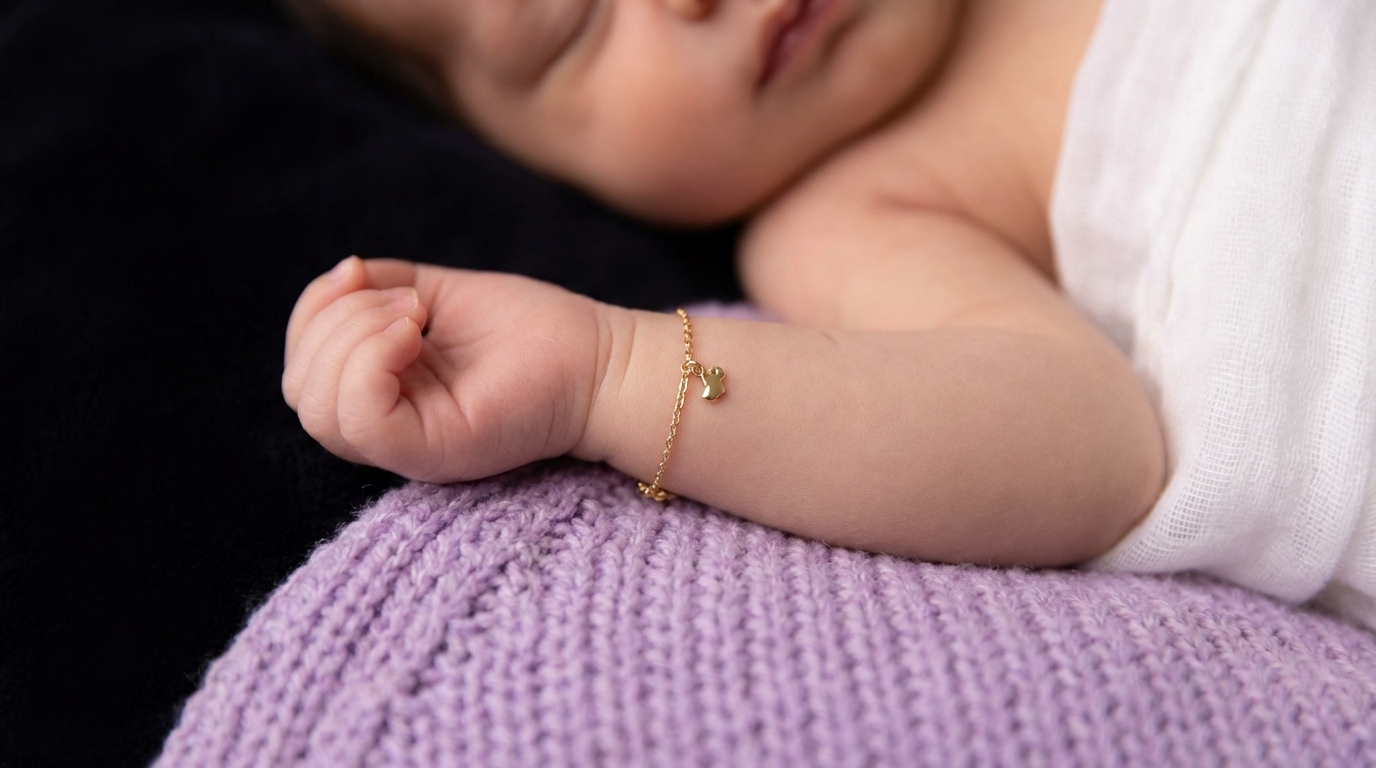

“Newborn baby jewelry is unsafe, unnecessary, and only for showing off.”
I hear this a lot, and I get where it comes from. Some of it is true, some is not. New born baby jewelry can be unsafe if you pick the wrong pieces, ignore size, or skip safety checks. It can also feel like it is only about looks. But if you approach it with care, the right gold pieces can be meaningful, practical to keep clean, and safe for your infant. On Sunday Best Blog I spend a lot of time looking at how small choices like this shape family memories, and infant gold jewellery is one of those choices that needs clear thinking, not fear or hype.
Why parents pick gold jewelry for newborns
For many parents, this is not a random shopping choice. It sits at the crossroad of culture, money, health, and emotion.
Gold is soft, does not rust, and in higher purities is less likely to cause skin issues. It can act as a keepsake that moves with your child through life. I might be wrong, but most parents are not trying to show off. They are trying to mark a moment that feels huge.
“Jewelry can wait. A newborn does not care about a bracelet.”
True. Your baby does not care today. You care. The grandparents care. And your future teenager might care when they see that tiny bangle you kept for 15 years. That is the real purpose. The jewelry is for memory, meaning, and in some families, for blessing or protection.
If you only think about style, you will probably make poor choices. If you start with safety and meaning, style falls into place.
Key safety rules for infant gold jewellery
Before we talk about cute designs, we need to talk about risk. This is where many parents take a wrong approach. They pick what looks nice on Instagram and hope it is fine.
You need a clear filter in your head.
“If there is any doubt about safety, do not put it on the baby.”
Use that as your rule. Here is how to think about safety in a structured way.
Gold purity and materials
For infant skin, the metal choice matters more than the design.
Higher purity gold (like 18k and 22k) has less alloy metal mixed in, which usually means fewer skin reactions. Lower karats like 10k or 14k often have more nickel or other metals that can irritate sensitive skin.
Here is a simple table to compare common gold purities for newborn jewelry:
| Gold purity | Gold content | Pros for infants | Cons for infants |
|---|---|---|---|
| 24k | 99.9% gold | Very low chance of irritation | Very soft, bends easily, scratches fast |
| 22k | 91.6% gold | Good balance of purity and strength | Still soft, delicate for active babies |
| 18k | 75% gold | Stronger, less likely to bend | More alloy metals, slightly higher allergy risk |
| 14k | 58.5% gold | Durable and more affordable | Greater chance of skin reactions |
For a newborn, parents often lean toward 18k or 22k gold. Pure 24k is beautiful but so soft that it can distort with small pulls. For something like a tiny bangle that is mostly for keepsake and ceremony, 22k works well. For daily wear, 18k is usually more practical.
If your family has a history of metal allergies, speak with your pediatrician before you introduce any jewelry. Also ask the jeweler for detailed metal content. If they are vague, walk away.
Choking and strangulation risk
Necklaces on newborns are risky. This is where many parents go wrong.
Newborns cannot move jewelry away from their face. Chains can wrap, catch on bedding, or pull tight under the chin. That risk is not worth a photo.
If you feel strongly about a small gold chain for cultural reasons, limit it to very short, supervised periods. Ceremonies, photos, quick family visits. Remove it for sleep, feeding, and any time your attention is elsewhere.
For bracelets and anklets, aim for:
– No sharp edges
– No separate dangling charms for daily wear
– A smooth shape that glides on the skin
Make it a rule that anything that swings or dangles is for short-term wear only.
Clasp and closure design
The clasp is a small part, but it carries big risk.
Babies love to rub their wrists and feet together. A poorly made clasp can pop open, and tiny beads or charms can end up near their mouth.
Safer closure choices for newborns:
– Smooth screw clasps that lock well
– Soft, continuous bangles that slide over the hand
– Adjustable rope or thread with gold pieces fixed on it (for some cultural styles)
Closures to avoid for daily wear:
– Lobster clasps with tiny moving parts
– Spring ring clasps on thin chains
– Hook closures that can catch on blankets
Test the piece with your own fingers. Tug gently. Try to open the clasp as if you were a clumsy baby. If it opens too easily, that is a warning sign.
Size and fit for tiny wrists and ankles
Too tight can leave marks and restrict blood flow. Too loose can slide off or catch. Many parents guess the size, which is not ideal.
As a simple check:
– You should be able to slide your little finger between the jewelry and the baby’s skin, but not more than that.
– Watch for red impressions after you remove the piece.
– Check fit again after bath time, when skin can be slightly puffy.
Here is a rough guide for sizing, but remember, every baby is different:
| Age range | Wrist circumference (approx.) | Bangle/bracelet inner size | Note |
|---|---|---|---|
| Newborn (0 – 3 months) | 9 – 11 cm | 11.5 – 13 cm | Choose adjustable or slightly larger for growth |
| 3 – 6 months | 11 – 12.5 cm | 13 – 14.5 cm | Recheck fit every few weeks |
| 6 – 12 months | 12.5 – 14 cm | 14.5 – 15.5 cm | Babies move more, so keep things snug but not tight |
If you want this to be a keepsake more than daily wear, you can size it slightly large and accept that it may not stay on all the time. That can be safer anyway.
Popular newborn gold jewelry types and how to choose
Now we can talk about ideas. I will walk through the most common types of infant gold jewellery and point out where people often make mistakes.
Gold bracelets and bangles for newborns
Bracelets and bangles are usually the safest choice for newborns when picked well. They stay on the wrist, far from the airway, and are easy to check.
Types you might consider:
1. Plain gold bangle
2. Soft gold chain bracelet
3. Personalized name plate bracelet
4. Cultural charm bracelets (like evil eye, religious symbols)
Let us look at each type more closely.
Plain gold bangles
These are simple circles with no stones or extra parts. They photograph well, hold value, and adapt across styles and generations.
Why parents like them:
– Smoother surface on delicate skin
– Less cleaning effort
– Easier to pass down
Watch out for:
– Sharp inner edges
– Very thin bangles that bend out of shape with light pressure
– Designs with heavy texturing that can trap dirt
If you want something your child might wear again at age 5 or 6, you can choose a slightly larger inner diameter and limit actual wear during infancy. Keep it in a soft cloth pouch when off the baby.
Soft gold chain bracelets
Chain bracelets look delicate and are common for naming ceremonies. They often have small rings to adjust the length.
Pros:
– Adjustable sizing as baby grows
– Works well with a simple charm or name plate
Risks:
– Chain links can catch on fabric
– Thin chains can snap if pulled
– Complex clasps can open if not checked
For a newborn, a chain bracelet makes more sense for short, supervised wear. Think of it as a ceremonial piece rather than day-and-night gear.
Name plate bracelets
These bracelets have a small flat plate where you can engrave the baby’s name, initials, or a date. They feel personal and usually stay in the family for a long time.
Tips for safer name plate designs:
– Stick to smooth, rounded corners on the plate
– Avoid raised, sharp engraving styles for daily wear
– Keep plate length short so it sits well on the tiny wrist
Some parents engrave the inside of the plate with an initial and date of birth to keep the outer side very simple. That can be a nice balance of meaning and clean design.
Cultural charm bracelets
In many cultures, gold bracelets include symbols that represent protection, blessing, or family tradition.
Pieces might include:
– Small religious icons
– Tiny bells
– Evil eye motifs
– Family emblem
For a newborn, this is where you need to be strict.
Safer approach:
– Fix charms directly onto the bangle or plate so they do not dangle freely
– Keep charm size very small and flat
– Avoid bells on daily wear pieces because they can break off
You can create two versions: a more decorative one for ceremonies and photos, and a very simple everyday bracelet with the same symbol but in a flatter, safer form.
Newborn gold anklets
Anklets are common in many families and can be very pretty in photos. At the same time, they touch socks, rompers, and bedding more often than bracelets, which can increase snag risk.
“Anklets are always safer than bracelets.”
That statement is not correct. Anklets are lower on the body, so they might feel less risky, but your baby’s feet move a lot. They kick blankets, car seat straps, and clothing. An anklet that catches on fabric can pull the skin or open up.
If you want gold anklets for your infant:
– Pick soft, rounded designs without beads for daily wear
– Avoid heavy dangling charms, especially bells
– Check under the ankle every day for any redness or rash
– Remove for car rides if straps lay over the ankle
Some parents keep anklets only for special days. That can be a good compromise if you worry about constant friction.
Newborn gold earrings: pierce now or wait?
This topic triggers strong opinions. Some families pierce ears within weeks. Others wait until the child can decide for themselves.
From a safety and care angle, early piercing requires:
– Strict cleaning routine
– Watching for signs of infection
– Careful choice of metal
If you decide to pierce your infant’s ears:
– Ask your pediatrician about timing and method
– Choose medical-grade equipment and a trained professional
– Pick flat-back gold studs, not hoops
– Avoid heavy or large frontal designs that babies can grab
Gold purity matters here as well. 18k or 22k studs with simple posts usually work better for sensitive skin than low-karat alloys.
I might be wrong, but if you are unsure, waiting a little is often the lower-stress path. You can still buy tiny gold studs as a symbolic gift and store them safely until your child is older.
Necklaces and pendants for newborns
This is the most sensitive category. Necklaces present the highest risk of strangulation, especially in sleep or unsupervised play.
You will see many cute newborn photos with tiny gold chains and pendants. These can be safe for a short, very controlled photo session. They are not safe for overnight wear.
If you choose to use a gold necklace for your baby:
– Keep the chain short, so the pendant sits high and does not reach the mouth
– Avoid chunky pendants that can hit the face
– Skip sharp or pointed shapes
– Remove the necklace before putting the baby in a crib, car seat, or carrier
An alternative that many families like is to keep the baby’s pendant on a chain worn by the mother or father. The gold still stays close to the child symbolically, without placing it on the tiny neck.
Design choices: stones, enamel, and engraving
Once safety is covered, design details come into play. This is where it is easy to get carried away and forget that the wearer is a newborn, not an adult.
Should you add stones to infant gold jewellery?
Diamonds and colored stones catch the eye. For adults, they are common. For infants, they add risk.
Risks from stones:
– Prongs can scratch skin
– Small stones can come loose and become choking hazards
– Dirt builds up around the setting
If you really want stones:
– Keep to one or two tiny stones in a very secure bezel setting
– Ask the jeweler to file and polish any edges near the stone
– Make that piece for limited wear, not constant use
For many babies, plain polished gold looks cleaner and is far easier to care for.
Enamel and colored accents
Enamel can add color to motifs like hearts, animals, or religious symbols. It sits on the surface of the gold.
Questions to ask the jeweler:
– What chemicals are in the enamel?
– Is the enamel lead-free and safe for contact with skin?
– How is it treated to prevent chipping?
If you get vague answers, it is better to skip enamel. Chipped enamel can leave rough edges and tiny flakes.
Engraving ideas for newborn gold jewelry
Engraving turns a simple piece into a personal one. Some classic choices:
– Baby’s first name
– Initials
– Birth date
– Short phrase such as “Love Mom” or “Love Dad”
You can use engraving on:
– The inner side of a bangle
– A bracelet plate
– The back of a small pendant
Keep the text short. Remember that this piece is small. Long phrases can crowd the surface and weaken the structure.
When and how long should newborns wear gold jewelry?
Many safety concerns come from constant, round-the-clock wear. You can reduce risk by choosing specific times and patterns.
Occasions where infant gold jewellery fits well
– Naming ceremonies
– Religious or cultural rituals
– First family photos
– Meeting grandparents
During these times, you are usually very alert to the baby’s state and can respond if anything looks off. Jewelry is less risky when your focus is high.
Times to remove jewelry from your baby
A simple rule: if you are not actively watching the baby, jewelry should probably come off.
High-risk times:
– Sleep (both naps and nighttime)
– Car rides
– Stroller walks where baby may nap
– Daycare or extended babysitting runs
– Bath time
Water can slip under clasps and under the metal, leading to trapped moisture and skin irritation. Soap, lotion, and oils can build up under jewelry and cause itching.
Build a simple routine:
– Put on gold pieces just before the event
– Check skin when you remove them
– Store them in one safe, soft-lined box when off
Cleaning and caring for infant gold jewellery
Babies drool, spit up, and sweat. Their jewelry sits right in the middle of all that.
If you never clean gold pieces, they will gather a thin layer of skin oils, soap traces, and dust. This can irritate sensitive baby skin.
Here is a simple cleaning routine that works for most plain gold pieces:
| Step | What to do | Frequency |
|---|---|---|
| 1. Inspect | Check clasps, edges, and any charms for looseness or sharp spots. | Before and after each wear |
| 2. Wash | Use warm water with a tiny amount of mild baby soap. Gently rub with your fingers. | Every few wears or after heavy exposure to lotions or sweat |
| 3. Rinse | Rinse under clean water until no soap remains. | Each time you wash |
| 4. Dry | Pat dry with a soft cloth. Make sure no moisture stays in tiny gaps. | Each time you wash |
| 5. Store | Keep in a soft pouch or lined box away from other jewelry that can scratch it. | Every time it is off the baby |
Do not use harsh chemicals, metal dips, or stiff brushes on baby jewelry. They can leave residues you do not want near infant skin.
Budgeting for newborn gold jewelry
You do not need a huge budget to create something meaningful. One of the mistakes parents make is equating price with love. They buy heavy pieces that the baby cannot safely wear.
Think through these points:
– How many pieces do you actually need? Often, one carefully chosen bracelet or bangle is enough.
– Is this mainly for ceremony, for long-term keepsake, or for both?
– Will this piece be passed on to future siblings or kept only for this child?
A simple, small 18k or 22k gold bangle with engraving often gives more long-term satisfaction than a full set of bracelet, anklet, ring, and chain that stays in a box.
If family members want to gift gold, you can guide them. Suggest a small matching piece or even a tiny gold coin with the baby’s initial. Then you are not stuck with several unsafe items that no one uses.
Questions to ask your jeweler
When you walk into a store or browse online, do not rely only on photos and price. Ask direct questions. If the seller cannot answer clearly, that is a problem.
Here are some focused questions:
– What is the exact gold karat and metal mix?
– Is this piece designed for infants or just small in size?
– How secure is this clasp? Can you show me how it locks?
– Are there any loose parts that can detach if pulled?
– How should I clean this safely for a newborn?
A good jeweler will not rush you. They will acknowledge safety concerns and show you which items are actually intended for babies.
If you feel any pressure to buy quickly, step back. This is a keepsake, not a rush purchase.
Balancing culture, safety, and personal style
New born baby jewelry sits at an intersection of:
– Cultural traditions that may go back several generations
– Modern safety guidelines from doctors and health bodies
– Your own taste as a parent
You do not have to follow every tradition exactly as in the past. You also do not need to reject everything older relatives suggest. You can adjust.
Some practical compromises:
– Use thread-based bracelets with small gold elements for daily wear and keep pure gold chains for ceremonies.
– Keep charmed or stone-set pieces for short events and rely on plain bangles for anything longer.
– Wear some of the baby’s gifted pendants on your own chain until your child is older.
If a relative insists on a piece you feel is risky, thank them, accept the gift, but be honest that you will mainly treat it as a keepsake until the baby is older. You are not wrong to prioritize safety over expectation.
Age progression: when can your child wear more complex jewelry?
Your newborn grows, and the jewelry question changes with each stage.
A rough guide:
| Age | Jewelry type | Key guide |
|---|---|---|
| 0 – 6 months | Simple bangles or bracelets, short-term wear only | Focus on photos and ceremonies; remove for sleep and unsupervised time. |
| 6 – 12 months | Plain bracelets/anklets with better fit | Baby moves more, so reduce dangling parts; still remove for naps and nights. |
| 1 – 3 years | More durable pieces, possibly slightly heavier | Child pulls on things; make sure no sharp edges and nothing that opens easily. |
| 3+ years | Simple stud earrings, small pendants under supervision | Child can express discomfort; still avoid overnight chains or hoops. |
The exact timing varies by child. Some kids cannot stand anything on their body. Others are unbothered. Listen to your child. If they keep pulling at a piece, even if it is safe in theory, remove it.
Turning newborn gold jewelry into long-term memories
The part people often forget is what happens to the jewelry after the baby outgrows it.
Instead of letting pieces scatter or get lost:
– Keep all infant gold items in one dedicated box or pouch.
– Add a small note with the date, who gifted it, and any story behind it.
– Take a clear photo of your baby wearing the piece, and store a printout near the jewelry.
Later, when your child turns 10, 16, or even older, you can gift the box back. The meaning will likely matter more than the metal weight.
You can also:
– Turn a tiny bangle into a pendant for an adult chain.
– Use part of the gold from a baby bracelet to make a new ring or charm that your grown child designs.
That way, the piece stays alive instead of sitting in a drawer.
“Gold jewelry for babies is just about showing status.”
For some, maybe that is true. For many parents, it is much more modest. It is a way to mark a life that just started, to connect with grandparents and traditions, and to create one small object that bridges past and future.
If you keep safety first, keep designs simple, and stay honest about when your baby actually wears the pieces, infant gold jewellery can be both safe and meaningful. You are not wrong to want that, as long as you are ready to say no to anything that puts style ahead of your child’s comfort and safety.
