
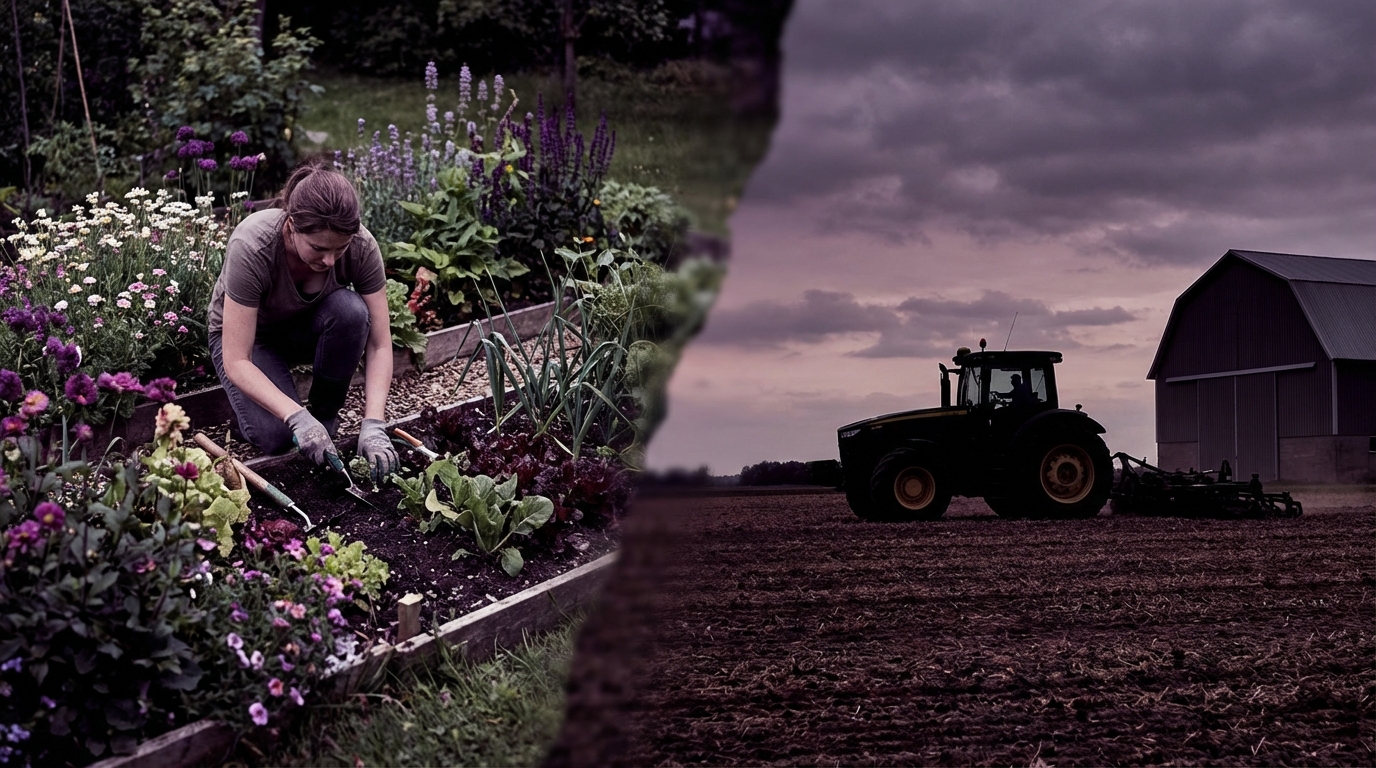

“Gardening and farming are basically the same thing, just on a different scale.” – SundayBestBlog.com
That sounds reasonable at first, but it is not right. Scale is one difference, yes, but gardening and farming are built on different goals, economics, mindsets, and even different kinds of risk. If you treat them as the same thing, you make bad choices, waste money, and end up frustrated, whether you are planting a backyard bed or starting a small farm business.
Let me unpack that in a clear way.
Gardening is usually about personal satisfaction, home use, learning, and sometimes beauty. Farming is about producing goods for sale at a profit. That single change in purpose reshapes everything: what you plant, how you plan, how you invest, how you handle pests, how you think about soil, water, time, and even your own body.
They share soil, plants, tools, and often passion. But they run by different rules.
I might be wrong in some edge cases. There are gardeners who sell a bit at a weekend market and farmers who still treat part of their field like a giant hobby garden. Life is messy. Still, those are the exceptions. If you understand the key gaps between gardening and farming, your decisions get clearer and your results get better.
Let us walk through the main differences in a structured way, without pretending they are worlds apart or pretending they are the same thing.
“If I can grow tomatoes in my backyard, I can run a small tomato farm.”
No. That kind of thinking trips up a lot of people. Growing a good tomato in a raised bed tells you almost nothing about running a profitable tomato operation, managing labor, dealing with weather risk, or delivering consistent quality to paying customers. The skill overlap is real, but limited.
So let us set scale aside for a moment and talk about purpose, money, planning, and systems. Once you see those, the rest falls into place.
Purpose: Hobby vs Business
“Gardening feeds the soul. Farming feeds the market.”
I do not love that line, but it does capture something simple.
Gardening usually exists for you and your close circle. You grow herbs so your food tastes better. You grow flowers because you like how they look. You grow vegetables because you want fresh produce or like the process.
Farming exists for buyers. That might be a local restaurant, a wholesaler, a farmers market, a grain elevator, or a supermarket chain. The core measure is not “did I enjoy this” but “did I make money and can I keep this going next year.”
Here is how that difference in purpose plays out:
Personal goals vs financial goals
A gardener might ask:
– What do I want to eat this summer?
– What looks good in this space?
– What can my kids help with?
A farmer asks:
– What crops have demand in my market?
– Can I sell at a price that covers all my costs and still leaves profit?
– How does this crop fit into my rotation and cash flow?
Those questions lead to different choices, even if the crop is the same. A gardener might grow one cherry tomato variety they love. A farmer might test several, compare yields, disease resistance, harvest speed, and shelf life, then settle on the variety that makes money, even if it tastes slightly less ideal.
Risk tolerance and expectations
If your garden fails, it is disappointing, but your grocery store still exists.
If a key farm crop fails, it can break the business.
That difference shapes behavior. Gardeners can experiment freely. Try new varieties, push planting dates, skip spraying, ignore forecasts. Farmers can experiment, but usually on a small test plot, while the bulk of their land follows proven systems.
If you are a gardener thinking about turning “a love of growing things” into a farm, you need to be blunt with yourself. Are you ready for weather risk, market risk, and the mental load of tying your income to something you cannot fully control?
Scale: Space, Time, and Effort
Scale matters, but not just as “bigger.”
It changes how you plan, what tools you use, and how you spend your days.
Physical size and plant count
A common vegetable garden might be 100 to 500 square feet. Some are smaller, some bigger, but it is usually manageable by one person in spare time, with hand tools.
A farm might be:
– A half-acre intensive market garden.
– A 5-acre mixed vegetable farm.
– A 500-acre grain operation.
– A 2,000-acre cattle and hay setup.
Those are completely different worlds.
Here is a simple comparison table to ground this.
| Aspect | Typical Gardening | Typical Farming | |
|---|---|---|---|
| Primary purpose | Personal use, hobby, learning | Income, business sustainability | |
| Scale of land | Square meters / square feet | Acres / hectares | |
| Time commitment | Spare time, weekends, seasonal focus | Part-time or full-time, often year-round | |
| Plant diversity | High diversity, small amounts of many crops | Lower diversity per field, focus on saleable crops | |
| Main success metric | Satisfaction, harvest quality for home | Profit, yield, reliability, quality for buyers | |
| Risk of failure | Low financial risk | High financial and operational risk |
I might be oversimplifying the middle here, but the pattern holds.
Time and labor
Gardening usually fits around other life priorities.
You go to work, come home, water the beds, do some weeding on weekends, maybe big spurts of effort during planting and harvest.
Farming often sets the calendar. Seasons decide when you wake up, when you travel, and when you rest. During planting and harvest, many farmers work long days. In slower months, the work shifts to planning, maintenance, marketing, and repairs.
That time commitment shapes your life. It affects your family, your health, your other work. If you are thinking about “scaling up” your garden, this is one place where people often underestimate the shift.
Economic Model: Cost, Revenue, and Profit
“If the land is free and I grow my own seed, my farm profit is almost all margin.”
No. That kind of thinking ignores most of the true costs.
Gardening usually does not require careful accounting. Many gardeners do not even track costs. They buy seeds, compost, some tools, maybe raised beds, and see it as a hobby expense. If they save money on groceries, that is a bonus.
Farming needs a real economic model. That includes:
– Upfront capital: land, equipment, infrastructure.
– Operating expenses: seed, compost or fertilizer, fuel, water, labor, repairs, packaging, fees.
– Overhead: insurance, taxes, accounting, marketing, transport.
Here is a basic comparison.
| Financial Aspect | Gardening | Farming |
|---|---|---|
| Need for strict budgeting | Low, often casual | High, survival depends on it |
| Upfront capital required | Low to moderate | Moderate to very high |
| Revenue expectation | None or minor (maybe surplus sales) | Primary or significant income source |
| Cost of failure | Lost time, some money | Debt risk, cash flow gaps, business stress |
| Pricing concern | Almost none | Central; must cover costs and profit |
Market and customer expectations
The garden “customer” is mostly you. If a tomato cracks, you still eat it. If carrots look crooked, that is fine.
On a farm, the customer expects:
– Consistent quality.
– Steady supply during the agreed season.
– Food safety standards.
– Professional delivery.
A restaurant chef does not care if the carrot has sentimental value. They want uniform size and predictable taste. A supermarket chain expects contracts, certifications, maybe traceability.
That can sound harsh, but that is the tradeoff: you get money, you give reliability.
Planning and Systems
Both gardening and farming need planning, but the level and type differ a lot.
Crop planning
A gardener might plan like this in their head:
“Tomatoes here, beans there, some lettuce in the front. I will rotate things next year.”
A farmer usually has:
– A written crop plan.
– Field maps.
– Planting/harvest calendars.
– Succession schedules.
– Rotation schedules over several years.
Part of this is about yield. Part of it is about logistics. If you promise a market that you will bring 100 bunches of kale every Saturday for 12 weeks, you cannot just “see how it goes.”
Here is a contrast in planning depth.
| Planning Area | Typical Gardener | Typical Farmer |
|---|---|---|
| Crop rotation | Informal, short-term memory based | Multi-year plan to manage pests, disease, soil |
| Seed ordering | Small, often last-minute | Bulk, early, based on sales projections |
| Harvest planning | Harvest when ripe, store short term | Harvest to match orders, storage limits, labor |
| Record keeping | Minimal, optional | Detailed, often legally or financially required |
Systems and repeatability
Gardening is often personal. You can improvise, change your mind, skip a season, try something different. That flexibility is part of the appeal.
Farming pushes you toward repeatable systems:
– Standard procedures for planting.
– Standard ways of spacing, trellising, pruning.
– Fixed schedules for irrigation and feeding.
– Written or at least repeatable harvesting methods.
This is not about being rigid. It is about reducing mistakes and getting consistent results.
If you ever think “I will just scale my garden by planting more,” you might hit a wall. Your current approach might not scale. A bed you can weed on your knees does not easily translate to 5 acres without a system and different tools.
Tools, Technology, and Inputs
At a glance, a trowel and a tractor are just tools. They do physical work. Still, the choice and impact differ a lot.
Tool scale and complexity
Garden tools:
– Hand trowels.
– Small shovels.
– Hand pruners.
– Watering cans or small hoses.
– Simple raised beds.
Farm tools can include:
– Tractors and implements (plows, harrows, planters).
– Walk-behind tractors for small farms.
– Irrigation systems with pumps, timers, drip lines on a big scale.
– Harvest tools and machines.
– Cold storage, packing sheds, coolers.
Here is a quick comparison.
| Tool Category | Gardening | Farming |
|---|---|---|
| Soil preparation | Hand tools, small tillers | Large tillers, chisels, no-till drills, tractors |
| Irrigation | Manual watering, small drip kits | High-capacity pumps, full-field drip or pivots |
| Harvest | By hand, small baskets | By hand at scale or with harvesters, bulk bins |
| Storage | Kitchen fridge, small sheds | Walk-in coolers, grain silos, controlled environments |
The big jump is not just cost. It is maintenance, skill, safety, and commitment. Owning a tractor is different from owning a hoe.
Inputs and regulations
Gardeners often buy:
– Small bags of compost.
– Packets of seed.
– A bit of fertilizer.
– Maybe some pest sprays from a garden center.
Farmers often deal with:
– Bulk seed.
– Bulk compost or manure.
– Fertilizer at larger rates.
– More complex pest and disease management tools.
– Legal rules about certain chemicals and food safety.
On a farm, a mistake with chemicals can affect neighbors, groundwater, and the business. There are usually clear regulations around that.
If your goal is to stay in the gardening world, keep things simple. If your goal is to farm, you will need to learn these rules and respect them. Ignoring them is not just “rebellious,” it can be dangerous and expensive.
Soil, Water, and Environmental Impact
Both gardeners and farmers depend on soil and water. The difference is in scale of impact and the need to manage long-term health.
Soil care
A gardener can fix a small soil problem pretty quickly:
– Add compost.
– Adjust pH with small amounts of lime or sulfur.
– Change plants next year.
On a farm, soil care is a strategic, multi-year process. Decisions like:
– Crop rotation.
– Cover crops.
– Tillage or no-till.
– Manure management.
– Fertility programs.
These have long-term effects and financial implications.
Here is a simple soil care comparison.
| Soil Aspect | Gardening | Farming |
|---|---|---|
| Soil testing | Occasional, sometimes skipped | Regular, often every few years or more |
| Organic matter management | Kitchen compost, bagged products | Cover crops, large compost/manure applications |
| Impact of mistakes | Small, local | Large, across fields and seasons |
Water management
A gardener might drag a hose or use a small timer. If they overwater one day, it is not a big deal.
A farm irrigates large areas. That often means:
– Planning water sources.
– Calculating flow rates and needs.
– Meeting water rights or local rules.
– Paying real money for pumps, lines, energy.
If you mismanage water on a farm, you can stress crops, trigger disease, or waste a lot of money.
So while the basic science is the same, the stakes are different.
Pests, Diseases, and Weeds
“If something goes wrong in my garden, I can always hand-pick bugs or replant.”
That is usually true for a backyard space. It does not translate to field scale.
Scale of pest impact
On a small bed, hand-picking caterpillars might work.
On 5 acres of brassicas, it is not realistic.
Gardeners sometimes live with cosmetic damage. A few holes in a leaf, some small scars on fruit. They might even enjoy the challenge of “balancing nature.”
Farming cannot always accept that. Some buyers reject blemished produce. Pest and disease outbreaks on a farm can scale up fast and wipe out a season’s income.
Management strategies
Both gardeners and farmers can use:
– Physical barriers (row cover, netting).
– Biological controls.
– Crop rotation.
– Resistant varieties.
But farmers need consistent systems across large areas, combined with careful timing. They may need to follow integrated pest management plans, scout fields regularly, and keep records that prove what they did and when.
This is where you see another big shift: from “reactive, when I see something” in gardening to “proactive, based on history and monitoring” in farming.
Mindset and Identity
Gardening and farming shape how people think about themselves and their work.
“I am just a gardener, not a real farmer, so my choices do not matter.”
That is not fair to you or to the land. Gardening still affects soil, water, and local ecology. Your choices matter, they just play out on a smaller area.
At the same time, farming often becomes a core part of identity. It is not just what someone does, but who they are to their community.
Control vs exposure
Gardeners tend to have more control. They choose when to plant, when to skip, how much to do each year. If work becomes heavy, they can scale back.
Farmers face more exposure:
– To markets.
– To supply chains.
– To weather.
– To policy and rules.
This is not about glorifying farming or putting gardening down. It is about recognizing that once you depend on land for income, you enter a different mental zone.
Learning curves
You can become a solid gardener fairly quickly. A few seasons of trial and error, some reading, maybe advice from others, and you are on your way.
Farming has several parallel learning curves:
– Agronomy or horticulture (plants, soil, pests).
– Business and accounting.
– Market and sales.
– Labor management.
– Regulations, insurance, risk.
That combination is what makes farming demanding. It is also why many people fail when they treat a farm like “a bigger garden.”
If your plan is to move along that path, be honest with yourself:
– Are you ready to track numbers, not just seeds?
– Are you willing to learn marketing, not just mulching?
– Are you prepared for years of gradual improvement, not overnight results?
Social and Community Role
Gardens and farms sit differently in communities.
Gardening in communities
Gardening often connects to:
– Home life.
– Community gardens.
– School projects.
– Local beautification.
The impact is local, personal, and often social. People share seeds, swap produce, provide a sense of place.
Farming in communities
Farms can shape:
– Local food supply.
– Local jobs.
– Land use patterns.
– Environmental outcomes over large areas.
That role comes with visibility. Sometimes respect, sometimes criticism.
If you are thinking about moving from gardening to farming, understand that you are also moving into a more visible role. People may have expectations of you: about how you treat workers, animals, water, soil, and neighbors.
Common Overlaps and Gray Areas
So far, I have drawn clear lines. In real life, there are many mixed situations.
For example:
– A serious gardener who sells extra produce to friends.
– A “micro-farm” on a quarter acre that mixes hobby and sales.
– A homestead where people grow most of their own food and sell a bit.
These sit somewhere between classic gardening and classic farming. They can be rewarding, but they can also be confusing if you do not decide which rules you are following.
Are you measuring profit? Or just looking at how full the pantry is?
Are you accountable to paying customers? Or just to your own standards?
I might be slightly biased here, but I recommend you choose a main identity for each project:
– “This is my garden. Joy, learning, some food.”
– “This is my farm. Business, systems, markets.”
You can still cross over. Just be clear which rules apply where.
Practical Steps: Moving from Gardening Toward Farming
If your deeper question behind “What are the differences?” is “Can I move from gardening into farming without losing my mind,” then it helps to think in steps.
Here is a simple path that many people follow. It is not the only way, but it keeps the risk in check.
Step 1: Get very good at gardening
Before thinking about market sales:
– Track what grows well in your area.
– Improve your soil and understand its behavior through different seasons.
– Record planting dates, harvest timelines, and yields (even rough).
– Learn basic pest and disease identification and management.
Treat your garden as an experimental plot where the cost of mistakes is low. If you are not tracking anything yet, that is a sign you are not ready for farm-scale decisions.
Step 2: Add structure and small experiments
Once you feel confident:
– Start using a simple planting schedule.
– Try growing one or two crops as if they were commercial: same variety, same spacing, same care.
– Track yield more precisely for those crops.
This gives you real numbers: “On my soil, this variety gave me X kg per square meter.”
You can then compare that to typical market prices and start to see if things make sense economically.
Step 3: Test the market on a tiny scale
Without going full farm:
– Sell surplus at a local stand, neighbor group, or small community market.
– Watch how people react to different crops and qualities.
– Learn simple pricing and customer communication.
You will discover very quickly that selling is its own skill. Feedback is rarely gentle, but it is valuable.
Step 4: Decide if you want a business, not just more plants
This is the point many people avoid.
Ask yourself:
– Do I enjoy the business side (numbers, planning, selling) enough to keep doing it?
– Is my life structure ready for seasonal peaks of labor?
– Can I handle years that are not financially strong?
If the answer to these is “no,” you are not wrong. It means you might be better off staying a skilled gardener, maybe with side sales, without calling it a full farm.
If the answer is “yes,” then you start to design an actual farm plan, including:
– Land access.
– Initial investments.
– Production plan.
– Sales channels.
– Risk management.
Skipping this thinking and just planting more is a bad approach. That is where many people get into debt and burnout.
Mind the Differences, Use the Similarities
Gardening and farming share a love of growing things and a relationship with land. Beyond that, they diverge on purpose, scale, money, planning, tools, and risk.
Treating them as “basically the same, but bigger” misleads you.
If you are a gardener, the big advantage you have is curiosity and hands-on experience. Use that. Build your knowledge. But do not assume that success with a few beds automatically translates into a viable farm.
If you are a farmer, you might benefit from thinking like a gardener sometimes: try small experiments, grow something just for joy, keep a patch that is not tied to market demands.
Both roles matter. Neither is “higher” than the other. They are just different games, played on related fields.
The clearer you see the gap between gardening and farming, the better your choices get about where you stand and where you want to go next.
