
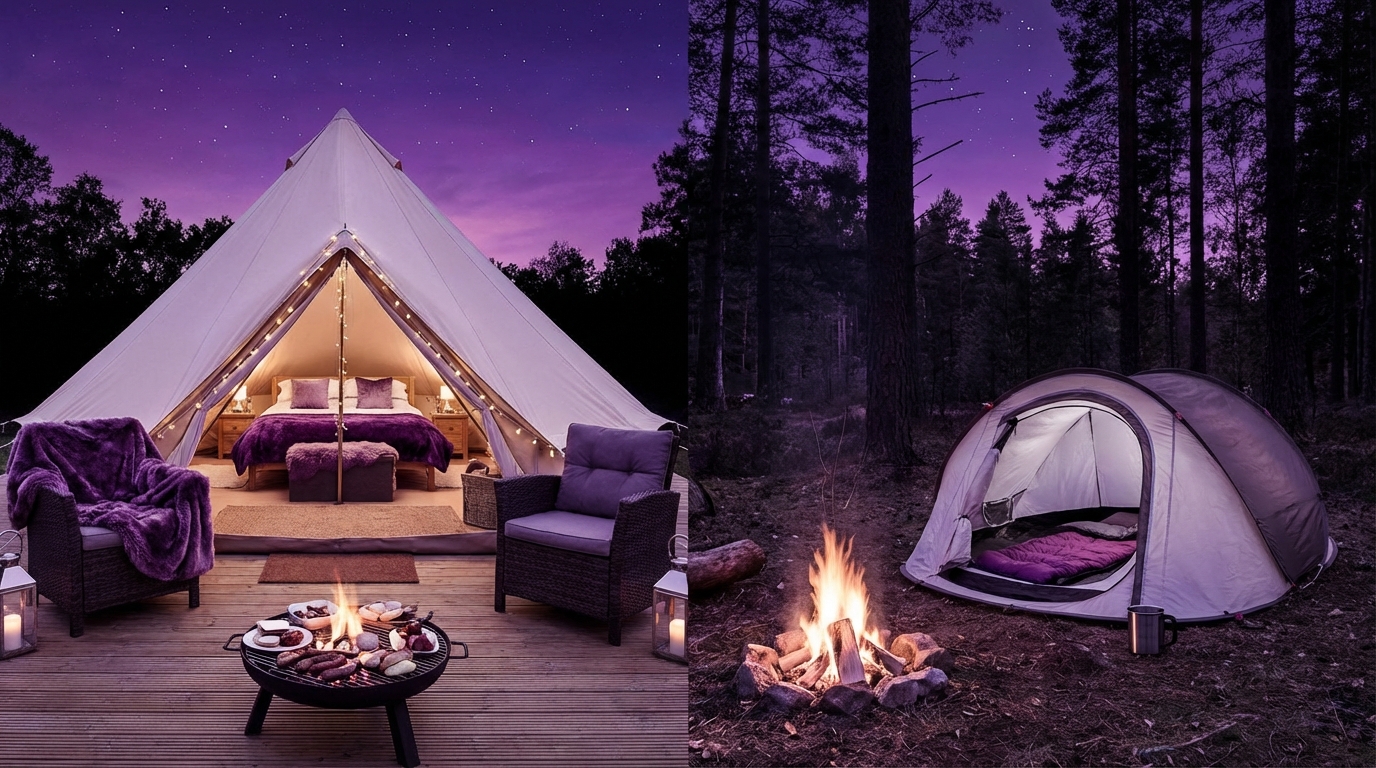

“Glamping is just camping for people who hate nature.”
That line is everywhere. Social feeds. Comment sections. Group chats when someone floats the idea of “glamping” for the next trip.
It is not true. Or at least, it is incomplete. Glamping is not the enemy of “real” camping. It is just a different tradeoff. More comfort, less grit. More structure, less improvising. The real question is not “Is glamping fake?” The real question is the one in your title: is the upgrade worth it for you, for this trip, with these people, at this point in your life?
If you only remember one thing from this article, let it be this:
Glamping is worth it when comfort and convenience help you spend more time outside, with less stress and more energy. Camping is worth it when you want simplicity, lower cost, and the feeling that you are doing more things yourself.
I might be wrong, but most arguments about glamping vs camping are not about tents or mattresses. They are about identity. “I am the kind of person who…” Once you drop that, the decision gets calmer and more practical.
So instead of starting with gear or budget, I want you to start with a few blunt questions:
Are you trying to rest, or trying to test yourself?
Are you traveling with people who are excited about roughing it, or people you do not want to scare away from the outdoors forever?
Are you more stressed by planning and packing, or by paying extra?
Your honest answers matter more than any trend or viral “aesthetic.”
“Real camping means sleeping on the ground and suffering a little.”
That is one of those strange beliefs that hangs around because it feels tough. But discomfort by itself does not make a trip meaningful. A miserable trip can turn into a funny story later, yes. It can also turn into your partner saying “Never again” and refusing every future outdoor plan.
I want to walk through glamping vs camping in a way that respects both. No shaming. No camping snob voice. No glamping brochure voice. Just tradeoffs.
What “Camping” Really Means (And What People Pretend It Means)
When people say “camping,” they often mix up three different things:
1. Sleeping outside or in a simple shelter.
2. Doing more of the work yourself.
3. Accepting some level of discomfort.
Some campers are into all three. Some like campgrounds with hot showers and a camp store. Some go deep into the backcountry with everything on their back. Others drive up to a site with a big cooler and a giant tent and still call it “roughing it.”
I am not saying any of them are wrong. I am saying “camping” is a wide word.
Glamping is not a different planet. It is just further along the same line toward more comfort and less work.
“If you are not pitching your own tent, it does not count as camping.”
That kind of gatekeeping is useful for exactly no one. The outdoors is not a private club.
Here is a simpler way to think about it:
– Camping: you bring most of the gear, do most of the setup, accept more variability in comfort.
– Glamping: the host provides most of the structure, you get more predictable comfort, you pay extra for that predictability.
Neither one is morally better. They just fit different goals.
What Counts as Glamping vs Camping? Clear Definitions
Before comparing, it helps to be concrete.
Typical Camping Setup
Camping usually looks like this:
– You bring a tent, sleeping bags, sleeping pads, and most cooking gear.
– You handle setup: pitching the tent, arranging the site, managing the fire.
– Bathrooms might be shared or basic, sometimes just pit toilets.
– Water might come from taps, pumps, or nearby sources that you treat.
– Weather control is limited: you deal with heat, cold, and noise more directly.
The key point: your experience depends a lot on your gear and your skills.
Typical Glamping Setup
Glamping is wide, but often includes:
– Fixed structures: bell tents, yurts, cabins, pods, airstreams, “tiny houses.”
– Real beds with mattresses, sheets, pillows.
– Some kind of power: outlets, lights, sometimes Wi-Fi.
– Often private or semi-private bathrooms, or at least much nicer shared ones.
– Heat or AC in many cases, plus insulation.
– Many hosts supply cookware, dishes, seating, sometimes even breakfast or meals.
You are still close to nature. You might still hear crickets, feel the breeze, walk on dirt. But your basic comfort is less of a question mark.
The Real Tradeoffs: Comfort, Effort, Cost, and Control
To know if the upgrade is “worth it,” you have to look at the main tradeoffs in a structured way.
Here is a table to keep things clear.
| Factor | Camping | Glamping |
|---|---|---|
| Upfront cost per night | Lower | Higher |
| Gear cost (lifetime) | Higher (if you buy your own) | Lower (for casual or rare trips) |
| Comfort (sleep, climate) | Highly variable | More predictable |
| Effort & setup | Higher | Lower |
| Control over setup | High | Lower |
| Sense of “doing it yourself” | Stronger | Softer |
| Weather exposure | More direct | More protected |
| Group suitability | Great for willing, prepared groups | Better for mixed comfort levels |
Let me walk through these without turning it into a sales pitch for either side.
1. Money: Nightly Cost vs Long-Term Spend
Most people look at the nightly rate first. Glamping can be 2x, 3x, even 5x more than a basic campsite. At first glance, camping looks like the obvious winner for your wallet.
But there is a catch.
Camping only stays cheap if:
– You already own gear, or
– You go often enough that the gear pays for itself.
If this is your first time and you want to outfit a family, that “cheap” camping trip can look like this:
– Tent
– Sleeping bags for each person
– Sleeping pads or air mattresses
– Cooler
– Camp stove
– Lanterns or lights
– Kitchen kit (pans, utensils, plates, etc.)
– Tarp or shade
– Folding chairs
Buy all of that new and you can easily spend more than several nights of glamping. Rent some of it and the math shifts again.
So glamping can make more sense if:
– You only go once a year.
– You want to “test” whether you even like sleeping outdoors.
– You do not have storage space for gear.
On the other hand, if you love the idea of many trips over years, camping gear is like an upfront membership fee. After that, every cheap campsite night saves money compared to glamping.
2. Comfort: Sleep, Bathrooms, Weather
A full night of deep sleep is not a luxury. It affects mood, patience, and how you remember the trip.
Tents can be great when:
– You have good pads or cots.
– You pick level, soft ground.
– You bring warm-enough bags and layers.
They can be awful when:
– The ground is uneven or rocky.
– You underestimated the temperature.
– Wind keeps slapping the tent walls.
– Nearby campers are loud past midnight.
Glamping raises the floor of comfort. You are more likely to get:
– A mattress that feels like home.
– Real sheets instead of zippers and nylon.
– Better insulation from noise and wind.
– Solid walls that feel safer to light sleepers.
Bathrooms are similar. With camping, you might have a short walk at night with a headlamp and some guesswork. Glamping often removes that mental load.
Is that “worth it”?
Here is a simple test: if poor sleep tends to color your whole memory of an experience, glamping starts to look like an investment in the outcome, not a luxury.
If you are the type who can fall asleep anywhere and stay asleep, camping’s variability may not bother you.
3. Effort: Setup, Packing, and Invisible Work
Many people underestimate how much energy goes into:
– Planning the packing list.
– Shopping for gear and food.
– Packing the car.
– Driving, arriving late, setting up in the dark.
– Cooking with limited tools.
– Breaking down camp in the morning.
Some people love that process. They like practicing skills, refining their setup, feeling prepared. If that is you, camping is not a burden. It is part of the fun.
For others, especially the person in the group who does most of the mental and physical work, that list looks like a part-time job on top of regular life.
Glamping removes some of that:
– Less gear to pack.
– No tent to pitch or break down.
– Often fewer decisions to make on site.
You still need to plan clothes, some food, and activities, but the “invisible work” drops.
If your schedule is already crowded, that easier path might be exactly what lets the trip happen at all.
4. Control vs Convenience
Camping gives you more control:
– Where you pitch the tent.
– How you arrange the site.
– How remote or busy your area is.
You can pick quieter loops, more trees, more shade, or closer access to trails. You are not limited to a set structure.
Glamping trades some of that control for convenience. You usually accept:
– A fixed spot chosen by the host.
– The host’s idea of decor and layout.
– The amenities and rules provided.
If you are picky about how your space feels or you want freedom to adjust everything, camping feels better. If you do not care as long as things work, glamping saves time.
Who Glamping Is Perfect For (And When It Is Not)
Instead of saying “glamping is good” or “camping is pure,” let us match each option to real situations.
Glamping Makes Sense When…
1. You are introducing someone to the outdoors.
If your partner, friend, or family member is nervous about bugs, bathrooms, or sleeping on the ground, throwing them straight into basic camping can backfire.
Glamping lets them taste:
– The night sky
– Morning air
– Outdoor meals
without feeling unsafe or miserable. That first positive memory opens the door for future trips, maybe more rustic ones later.
2. You want a low-stress short break.
For a single weekend, especially after a busy stretch, you might not have the energy to plan a full camping setup. In that case, it is rational to buy back your time and mental space with a ready-to-go glamping stay.
3. You are traveling with kids or older adults.
If you have toddlers, school-age kids, or grandparents with you, predictable sleep and easy bathroom access can be the difference between a relaxed group and a meltdown-filled disaster.
4. Weather is intense or unpredictable.
In very hot, very cold, or very wet periods, glamping with heating or AC might be the only way some people can safely and comfortably be outside. You still get nature; you just do not gamble your whole trip on a thin nylon wall.
Glamping Probably Is Not Worth It When…
1. You crave the satisfaction of full self-reliance.
If the main draw for you is testing your skills, feeling resourceful, and solving problems as they come, glamping might feel flat. You might feel like you paid someone to do the “interesting” part.
2. You have solid gear and go often.
Once you already own good camping gear and have a routine, campground fees are low compared to glamping. In that phase, the extra money might feel like a waste.
3. You want remoteness above all.
Some of the most remote, quiet places will not have glamping setups. If you want solitude, deep trail access, or very specific locations, camping will usually give you more options.
The Emotional Side: Identity, Pride, and Social Pressure
I want to call out something that often shapes these choices in the background: pride.
“Real outdoors people do not need glamping.”
You might not say that out loud, but you have probably felt that attitude somewhere. You might even feel it about yourself.
The problem is, pride does not keep you warm at 3 a.m. It does not carry your gear. It does not make your friends enjoy the trip more.
If you feel yourself thinking:
– “People will think we are soft if we book glamping.”
– “Camping is the only authentic way.”
pause for a moment. Ask:
– Is that belief helping me plan a better trip?
– Or is it just a story I picked up?
There is nothing “fake” about wanting sleep, privacy, or a working heater. There is also nothing embarrassing about enjoying simple tent life. Both are valid.
The smarter question is:
What mix of discomfort and comfort gives me the most meaningful, repeatable outdoor time?
If you choose camping and your group is cold, grumpy, and counting the hours until they can go home, that trip failed its purpose. If you choose glamping and your group relaxes, explores, and returns wanting more, you did it right.
Experience: What Feels Different On-Site
Move away from price and gear for a minute. Think about how glamping vs camping feels hour by hour.
Typical Camping Day
Morning:
– Wake up with the sun, birds, or neighbors.
– Crawl out of a sleeping bag, maybe a bit stiff.
– Boil water for coffee on a camp stove.
– Eat a simple breakfast, maybe with some smoke from the fire.
Daytime:
– Activities: hiking, swimming, exploring, reading in a camp chair.
– Some chores: gathering firewood where allowed, managing cooler ice, tidying the site.
Evening:
– Build or tend a fire.
– Cook dinner with basic tools, often one or two pots.
– Eat in camp chairs, on a picnic table, or on a blanket.
– Quiet talk around the fire, stars overhead.
There is often more physical effort, more small tasks, more improvising.
Typical Glamping Day
Morning:
– Wake up in a real bed. Less stiffness for many people.
– Coffee might be from a kettle, a small machine, or a provided setup.
– Breakfast is easier to prepare if there is a mini kitchen or shared cooking area.
Daytime:
– Similar outdoor activities: hikes, walks, water time.
– Fewer chores tied to your shelter. The structure is already stable and stocked.
Evening:
– Some glamping sites still offer fire pits or grills.
– Cooking can range from simple to quite elaborate depending on equipment.
– You often have more options to retreat inside if it gets cold, windy, or buggy.
The main difference is not “nature vs no nature.” It is how much of your attention is on survival basics versus relaxation.
For some people, that survival-lite focus is exactly what they want. For others, it is friction that distracts from connection and rest.
Risk, Safety, and Skill-Building
Another angle that often gets ignored: what are you practicing?
What Camping Teaches You
Camping rewards you with skills such as:
– Reading weather and preparing for it.
– Managing limited resources: water, fuel, food.
– Basic shelter setup and repair.
– Fire safety and cooking in simple conditions.
– Staying calm when things do not go to plan.
These are useful beyond the campsite. They can make you feel more capable in many settings.
If you want those skills, glamping will not give them to the same level. It removes many friction points. That is the point of glamping, but it comes with this tradeoff.
What Glamping Teaches You
Glamping can still nudge you to:
– Spend more time outdoors than you do at home.
– Learn the area: trails, weather, local wildlife.
– Reconnect with slower pacing and less screen time.
But it focuses less on survival skills and more on presence and comfort.
So ask yourself plainly:
Is this trip about learning and practicing, or about resting and reconnecting?
Your answer should heavily influence whether the glamping upgrade is worth it.
How to Decide: A Simple Checklist
At this point, you might still feel unsure. That is normal. A bit of ambiguity is fine. Still, we can minimize regret.
Here is a simple way to decide for your next trip.
Step 1: Rate Your Priorities
Take each of these and rate from 1 (not at all) to 5 (very much):
– I want this trip to feel restorative and low-stress.
– I care about cost more than comfort.
– I want to learn outdoor skills.
– I am bringing people who are new or nervous about camping.
– I want this trip to feel like an “adventure.”
– I know I get cranky with poor sleep or bad bathrooms.
– I expect to go on several trips in the next 2-3 years.
Then look at the pattern:
– High scores on “restorative,” “new/nervous people,” and “cranky without comfort” point toward glamping.
– High scores on “cost,” “skills,” and “multiple trips soon” point toward camping.
If your answers split, glamping for a first outing can help you test your preferences before you commit to gear.
Step 2: Look at Real Options, Not Abstract Ideas
One mistake people make is comparing a dream version of camping to a fancy brochure version of glamping. That is not fair.
Instead:
– Look up actual campgrounds within your reach.
– Look up actual glamping sites in the same general area.
Compare:
| Aspect | Camping Option You Found | Glamping Option You Found |
|---|---|---|
| Nightly price (all fees) | Fill with real number | Fill with real number |
| Travel distance & time | Fill with details | Fill with details |
| Bathroom setup | Fill with details | Fill with details |
| Weather protection | Fill with details | Fill with details |
| Activities nearby | Fill with details | Fill with details |
Sometimes the real camping option is crowded, noisy, or far, while the glamping option is quieter and closer. Sometimes it is the opposite. Base your choice on real listings, not stereotypes.
Step 3: Consider the “Worst Reasonable Case”
This is where many people are a bit optimistic.
For each option, ask:
– If things go mildly wrong (rain, noise, heat), what is the worst reasonable outcome?
– Would that outcome be a story I can laugh about, or something that might scare people off?
Example:
– Worst case camping: heavy rain leaks into a cheap tent, you sleep poorly, kids cry, bathrooms are muddy, you leave early.
– Worst case glamping: power goes out, it is warmer or colder than expected, some amenities do not work perfectly, but you still have a solid roof and bed.
It seems to me that this exercise alone pushes many first-timers toward glamping, at least for the first round.
Hybrids: Middle Ground Between Glamping and Camping
The choice is not always binary. There are several in-between options that can give you some of the comfort of glamping with more self-reliance.
Car Camping with Good Gear
If you drive right up to the site, you can bring:
– A larger, taller tent you can stand in.
– Thicker sleeping pads or folding cots.
– A decent camping table and chairs.
– Extra blankets and pillows from home.
Set up can still be work, but once camp is built, the comfort level is much higher than many people assume. For some, that is enough of an upgrade.
Cabins or Simple Huts
Many parks have basic cabins:
– Solid walls and roof.
– Bunks or simple beds.
– Sometimes no private bathrooms or kitchen, but access to shared facilities.
You still manage food, activities, and some packing, but you do not worry about shelter at all. This can be an affordable step between camping and high-end glamping.
Renting Gear for Camping
If you are camping-curious but not ready to buy gear, renting is an underused option. Some stores and local services will rent:
– Tents
– Sleeping bags and pads
– Stoves and cookware
That way, you experience real camping, but you reduce the upfront investment. If you like it, then you can buy your own gear with more confidence.
Common Mistakes People Make (And How to Avoid Them)
Here is where I will push back a bit on bad approaches I see often.
Mistake 1: Treating Camping as “Cheap Lodging” Only
Many people think, “I want to save money on a trip, so I will just camp instead of booking a hotel or glamping spot.” That can work, but:
– If you buy lots of gear in a rush, you might not actually save.
– If you do not learn how to use it, your experience will suffer.
If cost is your only driver and you do not care about outdoor skills or the feeling of camping, you might be better off:
– Finding simple budget cabins
– Watching for off-season deals on glamping
Camping shines when you care about the process, not just the price.
Mistake 2: Forcing Hardcore Camping on Newcomers
If you pressure friends or family into basic camping before they are ready, you risk:
– Turning them off from nature for years.
– Creating tension in your relationships.
A better approach is:
– Start with glamping or cabins.
– Have one “camp night” outside under the stars if people feel up for it.
– Gradually introduce more rustic trips for those who are interested.
You want people to associate the outdoors with positive feelings, not with dread.
Mistake 3: Buying Poor Gear and Blaming Camping
Cheap tents, thin pads, and under-rated sleeping bags can make anyone miserable. Then they say, “Camping is awful.” The real problem was gear and planning.
If you are going to camp:
– Borrow or rent decent gear for your first trip, or
– Spend a bit more on one or two key items like a good sleeping pad.
Glamping hides these gear mistakes because someone else already solved them for you. Camping exposes them.
Bringing It Back to Your Question: Is the Upgrade Worth It?
Let me answer your title as directly as I can.
Glamping is worth the upgrade if:
– You care more about relaxation than about practicing outdoor skills.
– You are inviting people who need extra comfort to feel safe and open.
– You are going on a short trip and you are low on planning energy.
– You are not sure you like sleeping outside and want a gentle first step.
Glamping is probably not worth it if:
– You enjoy planning, packing, and setting up.
– You already own good gear and use it often.
– You are chasing a sense of simplicity, challenge, and self-reliance.
– You want to stretch your budget across many nights or longer trips.
If your goal is “more quality time outside, more often,” both paths can get you there. The “right” choice is the one that people in your group will want to repeat.
So instead of asking, “Is glamping real?” ask:
– “Will this experience make us want to come back to nature next month or next year?”
If the answer is yes, then for that trip, the upgrade was worth it.
