
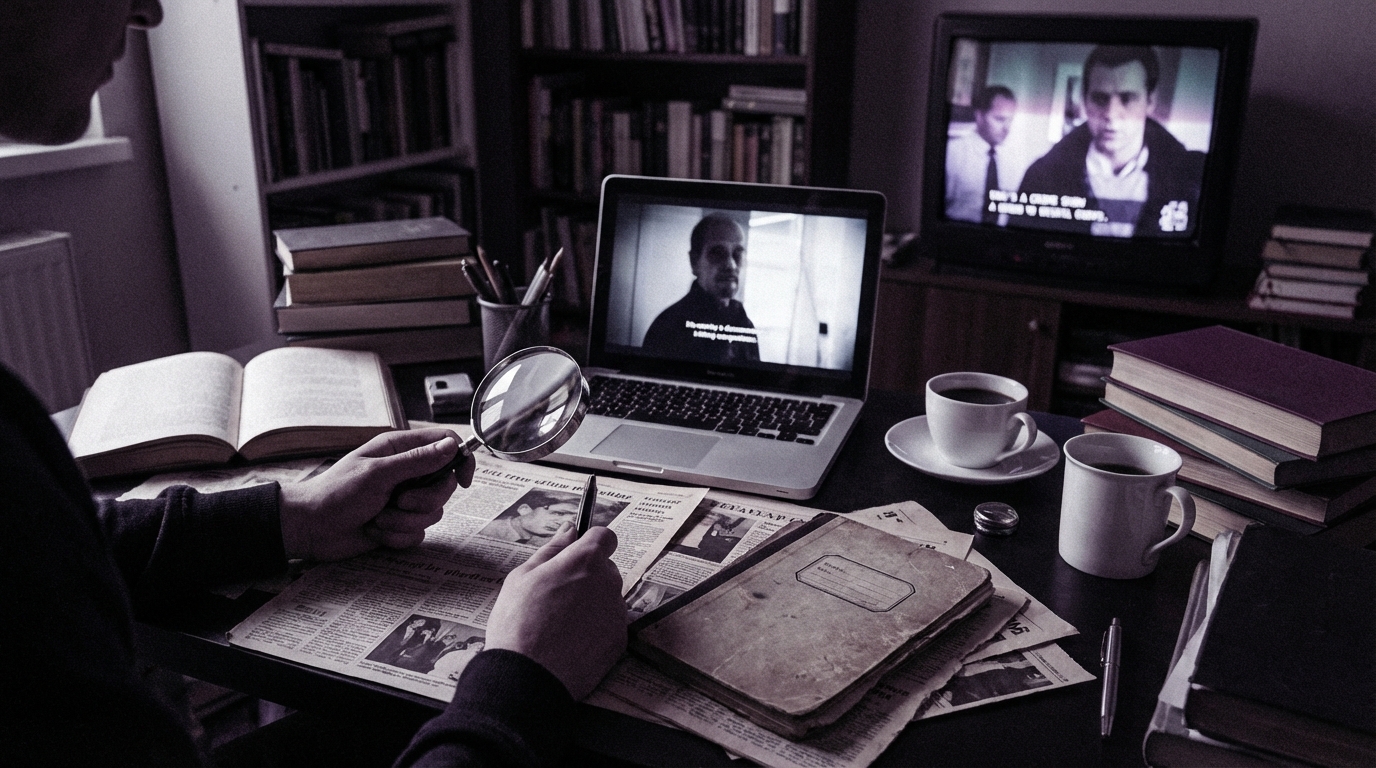

“True crime documentaries are dangerous because they glorify killers and make people lose empathy.”
That quote feels confident. It also misses most of what is actually happening.
Some true crime content is shallow and sensational. That part is real. But the reason so many people are obsessed with these documentaries is not that we secretly glorify criminals. It is that we are trying to understand fear, risk, justice, and our own minds in a controlled way. We want to feel close to danger while sitting safely on our couch. We want answers to questions that, deep down, may not have clear answers at all.
I might be wrong, but this obsession says more about us than about the crimes themselves.
You are not weird if you watch true crime before bed. You are not broken if you binge a six-part series about a case you already know. You are doing what humans have always done: trying to turn uncertainty into something you can hold, think about, and maybe predict.
Why true crime feels like “safe danger”
True crime documentaries give people a structured way to interact with something that, in real life, is chaotic and sometimes random.
The story usually starts with a victim, a crime, a setting. Then an investigation. Suspects. Clues. The trial. The verdict. Even when the case is unsolved, the documentary often gives you theories and patterns.
Real life does not come with this structure. It is messy. Police make mistakes. Courts get things wrong. People lie. Memory fails.
On screen, all of that mess is still there, but it is organized. Ordered. Edited into a path you can follow.
So you get:
– Fear, but inside a box.
– Suspense, but with pause and rewind.
– Violence, but with distance.
That is “safe danger.” You get the mental and emotional charge without physical risk. In a way, you are doing exposure therapy on yourself without calling it that.
“People who watch a lot of true crime are more paranoid and less trusting.”
Sometimes that happens. But not always. What actually happens is more subtle. For some viewers, trust goes down. For others, awareness and care go up. The line between those two outcomes is thin.
If all you consume is content that shouts “no one is safe, everyone is evil,” your view of the world will shift. If you watch stories that highlight flaws in systems, patterns of abuse, and the way victims are failed, your view might sharpen instead of just darken.
It seems to me most people are trying to do the second thing, even if they do not say it like that.
The brain science behind the obsession
You do not need a neuroscience degree to feel what your brain is doing during a good true crime documentary. But it helps to name a few things.
Dopamine and the “mystery loop”
Your brain loves incomplete patterns. A question without an answer is a small itch. A mystery is a big one.
A typical true crime documentary feeds that itch like this:
1. Present a disturbing event.
2. Withhold clarity.
3. Offer partial answers.
4. Reveal twists.
5. Land on a resolution or a theory.
Every time you get a new clue, your brain gets a little jolt of dopamine. It is not just pleasure. It is the sense of “progress.” You feel closer to the truth.
The key part: you are not just watching. You are guessing. You form theories. You judge people. You replay earlier scenes in your head.
That constant mental engagement is one reason people say they “cannot stop thinking” about a case. Their brain is still trying to close open loops.
Threat detection and survival learning
Your brain is wired to notice threats. Not just for you, but for your group. For many viewers, true crime feels like getting a free training session in danger detection.
You watch a case about someone who trusted a charming stranger. Your brain stores signals: voice tone, behavior, setting.
You see a story about a partner who slowly escalated control before turning violent. Your brain tries to file those small red flags under “warning signs.”
Are these signals always accurate? No. Sometimes they are biased. Sometimes they are based on rare events. But your brain does not care about statistics on a gut level. It cares about “Could this happen to me or someone I know?”
So you watch, and part of you is constantly asking:
– “What went wrong?”
– “Where was the turning point?”
– “What did everyone miss?”
That feels like morbid curiosity from the outside. Inside, it is closer to survival training.
Empathy, anger, and “moral accounting”
True crime documentaries also hit emotional buttons:
– Empathy for victims and families.
– Anger at systems that failed them.
– Relief when someone is held accountable.
– Frustration when justice does not match the harm.
Your brain likes moral clarity. It likes seeing wrongs turned into some kind of right, even if it is imperfect. That is why verdict scenes feel so gripping. It is not only about facts. It is about emotional math.
“Does this punishment fit what happened?”
“Does this apology feel honest?”
“Does anyone really understand what was lost?”
When that math does not add up, you feel a lingering tension. The story stays with you. That is part of the obsession too.
How true crime became a comfort genre
It sounds strange to call true crime “comfort viewing,” but for many people it is exactly that.
“How can you fall asleep to a story about murder? That cannot be healthy.”
On paper, I agree with that reaction. In practice, many people do it. And they function just fine.
Here is why some viewers treat true crime like background noise:
– The structure is predictable.
– The rhythm of interviews and narration is steady.
– You know what kind of emotional ride you will get.
Compare that to real life stress: job pressure, money worries, family conflict. Those do not have clear arcs or credits at the end. They just keep going.
True crime has a beginning, middle, and end. You can pause it. Choose it. Abandon it. That control itself feels safe.
It might sound odd, but some people would rather hear about a solved case than deal with the vague anxiety of their own day. The story is dark, but the edges are clear.
The ritual and community part
Another piece of the comfort comes from rituals:
– Watching every new episode of a popular series as soon as it drops.
– Listening to a new true crime podcast while cooking or commuting.
– Texting a friend live reactions during a documentary.
Ritual makes media feel less like content and more like routine. Routine calms people. It creates anchors in a week that can otherwise feel random.
Then there is the social layer. Viewers share theories online, argue about suspects, criticize police work, and praise or question filmmakers.
That sense of “we are in this case together” turns what could be a lonely habit into a shared activity.
Why women, in particular, flock to true crime
Not every study agrees on the exact numbers, but many reports and surveys point in a similar direction: women form a large part of the audience for true crime documentaries and podcasts.
There are a few reasons that come up again and again.
Managing fear through information
Many women already move through the world with a strong sense of possible danger. Not in a dramatic way. In a daily, practical way:
– Checking the back seat of the car.
– Texting friends when they get home.
– Keeping keys in hand at night.
True crime stories that focus on stalking, assault, or domestic abuse feel close to those lived experiences. Watching them is not just thrill seeking. It is sometimes a way to gather “data” on how danger escalates.
The logic, even if not spoken out loud, can be:
“If I understand the patterns, I can spot them earlier.”
“If I know what other people missed, I might avoid that.”
This is not foolproof. Some viewers may end up more afraid than before. But many report feeling more prepared, not only more scared.
Recognition and validation
For years, the stories of abused partners, missing girls, and marginalized victims did not receive much attention. True crime documentaries, at their better moments, put those stories at the center.
When a documentary takes a victim seriously, shows their life fully, and calls out the ways they were ignored, some viewers feel seen. They recognize the small dismissals, the “you are overreacting” messages they have heard.
So the obsession is not only with crime. It is also with having certain types of harm finally treated as real and serious.
Storytelling tricks that keep you hooked
If you strip away the topic for a second, many true crime documentaries are just very well constructed stories. Filmmakers know exactly how to keep you from pressing stop.
Here are some of the most common methods.
Nonlinear timelines
Instead of starting at the beginning and moving straight through, many series jump around:
– Start with the crime scene.
– Jump back to the victim’s childhood.
– Cut to present day interviews.
– Drop back into key moments of the investigation.
This back and forth does two things:
1. It hides information just long enough to create tension.
2. It lets you build emotional connection before you know every fact.
Your brain likes puzzles. It also likes people. Nonlinear timelines tie those two preferences together.
Unreliable narrators and perspective shifts
Some of the most gripping documentaries play with point of view. You might hear the story first from law enforcement, then from a family member, then from the suspect, then from a journalist.
Each version introduces bias and holes. So your job as a viewer becomes:
“Whose story feels closest to the truth?”
“Where are the gaps?”
“Who is avoiding which details?”
This is more engaging than a monotone voice telling you everything as if it is certain. It reflects real life, where no one has the whole picture.
The slow reveal of documents and physical evidence
Interviews are one layer. Documents, recordings, and photos are another. Many documentaries “save” key pieces of evidence for later episodes:
– A late-discovered witness statement.
– A forgotten police report.
– A missing phone record.
– An old diary entry.
When these appear, they reframe your thinking. You mentally edit your own theory and re-judge everyone. That creates another dopamine spike and pulls you deeper into the case.
The ethical tension: entertainment vs real suffering
Here is where the obsession gets uncomfortable.
“If you watch true crime for entertainment, you are exploiting someone’s worst day of their life.”
That sentence stings because it carries some truth. Real people were harmed. Real people died. Their families live with that forever.
So when millions of viewers treat those stories as weekend content, it raises real questions:
– Where is the line between awareness and spectacle?
– Who profits from these stories?
– Who gets protected, and who gets misrepresented?
I might be wrong, but a lot of viewers do feel this tension. They want to learn and care, not treat tragedy like a hobby. Yet the format of bingeable series and high-budget trailers leans toward entertainment.
Victim-first vs killer-first storytelling
One way documentaries handle ethics is by choosing how much focus to put on victims versus perpetrators.
A rough comparison:
| Approach | Main Focus | Potential Impact on Viewers | Potential Impact on Families |
|---|---|---|---|
| Victim-first | Life of the victim, community, context of harm | More empathy, broader social reflection | Greater sense of respect, but can still reopen wounds |
| Killer-first | Psychology, methods, “genius” or “monstrous” traits | More thrill, risk of fascination with the perpetrator | Possible feeling of erasure or glorification |
| System-first | Police work, courts, forensic science, media | More focus on institutions and errors | Can expose injustice, but might sideline personal grief |
Many viewers are getting better at spotting when a documentary leans too far into killer-first framing. They push back online, call attention to names and faces of victims, and question marketing that feels exploitative.
Consent, retraumatization, and profit
Another ethical layer is consent. Were families involved? Were they ignored? Did they object to the project? Were details included that they asked to keep private?
You can feel the difference between a series that treats subjects as people and one that treats them as content. The first tends to:
– Give space to family members’ voices.
– Avoid replaying suffering just for dramatic effect.
– Provide context about community impact.
– Acknowledge what remains unknown.
The second often:
– Relies heavily on graphic reenactments.
– Repeats gruesome details for shock value.
– Centers the killer’s “brand.”
– Skips over long-term aftermath.
Viewers who are conscious of these issues will still watch, but they will also pause, critique, and sometimes withdraw support.
How true crime shapes what we think “real danger” looks like
One of the less obvious effects of constant true crime viewing is that it can skew your picture of risk.
Stranger danger vs everyday harm
Many documentaries highlight:
– Rare serial offenders.
– Strange, elaborate plots.
– Unusual, headline-grabbing cases.
Those are compelling on screen. They feel different and shocking. Yet many real-world harms are much more ordinary:
– Violence from partners or family.
– Financial scams by people you think you can trust.
– Neglect and abuse in care settings.
When your media diet leans heavily on unusual stranger cases, your brain may overestimate that kind of risk and underestimate risks closer to home.
To keep your sense of danger grounded, it helps to mentally separate:
– “What the story focuses on.”
– “What most people actually face.”
Both matter. They are just not the same.
Stereotypes and bias
True crime documentaries can also reinforce stereotypes, or they can challenge them. The choice sits with the storytellers and, to some extent, with viewers.
Patterns that sometimes appear:
– Suspects of certain backgrounds shown with harsher framing.
– Victims from certain groups given less depth.
– Communities portrayed as helpless or inherently violent.
Better work in the genre slows down and adds context:
– Historical patterns of policing in an area.
– How media covered the case at the time.
– Who did and did not get believed.
Viewers who watch a lot of true crime would benefit from asking:
“Whose version of danger is this?”
“Who is framed as believable, and who is not?”
“Who never gets the camera pointed at them?”
Those questions can turn passive consumption into more active thinking.
Why some stories stick with you for years
You probably have a short list of cases that live rent-free in your mind. You remember names, faces, certain dates. Others blur together and fade.
What makes certain stories linger?
Unresolved questions
Cold cases and ambiguous verdicts are especially sticky. Your brain does not like open loops. When:
– The body is never found.
– The main suspect is acquitted.
– Key evidence goes missing.
– Witnesses contradict each other.
You are left with a story that never fully lands. That lingering tension can feel uneasy, but it also keeps the case alive in your head.
Relatability to your own life
Stories hit harder when you can imagine yourself or someone you know in the same position:
– The college student walking home.
– The young parent at home with kids.
– The person moving to a new city for work.
If a documentary spends time on daily routines, hobbies, family dynamics, you start to see yourself in the picture. That is part of why some people end up changing small habits after watching.
For example:
– Double-checking locks more often.
– Sharing locations with friends.
– Being more cautious with online dating.
Some of this is practical. Some is driven by fear. The impact will differ from person to person.
How to watch true crime without losing your balance
Enjoying true crime does not mean you are broken. It means you are human and curious. Still, like any intense genre, it can tilt your view if you never reflect on how you are consuming it.
Questions to ask yourself while watching
These prompts can keep your viewing grounded and a bit more ethical:
| Question | Why it helps |
|---|---|
| “How are victims portrayed here?” | Checks whether the story respects people rather than objectifying them. |
| “Who is telling this story, and who is missing?” | Highlights whose perspective dominates and who is silenced or ignored. |
| “What part of this is rare, and what part is common?” | Prevents overestimating unusual forms of danger. |
| “What is unknown, and is the documentary honest about that?” | Reduces the urge to treat theories as facts. |
| “How do I feel after watching, and do I want more of that feeling?” | Makes your emotional state part of your viewing choice. |
If you often end episodes feeling anxious, hopeless, or numb, that is useful feedback. You might not need to quit the genre, but you may want to change what you watch or how often.
Setting your own boundaries
Because true crime covers real harm, personal limits matter. Different people draw lines in different places. Some common boundaries:
– Avoiding reenactments that show graphic violence.
– Limiting binge sessions and taking breaks between series.
– Skipping content that centers on children or certain types of assault.
– Choosing series that clearly involve and respect families.
– Stopping a show if you notice you are becoming more jumpy or distrustful in daily life.
This is not about moral purity. It is about mental health and respect, including self-respect.
Why the obsession is not going away soon
Interest in crime stories is not new. Old trial pamphlets, newspapers, radio shows, TV news specials, podcasts, and now streaming series all feed the same basic drive: to understand harm, justice, danger, and human behavior.
Streaming platforms and social media amplify that drive. They make it easy to:
– Watch entire series in a weekend.
– Get recommendations for more of the same.
– Join online communities around single cases.
– Turn viewing into a long-term hobby.
At this point, true crime functions almost like a shared reference pool. People drop case names in conversation and assume others will recognize them. That reinforces the cycle: new viewers feel drawn in so they are not left out.
So the obsession is not only about fear or thrill. It is also about:
– Shared language.
– Shared rituals.
– Shared attempts to make sense of dark parts of human behavior.
If you watch true crime, you are participating in that. The key is to be aware of how you participate.
You can:
– Choose stories that respect victims.
– Notice when your fear is based on rare events.
– Balance crime content with other types of media.
– Use your interest as a prompt to learn more about justice systems, bias, and prevention, not only about “monsters.”
The quote at the top said that true crime documentaries are dangerous because they glorify killers and make people lose empathy. That can happen. Some projects move in that direction.
But the full picture is more complex. Many people are not losing empathy. They are shifting it, expanding it, questioning where systems failed, and trying to carry that awareness into their own lives.
Your obsession with true crime is not just about crime. It is also about seeking control, understanding risk, and testing your moral compass from the safety of your living room.
