
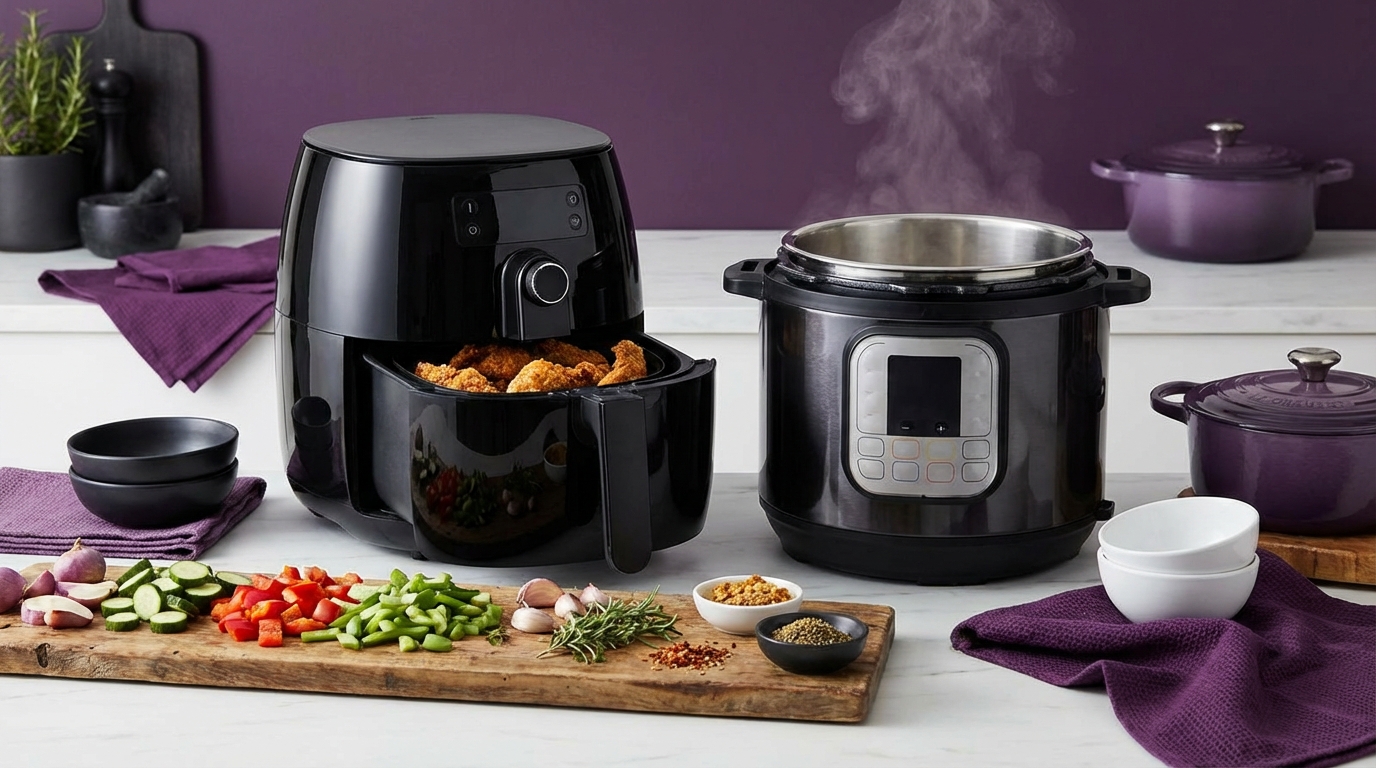

“Air fryers are just tiny ovens and Instant Pots are just pressure cookers with Wi-Fi. Neither really changes anything.”
That quote sounds confident, but it is wrong in a way that actually matters if you cook at home. Air fryers and Instant Pots really do change what you cook, how often you cook, and how much mental energy it takes. They are not the same thing, and one is not “better” than the other. The key choice is this: air fryer if you care more about quick crispy foods and small-batch cooking, Instant Pot if you care more about set-and-forget meals, stews, beans, and batch cooking. Some kitchens benefit from both, but many people only need one.
I might be wrong, but my guess is that if you are reading this, you are trying to avoid buying the wrong gadget that then lives in a cabinet for three years.
So let me be direct.
An air fryer is basically a small, very strong convection oven that pushes hot air around your food. It shines when you want crisp edges, browning, and “fried-like” results with less oil. It feels almost like a fast toaster oven that can fake deep-fried textures.
An Instant Pot is a brand of electric multicooker known mostly for pressure cooking, but it can also slow cook, steam, sauté, and keep food warm. It shines when you want tender results, one-pot meals, and foods that usually take a long time, like beans, stews, and braises, done much faster.
So the real question is not “Which is better: air fryer or Instant Pot?”
The real question is “What do you actually cook, and what do you wish felt easier?”
If your weekly menu rarely includes roast chicken, frozen snacks, or roasted vegetables, then an air fryer might look fun on TikTok but not earn its space in your kitchen.
If you never cook dry beans, stews, big soups, or tougher cuts of meat, then an Instant Pot might sound smart but gather dust after two recipes.
I will walk you through how both really behave in a normal home kitchen, where time, counter space, and energy matter more than fancy features. I want you to see where each gadget shines, where it fails, and where people waste money.
“Air fryers are healthier than regular ovens because they use less oil.”
Not quite. An air fryer can help you use less oil compared to deep frying. Compared to baking in a regular oven though, the “health” difference comes more from what you cook, not the device. The real win is that the air fryer can make healthier versions of crispy foods you might otherwise buy pre-fried or order out.
“Instant Pots cut cooking time by 70% and make every meal fast.”
That line comes from marketing, not from your Tuesday night reality. Pressure cooking inside an Instant Pot does speed up cooking of certain foods a lot: beans, stews, tough cuts, whole grains. But it does not speed up everything. It needs time to come to pressure and time to release pressure, and those minutes count.
“You need both if you want a modern kitchen.”
I disagree. Many people manage perfectly with neither. Some do best with one. Owning both can be great, but only if you actually use them often.
Let us dig into how they compare in real life.
What an air fryer really is (and what it is not)
An air fryer is a compact electric oven with a strong fan. It blasts hot air over and around your food. That air hits oil on the surface of food and helps it crisp and brown.
People often expect an air fryer to be a deep fryer replacement. It is not. It can mimic some textures, but not all.
Here is what actually stands out with most air fryers:
Strengths of air fryers in everyday cooking
Air fryers tend to shine in these situations:
You want fast, crisp results for small portions.
You want an easy way to cook snacks or sides without turning on your full oven.
You like convenience foods but want a bit less oil and faster cook times.
You will notice a pattern here: air fryers suit smaller, dryer, surface-focused foods.
Some very common wins with an air fryer:
– Frozen fries, wedges, tater tots
– Frozen breaded chicken (tenders, nuggets, patties)
– Roasted vegetables (broccoli, cauliflower, Brussels sprouts, carrots)
– Reheating pizza or fried food while keeping them crisp
– Cooking small pieces of chicken, tofu, or fish quickly
– Toasting nuts or chickpeas
These are foods where browning, crisping, and surface texture matter.
Now, the part that many people realize only after buying one.
Limits and annoyances of air fryers
Air fryers have some real limits:
– Capacity: Most basket-style air fryers do not hold a full meal for a family in one batch. You end up cooking in two or three rounds, which kills the time savings.
– Noise: The fan can be loud. Not a deal breaker, but not silent.
– Clean up: Baskets and trays need regular cleaning. If you skip it, you get smoke and smells.
– Uneven browning if overcrowded: You need space around food. Piling food up reduces crispness.
– Breaded “from scratch” food still needs a bit of oil. Air alone does not make magic.
If you are cooking for one or two people, the capacity issue is small. If you cook for four or more, this is not a small detail.
What an Instant Pot really is (and what it is not)
An Instant Pot is an electric multicooker. Its star feature is pressure cooking, but it can also slow cook, sauté, steam, and keep food warm. Some models add functions like yogurt making or rice cooking.
People often expect an Instant Pot to replace every pot and pan. That is not realistic.
The real value is simple: it brings pressure cooking into a safer, more hands-off format. You do not stand over a pot. You press a button and walk away.
Strengths of Instant Pots in everyday cooking
Instant Pots work best with foods that are water-heavy or sauce-based:
– Stews (beef, chicken, lentil, vegetable)
– Curries and braises
– Beans from dry (without soaking, or with short soaks)
– Whole grains like brown rice, barley, farro
– Tough cuts of meat that usually need slow cooking
– Broths and stocks
– Pot-in-pot cooking (for example, rice in a small bowl over a curry or stew)
What stands out is not speed alone. It is the combination of speed and tenderness with low hands-on time.
You set it up, let it come to pressure, then leave it. No stirring, no watching. It finishes and switches to Keep Warm, and your food stays safe for a while.
That can change how you feel about cooking after work. Instead of stirring a pot for 45 minutes, you spend 10 to 15 minutes on prep, press a button, and go do something else.
Limits and annoyances of Instant Pots
Instant Pots are not perfect either:
– There is a learning curve: figuring out times, liquid amounts, and what works well.
– Total time can surprise you: recipes say “10 minutes at high pressure,” but that might mean 10 minutes to come to pressure, 10 minutes at pressure, and 10 minutes to release pressure. So 30 minutes total.
– You do not get crisp browning inside pressure mode: food cooks in steam and liquid.
– Sauté mode is good, but not as strong as a real pan on a gas or induction stove.
– Some people do not like the sealed-lid cooking feeling; you cannot taste and adjust once it is under pressure.
If you picture “fast food in 10 minutes,” you might feel let down. If you picture “steady, predictable one-pot meals with less hovering,” it fits better.
Air fryers vs. Instant Pots: what they actually do differently
Here is the key difference in one line:
Air fryer: Dry heat + strong air flow, best for crisp, browned foods.
Instant Pot: Moist heat under pressure, best for tender, saucy, or brothy foods.
That drives almost everything else.
Cooking method comparison
| Feature | Air Fryer | Instant Pot |
|---|---|---|
| Primary cooking method | Dry heat with forced hot air (like a turbo convection oven) | Moist heat under pressure (electric pressure cooker + extra modes) |
| Best for | Crisp, browned foods, smaller portions, snacks, sides | Stews, soups, beans, braises, batch cooking |
| Texture focus | Crispy outside, drier surface | Tender, moist, falling-apart textures |
| Hands-on time | Short cooking time, but you may flip or shake food mid-cook | Short hands-on time, then mostly unattended |
| Preheat | Often 2 to 5 minutes | Needs time to reach pressure (often 5 to 15 minutes) |
| Batch size | Better for smaller batches | Better for larger batches |
Speed: what is actually faster?
People often assume the air fryer is always faster. That is not always true.
Think about a few real examples.
| Dish | Air Fryer | Instant Pot | Which feels faster? |
|---|---|---|---|
| Frozen fries (for 2 people) | 10 to 15 minutes cook time, brief preheat | Not suitable (texture will be soggy) | Air fryer |
| Chicken thighs, bone-in, for 4 people | 20 to 25 minutes, likely 2 batches unless large basket | 10 to 12 minutes at pressure, plus 10 to 15 minutes to come to pressure and release | Often close in total time, air fryer gives crisp skin, Instant Pot gives braised texture |
| Dried black beans (no soak), big batch | Not suitable | 35 to 45 minutes total including pressure time | Instant Pot |
| Roasted vegetables, small tray | 10 to 15 minutes | Texture not ideal; more like steamed | Air fryer |
| Beef stew, family-sized | Not really suitable | 45 to 60 minutes total including pressure | Instant Pot |
So speed is tied directly to the type of food.
If you care about dry, crispy foods, air fryers win.
If you care about big pots of wet, tender meals, Instant Pots win.
How each gadget changes your weekly cooking
This is where the decision really sits. Not in single recipes, but in patterns.
If you choose an air fryer
Your week might start to look like this:
– More roasted vegetables because you can cook a small tray fast with less waiting for a full oven.
– More homemade versions of frozen snacks with a bit less oil than deep frying.
– Less use of your big oven in hot months.
– Faster reheating of leftovers that you do not want to get soggy in the microwave.
You might find yourself doing things like:
– Tossing broccoli with a little oil and salt, air frying it for 8 to 10 minutes, and calling that your side.
– Throwing in a handful of frozen potato wedges to go with a sandwich.
– Reheating leftover roast potatoes or wings so they taste almost fresh.
If you are feeding kids who like nuggets, fries, or simple finger foods, this can remove friction from your evenings.
That said, if your meals are mostly stir-fries, salads, and pasta, the air fryer might only see occasional action.
If you choose an Instant Pot
Your week might start to look like this:
– Cooking larger batches of soups and stews on weekends and freezing portions.
– Making your own beans and broths instead of buying canned or boxed.
– Doing “dump and go” meals where you combine simple ingredients and let them cook together.
– Using cheaper cuts of meat that turn tender under pressure.
You might find yourself:
– Putting brown rice and water in the pot before your workout and coming back to cooked rice.
– Starting a lentil curry before a meeting and eating after it ends.
– Making a whole chicken in the pot, then using the bones for broth in the same pot.
The Instant Pot changes how you think about time. You start to anchor other small tasks around the cook cycle.
If your meals already lean toward stews, curries, grains, and beans, this can make cooking feel lighter.
Who should pick an air fryer, who should pick an Instant Pot
Let us walk through some common situations. If these do not fit you, that itself is useful feedback.
If you mostly cook for one or two people
You might lean toward an air fryer if:
– You often cook small portions and do not want to heat a full oven.
– You like crisp textures, roasted vegetables, and quick sides.
– You rely on frozen foods more than slow braises or beans.
You might lean toward an Instant Pot if:
– You like batch cooking and freezing meals for future days.
– You eat a lot of soups, stews, and grains and want them easier.
– You do not mind reheating leftovers and eating the same dish multiple times.
Both can work well for smaller households, but they serve slightly different cooking styles.
If you cook for three or more people
Here the Instant Pot often fits better, unless you buy a larger oven-style air fryer.
An Instant Pot:
– Handles larger volume in one pot.
– Helps with big pots of chili, stew, pasta dishes, or beans for the whole group.
– Can keep food warm safely for family members who eat at slightly different times.
A standard basket air fryer:
– Might not hold enough for a full meal in one go.
– Works best as a side or snack cooker, not the main container for protein for four.
There are larger, oven-style air fryers with racks that do better for families, but they also take more counter space.
If you do not enjoy cooking but want to eat at home more
This group is common and often misled by marketing.
If you do not enjoy cooking, you probably want:
– Short prep time.
– Simple clean up.
– Predictable results.
The Instant Pot can reduce active cooking time but does require learning a new method. If you do not like to think about recipes at all, that learning phase may frustrate you.
The air fryer is more intuitive for basic things: put food in, set temp and time, then check. Many people are already comfortable using an oven or toaster, so this feels familiar.
Still, if your idea of cooking is “open can, add to pot, heat,” then neither gadget will suddenly make you love the process. They only shift which parts feel easier.
Space, noise, and energy: boring, but real factors
Kitchen gadgets live in real kitchens, not in product photos.
Counter and storage space
| Aspect | Air Fryer | Instant Pot |
|---|---|---|
| Form factor | Often tall with a pull-out basket or front door | Shorter, squat pot with lid on top |
| Counter space | Needs front clearance to pull basket out | Needs top clearance to open lid |
| Storage | Baskets and trays to store or keep in place | Inner pot and lid; can store parts inside |
| Portability | Usually lighter | Heavier due to heating element and metal pot |
If you have low cabinets and limited vertical space, the Instant Pot lid might bump into them. If you have a narrow counter, the air fryer basket might stick out.
I might be wrong, but a quick way to test this is to tape out a footprint on your counter and pretend to “use” the space for a day.
Cleaning and maintenance
Air fryer:
– Basket and tray usually need washing almost every time.
– If crumbs and grease build up, you get smoke and smell.
– Nonstick coatings require gentle cleaning tools.
Instant Pot:
– Inner pot is easy to wash.
– Lid has a silicone ring that can trap smells and sometimes needs a deep clean.
– Steam release parts need occasional attention so they do not clog.
Neither is hard to care for, but both demand a small habit.
Energy use
Exact numbers depend on model and region, but some general patterns hold:
– Air fryers heat a smaller space and often cook faster for small portions, so they tend to use less energy than heating a full oven for the same small job.
– Instant Pots insulate heat well and work quickly on foods that normally simmer for an hour or more, so they can use less energy than a long stovetop simmer.
For most people though, the energy difference is not as meaningful as whether they actually cook at home more often. Takeout and delivery tend to impact both wallets and health more than a bit of electricity.
Common myths about air fryers and Instant Pots
“Air fryers do not need any oil”
Not true. You can cook some foods with no oil, but a small amount of oil improves browning and texture for many items, especially vegetables and fresh, unbreaded foods.
The difference is that you often use a teaspoon or tablespoon of oil instead of cups of oil in a deep fryer.
“Instant Pots make every meal taste the same”
This comes from people using similar tomato-heavy recipes over and over. Pressure cooking can blend flavors more deeply, but it does not force food into one taste. Variety in spices, sauces, and ingredients still matters.
If every recipe includes the same spice mix and canned tomatoes, your stovetop meals would blur together too.
“You cannot overcook food in an Instant Pot”
You definitely can. Overcooked vegetables can turn to mush. Chicken breast can dry out if the time is off. Beans can break down more than you want.
The margin of error is not infinite. It is just more forgiving for some foods than a hot pan.
“Air fryers are just a scam; a regular oven can do the same thing”
A regular convection oven can produce very similar results if it has strong air circulation and you preheat it. The difference is volume and convenience.
The air fryer heats up faster and concentrates hot air in a smaller chamber. For a single tray of food, this can feel faster and more pleasant than firing up a large oven.
So the question is not “Could my oven do this?” It is “Will I actually use my oven this often for small jobs?”
When owning both makes sense
Some people really do benefit from both gadgets.
This usually fits people who:
– Cook at home 4 or more nights per week.
– Feel comfortable with recipes and do not mind learning two devices.
– Have enough counter or storage space.
– See clear use cases for each: air fryer for sides and reheating, Instant Pot for mains.
A very common combo:
– Instant Pot: big pot of chili, stew, curry, or beans.
– Air fryer: crisped potatoes, garlic bread, or roasted vegetables on the side.
Another pattern:
– Instant Pot: cook chicken, pork, or beans to tender.
– Air fryer: use some of that cooked food in small crisped portions later (for example, crisped shredded chicken tacos).
If you rarely cook now, buying both in the hope that they will “make” you cook more is risky. You might spread your attention and not build habits with either.
Questions to ask yourself before buying
These questions can save you money:
1. What do you actually eat in a normal week?
Not your ideal diet. Your current one.
Write down 10 dinners from the last month. If most of them are:
– Soups, stews, curries, chili
– Rice or grain bowls
– Beans and lentils
Then the Instant Pot lines up very well.
If most of them are:
– Oven fries, nuggets, simple baked proteins
– Roasted vegetables
– Reheated takeout or frozen items that should be crisp
Then an air fryer fits your pattern better.
2. How much do you care about texture vs. sauce?
If you care a lot about crisp skin, golden edges, and roasted surfaces, the air fryer matches your priorities.
If you care a lot about tender, spoon-soft textures in a flavorful sauce or broth, the Instant Pot serves you better.
3. How do you feel about leftovers?
If you dislike eating the same food two or three days in a row, the Instant Pot’s batch strength might not match your habits.
If you are fine eating chili, soup, or curry for multiple meals, the Instant Pot becomes very powerful.
4. How much space can you give to a gadget?
If your counter is tight and you know you will not pull something out of a cabinet often, pick the one you see yourself leaving plugged in and ready.
A gadget you store far away is a gadget you rarely use.
Simple starting use cases for each
Sometimes people get stuck because they start with complex recipes. You do not need that.
Easy first wins with an air fryer
If you buy an air fryer, here are a few simple starting points:
– Frozen fries: Toss lightly with oil and salt, spread in a single layer, cook at around 380°F (about 193°C), and shake once mid-cook.
– Broccoli florets: Toss with oil, salt, and maybe garlic powder; air fry until edges are browned and crisp.
– Leftover pizza slice: Air fry at a moderate temperature for a few minutes until cheese melts and crust firms up.
These use the basic strengths of the air fryer: surface heat and quick browning.
Easy first wins with an Instant Pot
If you buy an Instant Pot, some easy starting points:
– Hard-boiled eggs: Many models have a reliable rule of thumb (for example, 5 minutes at pressure, followed by a quick release and an ice bath).
– White rice: Use the rice program or a known ratio, get used to the timing.
– Simple chicken stew: Sauté onions, add chicken, broth, and seasoning, cook under pressure for a short cycle.
These help you learn how long your pot takes to come to pressure and release. Once that feels normal, more involved recipes feel less like a guess.
Which should you actually buy?
Let me be clear and practical.
If your priority is:
– Crispy textures
– Roasted vegetables
– Frozen snacks and sides
– Toasting and reheating things that should stay crisp
Pick an air fryer first.
If your priority is:
– One-pot meals
– Beans and grains
– Soups, stews, curries
– Batch cooking for the week
Pick an Instant Pot first.
If you cook often, have space, and see distinct uses for each, then owning both can make sense. Just be honest about your real cooking patterns, not your ideal ones.
If your budget or space only allows one, you are not missing out. Choose the one that lines up with what your meals already look like, and build solid habits with it. After six months of real use, you will know if a second gadget would add real value or just take up space.
