
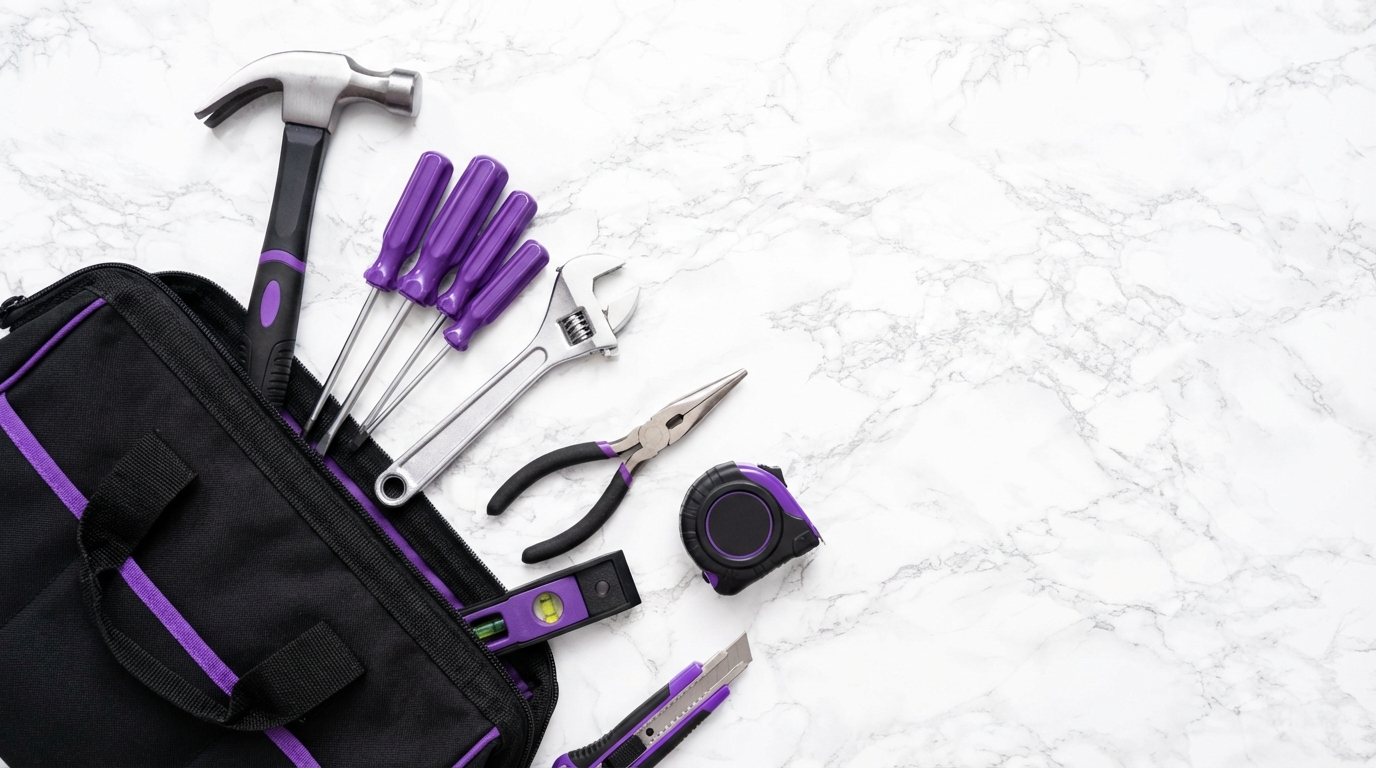

“If you own a home, you need every tool under the sun or you are not really prepared.”
That quote sounds strong. It also keeps a lot of people stuck. It is false. You do not need a garage full of gear, a truck, and a contractor’s license to take care of your home. You need a focused, smart tool kit that covers 90 percent of real problems you will face. The rest you can rent, borrow, or hire out.
I might be wrong, but most homeowners I talk to fall into one of two groups. Group one buys every gadget they see on a weekend store trip, then uses about five of them. Group two owns a single bent screwdriver and calls a professional for everything, even things they could fix in ten minutes.
Both groups waste money. Just in different ways.
There is a middle ground. A small, clear, honest set of tools that earns its space in your home. The kind of kit that lets you hang shelves, fix a leaking trap, swap a dead outlet, seal a draft, and open a painted-shut window without feeling lost.
That is what this guide is about.
I will walk through what I think every homeowner should have, where it makes sense to spend more, where it is fine to save, and how to avoid buying duplicates you never touch. I will also point to the tools you should not own, even if every store endcap tells you otherwise.
“If I just buy the big 300-piece set, I will be covered for everything.”
It feels safe to think that way. The big shiny kits look complete. But the truth: those sets are packed with filler. A dozen tiny sockets you never touch, random bits that do not fit your screws, cheap pliers that slip. You pay for quantity, not usefulness.
A better approach is to think in categories, not piece counts.
Do you have tools to measure, to fasten, to cut, to grip, to drill, to see in dark places, to stay safe? That mental checklist is much more helpful than “how many pieces are in the box?”
“If I am not very handy, buying tools is a waste. I will just call someone.”
That can be a bad approach if you do it across the board. Calling a professional for a structural crack, a gas issue, or major electrical work makes sense. Calling for a wobbly cabinet knob, a running toilet, or a simple light swap does not. Those are tasks where a $25 tool pays for itself in one use.
I am not saying you should turn into your own contractor. I am saying you should own enough tools to avoid a service call for every small thing.
Let me walk through what I would put into a realistic homeowner kit. Then we will stack it into levels: must-have, nice-to-have, and niche. You can build up over time instead of buying everything in one weekend.
“Expensive tools last longer, so I should buy the most expensive brand I can.”
Not always. Some high-end brands earn their price. Others sell the logo. For a homeowner who uses tools a few times a month, there is a clear middle tier that gives you solid quality without draining your budget. For a few items, like ladders or safety gear, I lean toward brands with strong safety records, not just the best packaging.
You do not need pro-grade everything. You do need tools that do not fail right when you need them.
—
How to think about a homeowner tool kit
Before we list specific tools, it helps to build a simple structure in your head. Otherwise this turns into a shopping list with no logic.
I like to break a homeowner kit into these core functions:
– Measure and mark
– Fasten and loosen
– Cut and trim
– Drill and drive
– Hold and grip
– Patch and seal
– Test and troubleshoot
– Reach and access
– Protect yourself
Nearly every small home job maps to one or more of these. If a tool does not serve one of these functions for you often, question why it belongs in your home kit.
Here is a quick table to keep that view clear:
| Function | Main tools | Typical home tasks |
|---|---|---|
| Measure & mark | Tape measure, level, pencil | Hanging art, placing furniture, planning shelves |
| Fasten & loosen | Screwdrivers, wrench, socket set | Assembling furniture, fixing hinges, plumbing nuts |
| Cut & trim | Utility knife, hand saw, snips | Opening boxes, trimming caulk, cutting small wood or metal |
| Drill & drive | Drill/driver, drill bits, driver bits | Mounting shelves, drilling pilot holes, hanging brackets |
| Hold & grip | Pliers, adjustable wrench, clamps | Holding bolts, pulling nails, gripping pipes |
| Patch & seal | Caulk gun, putty knife, patch kits | Fixing nail holes, sealing gaps, minor wall repairs |
| Test & troubleshoot | Voltage tester, stud finder | Safe electrical work, finding studs for heavy loads |
| Reach & access | Ladder, step stool, flashlight | Ceiling fixtures, attic access, dark corners |
| Protect | Gloves, safety glasses, masks | Any cutting, drilling, sanding, or dusty work |
Now let us turn that into a concrete kit.
Tier 1: The core tool kit every homeowner needs
This is the “no excuses” kit. If you own a home and you have less than this, you are making your life harder and your maintenance bills higher.
1. Measuring and marking tools
These seem basic. They remove guesswork. Guesswork is what leads to crooked shelves and extra holes in walls.
Tape measure (at least 25 feet)
Get a 25-foot lockable tape measure. Ten or sixteen feet feels easier to carry, but it fails when you measure large rooms or full wall spans.
Look for:
– Clear, high-contrast markings.
– A hook at the end that grabs edges.
– A case that survives drops.
Do not overthink it, but avoid the rock-bottom bargain bin.
Small level (9 to 24 inches)
You want things straight and flat. Your eyes alone are not enough.
A 9 to 12 inch level covers hanging pictures and small shelves. A 24 inch level helps with longer items, like curtain rods. If you pick one, lean toward 24 inches.
A simple bubble level is fine. Digital is not needed for home use.
Pencils or markers
Wooden pencils are ideal. They erase from painted walls more cleanly than markers. Keep a few in your kit, not just in random drawers.
2. Basic fastening tools
You will use these more than anything else.
Screwdriver set (at least 4 pieces)
You need:
– 2 Phillips (cross) sizes: #1 and #2.
– 2 flat (slotted) sizes: small and medium.
A multi-bit driver with a storage handle seems tidy, but bits go missing. Fixed screwdrivers often last longer and are faster to grab.
If you prefer one handle, choose a quality ratcheting driver with common bits. Avoid big 30-piece bit sets filled with obscure shapes you rarely see at home.
Adjustable wrench
A 10-inch adjustable wrench covers most nuts and bolts you see on furniture, basic plumbing, and appliances. It is not perfect for every job, but it is flexible and limits how many single-size wrenches you need at first.
Keep the jaws clean and smooth so they do not chew up fasteners.
Small socket set (metric and standard)
This is one of the few times a set makes real sense.
Look for:
– 1/4 inch and 3/8 inch drive ratchets.
– Common metric sizes (8 to 17 mm).
– Common SAE sizes (1/4 inch to 3/4 inch).
– A few extension bars.
You do not need every tiny size. A modest, mid-range set is enough for most home repairs and furniture.
3. Cutting tools
Cutting cleanly saves time. Tearing and snapping things usually leads to rough edges and extra work.
Utility knife with retractable blade
Use it for:
– Opening boxes.
– Scoring drywall.
– Trimming caulk.
– Cutting carpet edges.
Choose one with:
– A comfortable grip.
– Retractable blade.
– Easy blade changes.
Keep extra blades in the same box or case. Dull blades are more dangerous than sharp ones because they require unsteady force.
Handsaw or compact pull saw
You do not need a large carpenter saw unless you plan big projects.
A compact pull saw handles:
– Trimming small wood pieces.
– Cutting dowels.
– Adjusting closet rods.
– Light pruning.
Pull saws cut on the pull stroke, which gives decent control and clean cuts with less effort.
4. Pliers and gripping tools
These help with gripping, twisting, and holding onto things when your fingers are not enough.
Combination pliers
Also called lineman or combination pliers. They cut wire, bend metal, and grip nuts in a pinch.
Look for:
– Comfortable handles.
– Strong cutting edges.
Needle-nose pliers
These reach into tight spaces. Helpful for:
– Bending small wires.
– Pulling small nails or staples.
– Handling hardware in cramped spots.
A small pair fits most home jobs.
Slip-joint or groove-joint pliers
Groove-joint pliers (like channel-type pliers) adjust to grip pipes, fittings, and large nuts.
Choose a mid-size pair. Great for:
– Plumbing under sinks.
– Gripping stubborn pieces.
– Tightening or loosening large plastic nuts.
5. Drill and driver
This is the one power tool I consider core for any homeowner.
Cordless drill/driver
A 12V or 18V cordless drill/driver with a clutch covers:
– Driving screws for shelves, brackets, and furniture.
– Drilling pilot holes in wood and plastic.
– Light drilling into masonry with the right bit (if it has hammer mode).
For most homeowners, a compact 12V model is lighter and easier to handle. If you expect heavier work, a basic 18V kit is fine.
Drill bit and driver bit set
You need:
– Twist drill bits for wood and metal.
– A few masonry bits if you have brick or concrete walls.
– Driver bits: Phillips, flat, square, and Torx, in common sizes.
Pick a small, curated set, not a giant 100-piece case. The larger ones repeat sizes and add shapes you rarely need.
6. Basic patching and sealing tools
Homes shift, people bump into walls, and gaps appear around trim and fixtures. Some simple tools handle a lot of that.
Putty knife (1.5 to 3 inches)
Use for:
– Spreading spackle over nail holes.
– Scraping peeling paint.
– Removing old caulk or stickers.
A flexible blade works well for patching. A stiffer blade works better for scraping. If you pick one, lean slightly toward flexible.
Caulk gun
Buy a basic, smooth trigger caulk gun. Pair it with:
– Interior paintable caulk for trim and gaps around baseboards.
– Bathroom/kitchen caulk for wet areas.
You do not need specialty caulk for every corner, but match interior vs exterior and dry vs wet use.
7. Electrical safety and simple checks
Electric work deserves respect. You do not need to wire a panel, but you should not be blind around outlets and breakers.
Non-contact voltage tester
This simple pen-style tool detects live voltage without touching bare wires.
Use it:
– Before changing outlets or switches.
– Before touching any wire you are not fully sure about.
This tool is cheap and reduces risk a lot.
Outlet tester (optional but helpful)
A small plug-in tester shows whether a standard outlet is wired correctly. Good for:
– Checking an outlet after replacement.
– Spot-checking outlets in an older home.
8. Lighting and access
You cannot fix what you cannot see or reach.
LED flashlight or headlamp
Choose:
– A small, bright LED flashlight.
– Or a headlamp that frees your hands.
You will use this under sinks, in attics, behind appliances, and during power outages.
Step stool and ladder
At minimum:
– A sturdy two or three-step stool for indoor work.
– For higher tasks, a 6 to 8 foot ladder.
Avoid cheap, wobbly ladders. This is one area where paying more for safety features, solid locks, and non-slip feet makes real sense.
9. Safety gear
This part is often skipped. That is a mistake.
Safety glasses
Wear them when:
– Drilling.
– Cutting.
– Hammering.
– Doing any task where small pieces can fly.
A basic pair is inexpensive. Store them in your kit so you do not forget.
Work gloves
Gloves help with:
– Rough wood.
– Metal edges.
– Yard work.
– Moving heavy objects.
Pick gloves that fit well so you still have decent control.
Dust masks or respirators
Keep some disposable masks for:
– Sanding drywall.
– Sweeping very dusty areas.
– Light painting prep.
For large sanding jobs or paint removal, step up to better protection or call a professional, especially in older homes where materials may be risky.
Tier 2: Tools that make home projects easier
Once you have the core kit, you can add tools that speed up work or open new tasks. You do not need these on day one, but they pay off if you do a bit more than basic fixes.
Stud finder
Hitting studs securely is important for:
– Heavy shelves.
– TVs.
– Handrails.
– Large mirrors.
A simple electronic stud finder is enough. You do not need one with advanced features. Practice on a bare wall to learn how it behaves.
Hammer varieties and pry tools
You already need one hammer in your core kit, but let us talk about it in more detail and add a partner.
Claw hammer (16 oz)
Use it for:
– Driving nails.
– Removing nails with the claw.
– Light tapping and alignment tasks.
Wood or fiberglass handles absorb shock better than cheap hollow metal.
Pry bar
A small flat pry bar gives you leverage for:
– Removing trim.
– Pulling stubborn nails.
– Lifting things slightly during alignment.
Do not use your screwdriver as a pry bar. That is how handles crack and tips bend.
Adjustable pliers for plumbing
If you ever touch plumbing, two pairs of groove-joint pliers are helpful: one to hold, one to turn. For example, tightening a compression fitting on a faucet line.
This is still light work. Anything involving welding, old pipes, or main lines is usually a job for a licensed plumber.
Handsaw upgrades
If you do more woodworking or yard maintenance, you might add:
– A small miter box and saw for cleaner, repeated angled cuts (trim, small boards).
– A pruning saw for thick branches.
These are not core, but they boost precision and speed.
Work light
A work light fills a room or area rather than just a spot.
Helpful when:
– Working in a dim basement.
– Painting.
– Doing extended repairs after sunset.
LED work lights stay cooler and use less power than old halogen styles.
Level upgrades
If you do more projects involving long runs, like tiling, large shelving systems, or long railings, a 4-foot level gives more accurate reference over distance.
Tier 3: Project-specific tools that are nice, but not for everyone
This is where many homeowners waste money. They buy tools used once or twice in lifetime, then those tools sit.
Here is how I suggest thinking about them:
– Buy if you already have a project that needs them, not “just in case”.
– Rent if the tool is expensive and the project is rare.
– Borrow if a neighbor or family member has one and you only need it once.
Painting tools
If you plan to paint rooms, a few basics help:
– Roller frame and extension pole.
– Paint tray.
– Angled brush for cutting in edges.
– Painter’s tape.
These are disposable or semi-disposable tools. No need for top-of-the-line gear for one room, but do not pick the absolute cheapest rollers; they shed and leave fibers.
Sanding tools
Light sanding:
– Sanding sponges.
– Sandpaper in various grits.
Heavy or repeated sanding:
– Random orbit sander (buy).
– Floor sander (rent, do not buy).
Floor sanders are heavy and tricky. Owning one rarely makes sense for a typical homeowner.
Yard tools
This strays from the indoor tool kit, but homeownership often includes exterior care.
Common basics:
– Rake.
– Shovel.
– Hose and spray nozzle.
– Basic pruning shears.
Gas or battery yard tools like mowers and trimmers are bigger decisions. Those depend on your lot size, climate, and how much you want to outsource.
What you should not buy (at least not yet)
Some tools look attractive but rarely justify their space or cost at the beginning.
Huge “mechanic” tool sets
Those large kits with hundreds of pieces look complete. You already saw my view earlier: too much filler.
Better path:
– Buy a focused mid-size socket set.
– Add individual tools as real needs appear.
Gimmick multi-tools for home repair
The “18 tools in 1” gadget tools sound clever. In practice:
– The screwdriver bits are short and unstable.
– The cutting edges are weak.
– The grips are uncomfortable.
Multi-tools are nice in a glove compartment or backpack. For home care, dedicated tools work better.
Exotic power tools without projects
If you do not have a project in mind, skip:
– Table saws.
– Miter saws.
– Angle grinders.
– Nail guns.
These are powerful and require practice and respect. They can be great for focused DIYers, but they are not baseline homeowner gear.
Cheap “mystery metal” tools
Very low cost sets often bend, snap, or strip screws. A broken cheap tool in a tight spot can turn a small fix into a bigger repair.
A simple rule: if a set costs less than a single mid-range tool and claims to do everything, be suspicious.
How to store and organize your tools
A good kit is not just about what you buy. It is also about how you keep it all together so you can actually use it.
Pick one home base
Choose a place your tools live:
– A toolbox in a hall closet.
– A shelf in the garage.
– A rolling cart in the basement.
Spreading tools across the house leads to duplicates. You cannot find the screwdriver, so you buy another. That cycle adds cost with no extra value.
Toolbox vs bag vs wall
Here is a simple comparison:
| Storage type | Pros | Cons |
|---|---|---|
| Hard toolbox | Protects tools, stackable, portable | Can get messy inside, heavier |
| Soft tool bag | Lighter, easier to carry, many pockets | Less protection, can slump, small parts get lost |
| Pegboard/wall system | Tools visible, easy to grab and put back | Needs wall space, not portable |
For most homeowners:
– Start with a decent hard toolbox or structured bag.
– If you have a garage or basement, upgrade later with a small wall system for your most used tools.
Label and group
Group tools by function in your storage:
– One section for measuring and marking.
– One for screwdrivers and wrenches.
– One for cutting and scraping.
– One for electrical testers and small parts.
You can use small plastic boxes or divided organizers for screws, anchors, and nails. Label sizes and uses. Example: “Wall anchors for drywall, medium weight.”
Keep small hardware under control
Random jars of screws and nails are common. They are also hard to use. Most of that hardware is the wrong size for your current project.
Better method:
– Keep a small, labeled assortment of common screws and anchors.
– Store the rest in a separate, “misc” box so they do not clutter your main kit.
When to do it yourself and when to call a professional
Owning a solid tool kit does not mean you should tackle everything.
Here is a simple guide:
| Task type | DIY with core tools? | Usually call a professional? |
|---|---|---|
| Hanging shelves, mirrors, art | Yes, with stud finder & level | Call for very heavy/complex systems |
| Basic plumbing (traps, faucet aerators) | Yes, with wrenches & pliers | Main lines, major leaks, gas-related |
| Simple electrical (switch/outlet swap) | Yes, if you know how and use testers | New circuits, panels, unknown wiring |
| Wall patching & caulking | Yes | Large structural cracks, repeated water damage |
| Light carpentry | Yes, small repairs | Structural framing, roof work |
| Roof & high ladder work | Small gutter checks if safe | Most roof repairs, steep or high roofs |
If you feel unsure about safety, local codes, or what the previous owner did, step back. A decent rule: if an error could cause fire, flooding, or structural damage, lean toward professional help.
Your tool kit still helps, though. Even when you hire a pro, having a tape measure, ladder, and light ready makes their time more efficient, which can lower your bill.
How much to spend on a starter homeowner tool kit
People either overspend or underspend here.
If you go cheap on everything, you end up replacing tools early. If you go premium on everything, you pull money away from actual repairs.
Here is a rough breakdown for a solid starter kit, using mid-range pricing:
| Category | Estimated range (USD) |
|---|---|
| Tape measure, level, pencils | $20 – $35 |
| Screwdrivers & basic wrench | $25 – $50 |
| Pliers set | $25 – $50 |
| Cordless drill/driver & bits | $80 – $160 |
| Utility knife, hand saw | $20 – $40 |
| Caulk gun, putty knife, patch supplies | $20 – $40 |
| Voltage tester & outlet tester | $20 – $35 |
| Flashlight/headlamp | $20 – $40 |
| Step stool/ladder | $50 – $120 |
| Safety gear | $20 – $40 |
| Toolbox or bag | $30 – $70 |
Total: roughly $330 to $680, depending on brands and where you shop.
Spread over years of homeownership, that range is very reasonable, especially if it helps you avoid a few service calls that cost $100 to $300 each.
You can also build this over time:
– Month 1: Measuring tools, basic screwdrivers, utility knife, safety glasses.
– Month 2: Pliers set, adjustable wrench, flashlight, small ladder.
– Month 3: Cordless drill set.
– Month 4: Caulk gun, patch kit, stud finder.
This staged approach keeps cash flow gentle but still moves you toward a complete kit.
Simple maintenance tasks you can handle with this kit
To make all of this more concrete, here are common jobs and exactly which tools from your kit they use.
| Home task | Tools needed |
|---|---|
| Hanging a picture frame | Tape measure, level, pencil, drill/driver or hammer, appropriate wall anchors |
| Fixing a loose cabinet handle | Screwdriver set, possibly pliers |
| Sealing a drafty window trim | Caulk gun, caulk, utility knife, putty knife, rags |
| Patching nail holes in drywall | Putty knife, spackle, sandpaper or sanding sponge, touch-up paint and brush |
| Replacing a worn shower head | Adjustable wrench, groove-joint pliers, plumber’s tape, rag |
| Changing a light fixture (simple swap) | Non-contact voltage tester, screwdriver set, step stool/ladder, flashlight |
| Tightening a loose toilet seat | Adjustable wrench or pliers, flashlight |
| Freeing a stuck window | Utility knife (cut paint seal), putty knife, small pry bar if needed |
| Trimming a door that sticks slightly | Hand saw or plane (if you add one), screwdriver, sandpaper |
You can see a pattern. The same core tools repeat across many tasks. That is why they belong in a homeowner kit.
Common mistakes homeowners make with tools
Since you asked me to tell you when you are wrong or heading in a bad direction, let me call out a few patterns that cause trouble.
Buying tools before learning basic technique
Some people buy a powerful drill, a stack of bits, and heavy-duty anchors before they learn how to:
– Find a stud.
– Drill a simple pilot hole.
– Choose the right screw length.
If that is your tendency, slow down. A bit of technique with a simple kit beats fancy tools used poorly.
Using the wrong tool for the task
Examples:
– Using a screwdriver as a chisel or pry bar.
– Using pliers instead of the right size wrench on nuts.
– Using a dull utility knife with extra force.
These shortcuts damage tools and can hurt you. If a task feels much harder than it should, pause and ask if there is a better tool or method.
Skipping safety gear “just this once”
It is tempting to drill one hole without glasses or cut a small piece without gloves. That is when small accidents happen.
Leave your safety glasses and a simple mask in the same box as your drill and saw. That visual cue reminds you to use them.
Ignoring maintenance on the tools themselves
Tools need some care:
– Wipe metal tools dry if they get wet.
– Keep drill batteries charged but not always on the charger if the manual warns against that.
– Replace dull blades quickly.
A little care extends tool life and performance.
Building skill to match your tool kit
The best homeowner tool kit is backed by basic skills and honest limits.
Here is a practical way to build both:
Start with small, low-risk projects
Examples:
– Hang a light, framed print on an interior wall.
– Patch and paint a few nail holes.
– Replace a shower head.
– Fix a wobbly door hinge.
These tasks teach you:
– How your tools feel in hand.
– How materials behave.
– How to plan order of steps.
Track what feels confusing
After a small job, ask yourself:
– Which step felt uncertain?
– Which tool did I wish I had?
– Which tool did I grab but not actually need?
Adjust your kit slowly, based on real use. Remove rarely used tools from the main box and store them separately. Add missing ones with intent, not impulse.
Be honest about your comfort with risk
Some homeowners feel fine turning off a breaker and swapping an outlet, after watching solid guides and understanding wire colors and connections.
Others feel stress even near a breaker panel.
Neither is wrong. Your limits can be more strict than a generic list. Respect them. A tool kit should fit your comfort with risk, not just your home’s age and size.
—
You do not need every tool in the store to be a prepared homeowner. You need a clear set of essentials that cover common tasks, stored in one place, backed by basic skills and good judgment about when to call help.
If you find yourself planning to buy a tool that does not fit into the functions we walked through, pause and ask why. If there is not a clear, real job behind it, there is a good chance it belongs on the “rent or borrow later” list, not in your everyday homeowner kit.
